
Mind map
Enzymes SAC Mindmap
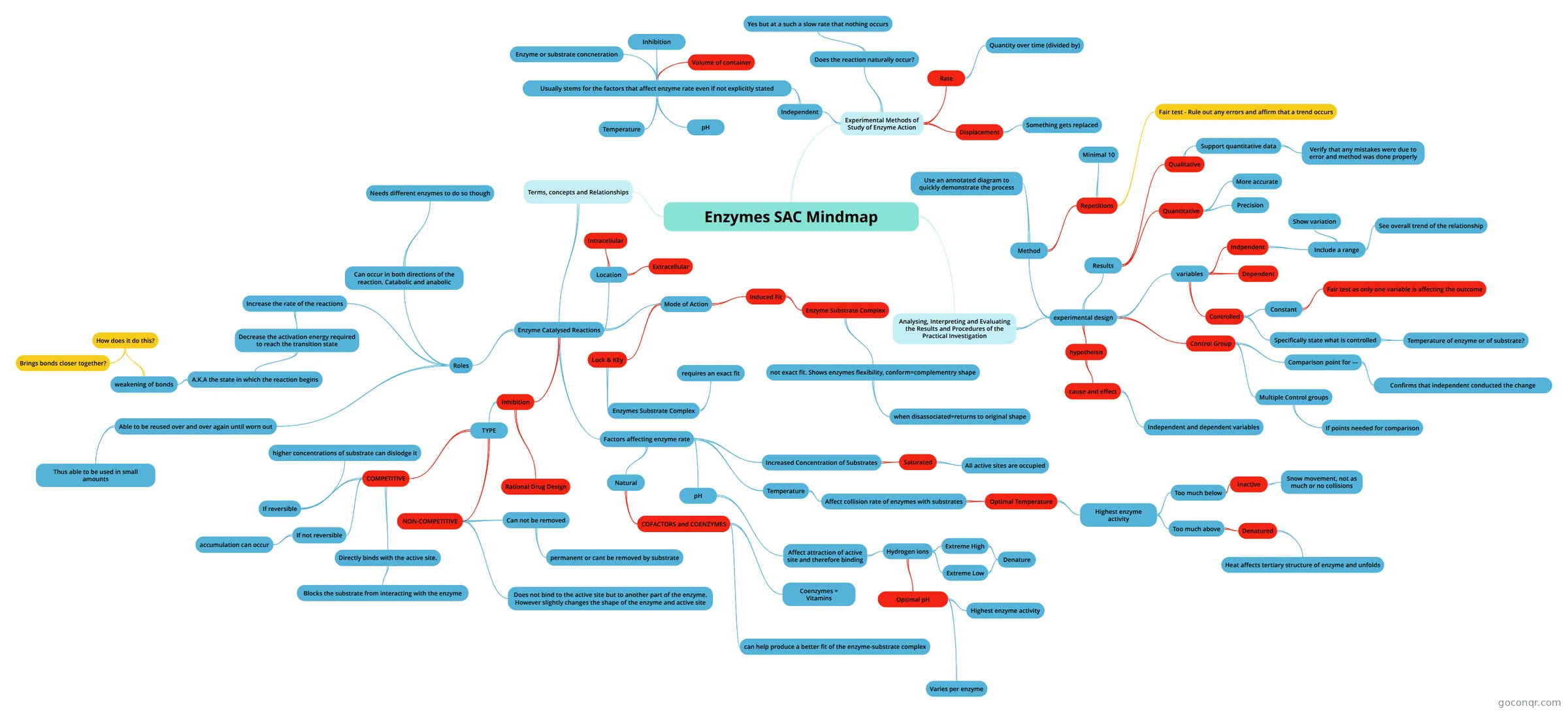
Mind map: Enzymes SAC
Map content
Enzymes SAC Mindmap
Experimental Methods of Study of Enzyme Action
- Rate
- Quantity over time (divided by)
- Displacement
- Something gets replaced
- Does the reaction naturally occur?
- Yes but at a such a slow rate that nothing occurs
- Independent
- Usually stems for the factors that affect enzyme rate even if not explicitly stated
- pH
- Temperature
- Enzyme or substrate concnetration
- Inhibition
- Volume of container
- Usually stems for the factors that affect enzyme rate even if not explicitly stated
- Rate
Analysing, Interpreting and Evaluating the Results and Procedures of the Practical Investigation
- experimental design
- hypotheisis
- cause and effect
- Independent and dependent variables
- cause and effect
- variables
- Indpendent
- Include a range
- See overall trend of the relationship
- Show variation
- Include a range
- Dependent
- Controlled
- Constant
- Fair test as only one variable is affecting the outcome
- Specifically state what is controlled
- Temperature of enzyme or of substrate?
- Constant
- Indpendent
- Method
- Use an annotated diagram to quickly demonstrate the process
- Repetitions
- Minimal 10
- Fair test - Rule out any errors and affirm that a trend occurs
- Results
- Qualitative
- Support quantitative data
- Verify that any mistakes were due to error and method was done properly
- Support quantitative data
- Quantitative
- More accurate
- Precision
- Qualitative
- Control Group
- Comparison point for ---
- Confirms that independent conducted the change
- Multiple Control groups
- If points needed for comparison
- Comparison point for ---
- hypotheisis
- experimental design
Terms, concepts and Relationships
- Enzyme Catalysed Reactions
- Roles
- Increase the rate of the reactions
- Decrease the activation energy required to reach the transition state
- A.K.A the state in which the reaction begins
- weakening of bonds
- How does it do this?
- Brings bonds closer together?
- How does it do this?
- weakening of bonds
- A.K.A the state in which the reaction begins
- Decrease the activation energy required to reach the transition state
- Able to be reused over and over again until worn out
- Thus able to be used in small amounts
- Can occur in both directions of the reaction. Catabolic and anabolic
- Needs different enzymes to do so though
- Increase the rate of the reactions
- Mode of Action
- Induced Fit
- Enzyme Substrate Complex
- not exact fit. Shows enzymes flexibility, conform=complementry shape
- when disassociated=returns to original shape
- not exact fit. Shows enzymes flexibility, conform=complementry shape
- Enzyme Substrate Complex
- Lock & KEy
- Enzymes Substrate Complex
- requires an exact fit
- Enzymes Substrate Complex
- Induced Fit
- Inhibition
- Rational Drug Design
- TYPE
- COMPETITIVE
- Directly binds with the active site.
- Blocks the substrate from interacting with the enzyme
- If reversible
- higher concentrations of substrate can dislodge it
- If not reversible
- accumulation can occur
- Directly binds with the active site.
- NON-COMPETITIVE
- Does not bind to the active site but to another part of the enzyme. However slightly changes the shape of the enzyme and active site
- Can not be removed
- permanent or cant be removed by substrate
- COMPETITIVE
- Location
- Intracellular
- Extracellular
- Factors affecting enzyme rate
- Natural
- COFACTORS and COENZYMES
- can help produce a better fit of the enzyme-substrate complex
- Coenzymes = Vitamins
- COFACTORS and COENZYMES
- Increased Concentration of Substrates
- Saturated
- All active sites are occupied
- Saturated
- Temperature
- Affect collision rate of enzymes with substrates
- Optimal Temperature
- Highest enzyme activity
- Too much below
- Inactive
- Snow movement, not as much or no collisions
- Inactive
- Too much above
- Denatured
- Heat affects tertiary structure of enzyme and unfolds
- Denatured
- Too much below
- Highest enzyme activity
- Optimal Temperature
- Affect collision rate of enzymes with substrates
- pH
- Affect attraction of active site and therefore binding
- Hydrogen ions
- Extreme High
- Denature
- Extreme Low
- Optimal pH
- Highest enzyme activity
- Varies per enzyme
- Extreme High
- Hydrogen ions
- Affect attraction of active site and therefore binding
- Natural
- Roles
- Enzyme Catalysed Reactions
Information
- Description
- Mind map of the concepts under enzymes
- Created by
- Minoshka Bocarro
- Views
- 84
- Tags
- Rating