
Mind map
Respiratory Mechanics
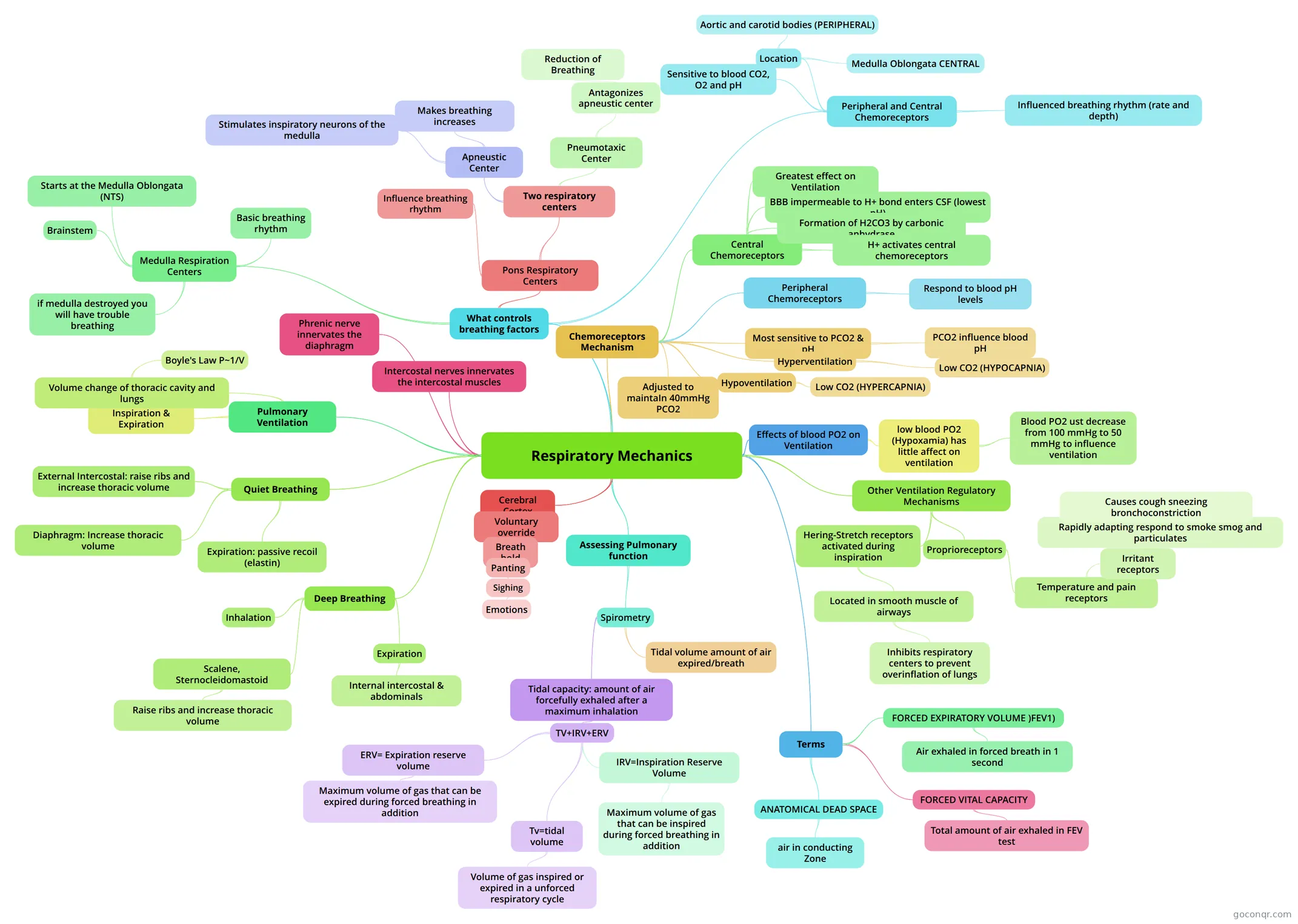
Mind map: Respiratory mechanics
Map content
Respiratory Mechanics
Pulmonary Ventilation
- Inspiration & Expiration
- Volume change of thoracic cavity and lungs
- Boyle's Law P~1/V
Quiet Breathing
- Diaphragm: Increase thoracic volume
- External Intercostal: raise ribs and increase thoracic volume
- Expiration: passive recoil (elastin)
Deep Breathing
- Inhalation
- Scalene, Sternocleidomastoid
- Raise ribs and increase thoracic volume
- Expiration
- Internal intercostal & abdominals
What controls breathing factors
- Medulla Respiration Centers
- Brainstem
- Starts at the Medulla Oblongata (NTS)
- Basic breathing rhythm
- if medulla destroyed you will have trouble breathing
- Pons Respiratory Centers
- Influence breathing rhythm
- Two respiratory centers
- Apneustic Center
- Stimulates inspiratory neurons of the medulla
- Makes breathing increases
- Pneumotaxic Center
- Antagonizes apneustic center
- Reduction of Breathing
- Antagonizes apneustic center
- Apneustic Center
- Peripheral and Central Chemoreceptors
- Influenced breathing rhythm (rate and depth)
- Sensitive to blood CO2, O2 and pH
- Location
- Medulla Oblongata CENTRAL
- Aortic and carotid bodies (PERIPHERAL)
- Medulla Respiration Centers
Phrenic nerve innervates the diaphragm
Intercostal nerves innervates the intercostal muscles
Chemoreceptors Mechanism
- Central Chemoreceptors
- Greatest effect on Ventilation
- BBB impermeable to H+ bond enters CSF (lowest pH)
- Formation of H2CO3 by carbonic anhydrase
- H+ activates central chemoreceptors
- Peripheral Chemoreceptors
- Respond to blood pH levels
- Most sensitive to PCO2 & pH
- PCO2 influence blood pH
- Hyperventilation
- Low CO2 (HYPOCAPNIA)
- Hypoventilation
- Low CO2 (HYPERCAPNIA)
- Adjusted to maintaIn 40mmHg PCO2
- Central Chemoreceptors
Effects of blood PO2 on Ventilation
- low blood PO2 (Hypoxamia) has little affect on ventilation
- Blood PO2 ust decrease from 100 mmHg to 50 mmHg to influence ventilation
- low blood PO2 (Hypoxamia) has little affect on ventilation
Cerebral Cortex
- Voluntary override
- Breath hold
- Panting
- Sighing
- Emotions
- Sighing
- Panting
- Breath hold
- Voluntary override
Other Ventilation Regulatory Mechanisms
- Proprioreceptors
- Temperature and pain receptors
- Irritant receptors
- Rapidly adapting respond to smoke smog and particulates
- Causes cough sneezing bronchoconstriction
- Rapidly adapting respond to smoke smog and particulates
- Irritant receptors
- Temperature and pain receptors
- Hering-Stretch receptors activated during inspiration
- Located in smooth muscle of airways
- Inhibits respiratory centers to prevent overinflation of lungs
- Located in smooth muscle of airways
- Proprioreceptors
Assessing Pulmonary function
- Spirometry
- Tidal volume amount of air expired/breath
- Tidal capacity: amount of air forcefully exhaled after a maximum inhalation
- TV+IRV+ERV
- Tv=tidal volume
- Volume of gas inspired or expired in a unforced respiratory cycle
- IRV=Inspiration Reserve Volume
- Maximum volume of gas that can be inspired during forced breathing in addition
- ERV= Expiration reserve volume
- Maximum volume of gas that can be expired during forced breathing in addition
- Tv=tidal volume
- TV+IRV+ERV
- Spirometry
Terms
- ANATOMICAL DEAD SPACE
- air in conducting Zone
- FORCED EXPIRATORY VOLUME )FEV1)
- Air exhaled in forced breath in 1 second
- FORCED VITAL CAPACITY
- Total amount of air exhaled in FEV test
- ANATOMICAL DEAD SPACE
Information
- Description
- Bio 235 Mind Map on Respiratory Mechanics, created by Susy Sanchez on 21/04/2013.
- Created by
- Susy Sanchez
- Views
- 190
- Tags
- Rating