
Mind map
SIS Project Ethics
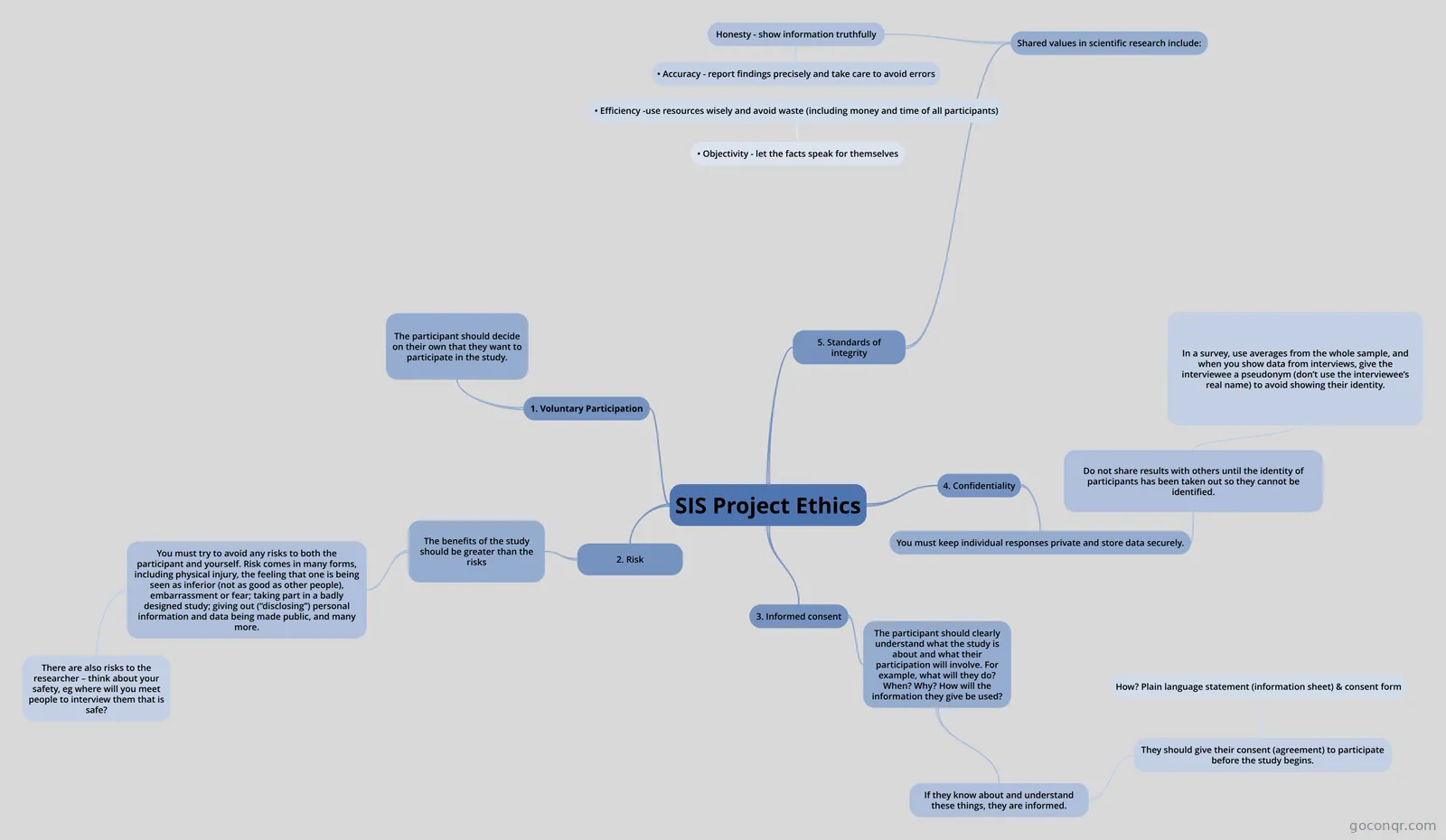
Mind map: SIS project ethics
Map content
SIS Project Ethics
1. Voluntary Participation
- The participant should decide on their own that they want to participate in the study.
2. Risk
- The benefits of the study should be greater than the risks
- You must try to avoid any risks to both the participant and yourself. Risk comes in many forms, including physical injury, the feeling that one is being seen as inferior (not as good as other people), embarrassment or fear; taking part in a badly designed study; giving out (“disclosing”) personal information and data being made public, and many more.
- There are also risks to the researcher – think about your safety, eg where will you meet people to interview them that is safe?
- You must try to avoid any risks to both the participant and yourself. Risk comes in many forms, including physical injury, the feeling that one is being seen as inferior (not as good as other people), embarrassment or fear; taking part in a badly designed study; giving out (“disclosing”) personal information and data being made public, and many more.
- The benefits of the study should be greater than the risks
3. Informed consent
- The participant should clearly understand what the study is about and what their participation will involve. For example, what will they do? When? Why? How will the information they give be used?
- If they know about and understand these things, they are informed.
- They should give their consent (agreement) to participate before the study begins.
- How? Plain language statement (information sheet) & consent form
- They should give their consent (agreement) to participate before the study begins.
- If they know about and understand these things, they are informed.
- The participant should clearly understand what the study is about and what their participation will involve. For example, what will they do? When? Why? How will the information they give be used?
4. Confidentiality
- You must keep individual responses private and store data securely.
- Do not share results with others until the identity of participants has been taken out so they cannot be identified.
- In a survey, use averages from the whole sample, and when you show data from interviews, give the interviewee a pseudonym (don’t use the interviewee’s real name) to avoid showing their identity.
- Do not share results with others until the identity of participants has been taken out so they cannot be identified.
- You must keep individual responses private and store data securely.
5. Standards of integrity
- Shared values in scientific research include:
- Honesty - show information truthfully
- • Accuracy - report findings precisely and take care to avoid errors
- • Efficiency -use resources wisely and avoid waste (including money and time of all participants)
- • Objectivity - let the facts speak for themselves
- • Efficiency -use resources wisely and avoid waste (including money and time of all participants)
- • Accuracy - report findings precisely and take care to avoid errors
- Honesty - show information truthfully
- Shared values in scientific research include:
Information
- Description
- SIS Week 5 preparation Adapted from material by Dr. Kara A. Makara, School of Education, University of Glasgow. Ethical principles from the ESRC Framework For Research Ethics (FRE) revised Jan 2015. The University abides by the research council (e.g., ESRC) recommendations
- Created by
- Rachel Elmslie
- Views
- 21
- Tags
- Rating