
Animal Cloning

Slides in this set (9)
-
-
- The process of producing genetically identical cells or organisms from the cells of an existing organism.
- Natural clones occur in humans and other mammals as identical twins.
- The two types of artificial cloning used for animals are reproductive cloning and non-reproductive cloning.
-
- Reproductive cloning is a type of cloning used to make a complete organism that’s genetically identical to another organism.
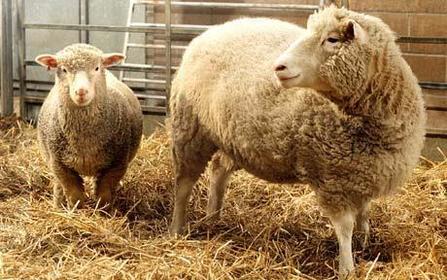
- Caption: Dolly was a female domestic sheep, and the first mammal cloned from an adult somatic cell, using the process of nuclear transfer.
-
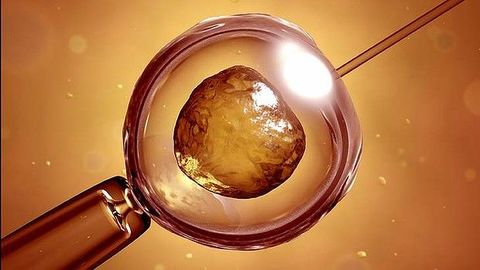
- Non-reproductive cloning is a type of cloning used to make embryonic stem cells that are genetically identical to another organism. Its also called therapeutic cloning.
-
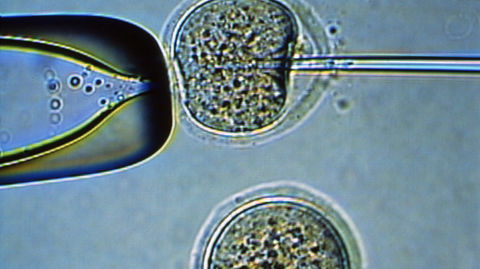
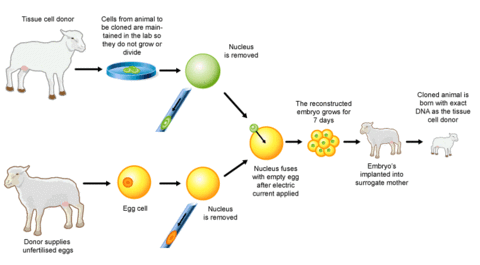
- A technique for cloning animals which involves taking a nucleus from an adult body cell and inserting it into an enucleated egg cell. Both reproductive and non-reproductive cloning use nuclear transfer.
-
-
- A body cell is taken animal A. The nucleus is extracted and kept.
- An egg cell is taken from animal B. Its nucleus is removed to form an enucleated egg cell.
- The nucleus from animal A is inserted into the enucleated egg cell - the egg cell from animal B now contains genetic information from animal A.
- The egg cell is stimulated to divide and an embryo is formed.
- In reproductive cloning the embryo is implanted into a surrogate mother. A infant is produced that's genetically identical copy from animal A.
- In non-reproductive cloning stem cells are harvested from the embryo. The stem cells are genetically identical to the cells in animal A.
-
- Advantages:Desirable characteristics are passed on
- Infertile animals can be reproduced
- Cloning can happen at any time - wouldn’t have to wait for breeding season
- Repopulate endangered animals
- Aids in medical research - all subjects standardised
- Disadvantages:
- Undesirable characteristics are passed on
- Some evidence suggest clones don’t live as long
- Reproductive cloning is difficult, time-consuming and expensive
- Genetic diversity is decreased
- Susceptibility to disease
-
Ethical Issues of Human Cloning
- There are many ethical issues surrounding the issue of human cloning. Reproductive cloning of humans is currently illegal in the UK, however, non-reproductive cloning is allowed under licence. Ethical issues include:
- Some believe that it undermines sexual reproduction.
- Some believe clones may have a lower quality of life due to social exclusion or difficulties developing their own personality.
- Unknown psychological effects to the clone.
- Puts both the surrogate and clone at risk as many cloning experiments have resulted in failures in the form of miscarriages, stillbirths, and life-threatening anomalies.
- Some evidence suggest that clones may have shorter lifespans.
- Might foster an understanding of people as objects that can be designed and manufactured to possess specific characteristics. Decrease the value of human life.
- The use of human embryos as a source of stem cells is controversial as the embryos are usually destroyed after they have been harvested.

Information
- Description
- Animal cloning from OCR Biology Unit 5: Section 3 - Cloning and Biotechnology
- Created by
- Jessica Phillips
- Views
- 258
- Tags
- Rating