
Mind map
Haemostasis (part 1: primary haemostasis)
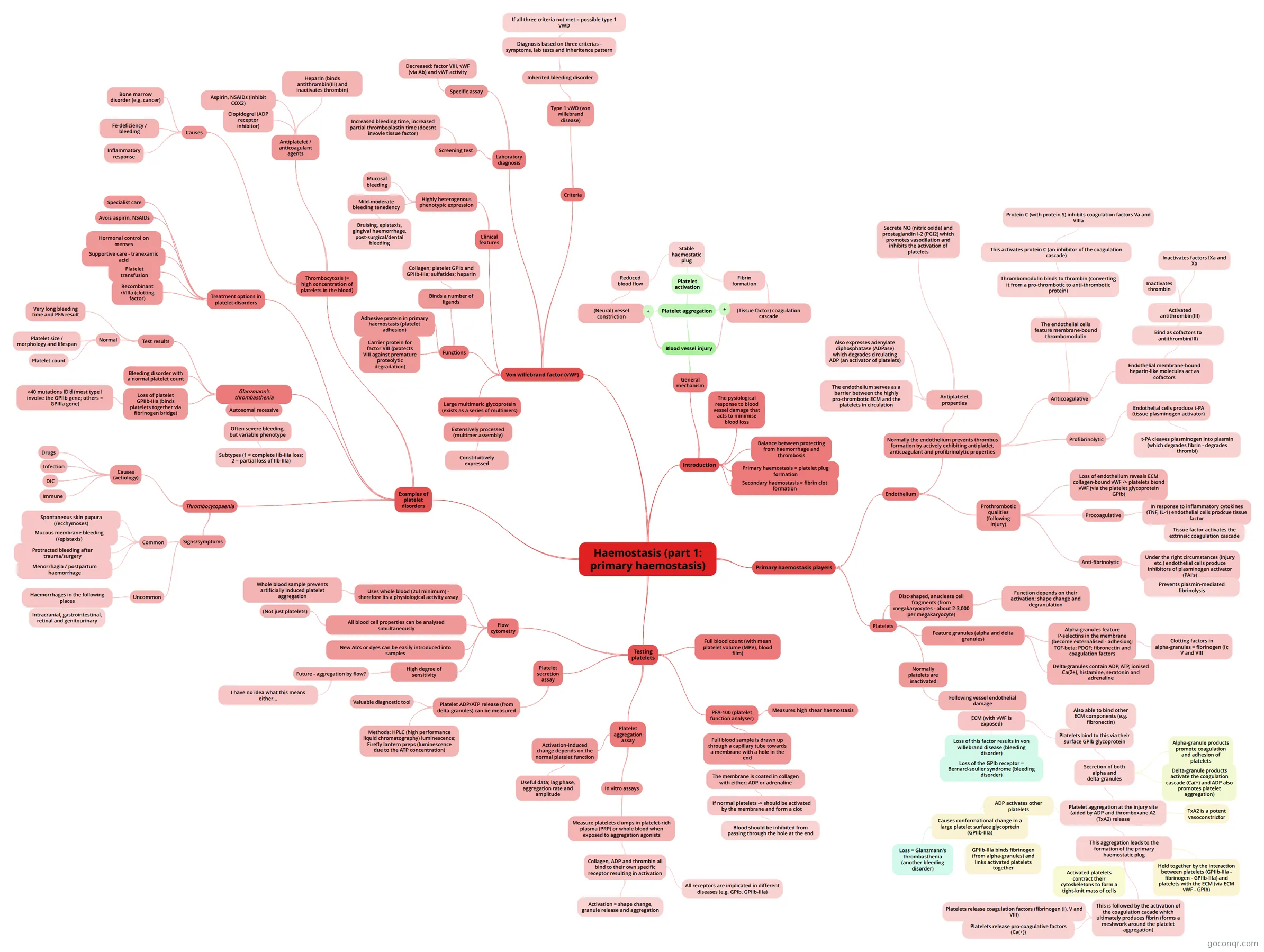
Mind map: Haemostasis part 1 primary haemostasis
Map content
Haemostasis (part 1: primary haemostasis)
Introduction
- The pysiological response to blood vessel damage that acts to minimise blood loss
- Balance between protecting from haemorrhage and thrombosis
- Primary haemostasis = platelet plug formation
- Secondary haemostasis = fibrin clot formation
- General mechanism
- Blood vessel injury
- Platelet aggregation
- Platelet activation
- +
- +
- Platelet activation
- (Neural) vessel constriction
- Reduced blood flow
- Stable haemostatic plug
- Reduced blood flow
- (Tissue factor) coagulation cascade
- Fibrin formation
- Fibrin formation
- Platelet aggregation
- Blood vessel injury
Primary haemostasis players
- Endothelium
- Normally the endothelium prevents thrombus formation by actively exhibiting antiplatlet, anticoagulant and profibrinolytic properties
- Antiplatelet properties
- The endothelium serves as a barrier between the highly pro-thrombotic ECM and the platelets in circulation
- Secrete NO (nitric oxide) and prostaglandin I-2 (PGI2) which promotes vasodilation and inhibits the activation of platelets
- Also expresses adenylate diphosphatase (ADPase) which degrades circulating ADP (an activator of platelets)
- Anticoagulative
- The endothelial cells feature membrane-bound thrombomodulin
- Thrombomodulin binds to thrombin (converting it from a pro-thrombotic to anti-thrombotic protein)
- This activates protein C (an inhibitor of the coagulation cascade)
- Protein C (with protein S) inhibits coagulation factors Va and VIIIa
- This activates protein C (an inhibitor of the coagulation cascade)
- Thrombomodulin binds to thrombin (converting it from a pro-thrombotic to anti-thrombotic protein)
- Endothelial membrane-bound heparin-like molecules act as cofactors
- Bind as cofactors to antithrombin(III)
- Activated antithrombin(III)
- Inactivates thrombin
- Inactivates factors IXa and Xa
- Activated antithrombin(III)
- Bind as cofactors to antithrombin(III)
- The endothelial cells feature membrane-bound thrombomodulin
- Profibrinolytic
- Endothelial cells produce t-PA (tissue plasminogen activator)
- t-PA cleaves plasminogen into plasmin (which degrades fibrin - degrades thrombi)
- Endothelial cells produce t-PA (tissue plasminogen activator)
- Antiplatelet properties
- Prothrombotic qualities (following injury)
- Loss of endothelium reveals ECM collagen-bound vWF -> platelets biond vWF (via the platelet glycoprotein GPIb)
- Procoagulative
- In response to inflammatory cytokines (TNF, IL-1) endothelial cells prodcue tissue factor
- Tissue factor activates the extrinsic coagulation cascade
- In response to inflammatory cytokines (TNF, IL-1) endothelial cells prodcue tissue factor
- Anti-fibrinolytic
- Under the right circumstances (injury etc.) endothelial cells produce inhibitors of plasminogen activator (PAI's)
- Prevents plasmin-mediated fibrinolysis
- Under the right circumstances (injury etc.) endothelial cells produce inhibitors of plasminogen activator (PAI's)
- Normally the endothelium prevents thrombus formation by actively exhibiting antiplatlet, anticoagulant and profibrinolytic properties
- Platelets
- Disc-shaped, anucleate cell fragments (from megakaryocytes - about 2-3,000 per megakaryocyte)
- Function depends on their activation; shape change and degranulation
- Feature granules (alpha and delta granules)
- Alpha-granules feature P-selectins in the membrane (become externalised - adhesion); TGF-beta; PDGF; fibronectin and coagulation factors
- Clotting factors in alpha-granules = fibrinogen (I); V and VIII
- Delta-granules contain ADP, ATP, ionised Ca(2+), histamine, seratonin and adrenaline
- Alpha-granules feature P-selectins in the membrane (become externalised - adhesion); TGF-beta; PDGF; fibronectin and coagulation factors
- Normally platelets are inactivated
- Following vessel endothelial damage
- ECM (with vWF is exposed)
- Platelets bind to this via their surface GPIb glycoprotein
- Also able to bind other ECM components (e.g. fibronectin)
- Secretion of both alpha and delta-granules
- Alpha-granule products promote coagulation and adhesion of platelets
- Delta-granule products activate the coagulation cascade (Ca(+) and ADP also promotes platelet aggregation)
- Platelet aggregation at the injury site (aided by ADP and thromboxane A2 (TxA2) release
- This aggregation leads to the formation of the primary haemostatic plug
- Held together by the interaction between platelets (GPIIb-IIIa - fibrinogen - GPIIb-IIIa) and platelets with the ECM (via ECM vWF - GPIb)
- This is followed by the activation of the coagulation cacade which ultimately produces fibrin (forms a meshwork around the platelet aggregation)
- Platelets release coagulation factors (fibrinogen (I), V and VIII)
- Platelets release pro-coagulative factors (Ca(+))
- Activated platelets contract their cytoskeletons to form a tight-knit mass of cells
- ADP activates other platelets
- Causes conformational change in a large platelet surface glycoprtein (GPIIb-IIIa)
- GPIIb-IIIa binds fibrinogen (from alpha-granules) and links activated platelets together
- Loss = Glanzmann's thrombasthenia (another bleeding disorder)
- Causes conformational change in a large platelet surface glycoprtein (GPIIb-IIIa)
- TxA2 is a potent vasoconstrictor
- This aggregation leads to the formation of the primary haemostatic plug
- Loss of this factor results in von willebrand disease (bleeding disorder)
- Loss of the GPIb receptor = Bernard-soulier syndrome (bleeding disorder)
- Platelets bind to this via their surface GPIb glycoprotein
- ECM (with vWF is exposed)
- Following vessel endothelial damage
- Disc-shaped, anucleate cell fragments (from megakaryocytes - about 2-3,000 per megakaryocyte)
- Endothelium
Testing platelets
- Full blood count (with mean platelet volume (MPV), blood film)
- PFA-100 (platelet function analyser)
- Full blood sample is drawn up through a capillary tube towards a membrane with a hole in the end
- The membrane is coated in collagen with either; ADP or adrenaline
- If normal platelets -> should be activated by the membrane and form a clot
- Blood should be inhibited from passing through the hole at the end
- If normal platelets -> should be activated by the membrane and form a clot
- The membrane is coated in collagen with either; ADP or adrenaline
- Measures high shear haemostasis
- Full blood sample is drawn up through a capillary tube towards a membrane with a hole in the end
- Platelet aggregation assay
- In vitro assays
- Measure platelets clumps in platelet-rich plasma (PRP) or whole blood when exposed to aggregation agonists
- Collagen, ADP and thrombin all bind to their own specific receptor resulting in activation
- All receptors are implicated in different diseases (e.g. GPIb, GPIIb-IIIa)
- Activation = shape change, granule release and aggregation
- Collagen, ADP and thrombin all bind to their own specific receptor resulting in activation
- Measure platelets clumps in platelet-rich plasma (PRP) or whole blood when exposed to aggregation agonists
- Activation-induced change depends on the normal platelet function
- Useful data; lag phase, aggregation rate and amplitude
- In vitro assays
- Platelet secretion assay
- Platelet ADP/ATP release (from delta-granules) can be measured
- Valuable diagnostic tool
- Methods: HPLC (high performance liquid chromatography) luminescence; Firefly lantern preps (luminescence due to the ATP concentration)
- Platelet ADP/ATP release (from delta-granules) can be measured
- Flow cytometry
- Uses whole blood (2ul minimum) - therefore its a physiological activity assay
- Whole blood sample prevents artificially induced platelet aggregation
- All blood cell properties can be analysed simultaneously
- (Not just platelets)
- New Ab's or dyes can be easily introduced into samples
- High degree of sensitivity
- Future - aggregation by flow?
- I have no idea what this means either...
- Future - aggregation by flow?
- Uses whole blood (2ul minimum) - therefore its a physiological activity assay
Examples of platelet disorders
- Thrombocytopaenia
- Signs/symptoms
- Common
- Spontaneous skin pupura (/ecchymoses)
- Mucous membrane bleeding (/epistaxis)
- Protracted bleeding after trauma/surgery
- Menorrhagia / postpartum haemorrhage
- Uncommon
- Haemorrhages in the following places
- Intracranial, gastrointestinal, retinal and genitourinary
- Haemorrhages in the following places
- Common
- Causes (aetiology)
- Drugs
- Infection
- DIC
- Immune
- Signs/symptoms
- Glanzmann's thrombasthenia
- Loss of platelet GPIIb-IIIa (binds platelets together via fibrinogen bridge)
- >40 mutations ID'd (most type I involve the GPIIb gene; others = GPIIIa gene)
- Bleeding disorder with a normal platelet count
- Test results
- Normal
- Platelet count
- Platelet size / morphology and lifespan
- Very long bleeding time and PFA result
- Normal
- Autosomal recessive
- Often severe bleeding, but variable phenotype
- Subtypes (1 = complete IIb-IIIa loss; 2 = partial loss of IIb-IIIa)
- Often severe bleeding, but variable phenotype
- Loss of platelet GPIIb-IIIa (binds platelets together via fibrinogen bridge)
- Treatment options in platelet disorders
- Specialist care
- Avois aspirin, NSAIDs
- Hormonal control on menses
- Supportive care - tranexamic acid
- Platelet transfusion
- Recombinant rVIIIa (clotting factor)
- Thrombocytosis (= high concentration of platelets in the blood)
- Causes
- Inflammatory response
- Fe-deficiency / bleeding
- Bone marrow disorder (e.g. cancer)
- Antiplatelet / anticoagulant agents
- Heparin (binds antithrombin(III) and inactivates thrombin)
- Aspirin, NSAIDs (inhibit COX2)
- Clopidogrel (ADP receptor inhibitor)
- Causes
- Thrombocytopaenia
Von willebrand factor (vWF)
- Large multimeric glycoprotein (exists as a series of multimers)
- Extensively processed (multimer assembly)
- Constituitively expressed
- Extensively processed (multimer assembly)
- Functions
- Carrier protein for factor VIII (protects VIII against premature proteolytic degradation)
- Adhesive protein in primary haemostasis (platelet adhesion)
- Binds a number of ligands
- Collagen; platelet GPIb and GPIIb-IIIa; sulfatides; heparin
- Clinical features
- Highly heterogenous phenotypic expression
- Mild-moderate bleeding tenedency
- Bruising, epistaxis, gingival haemorrhage, post-surgical/dental bleeding
- Mucosal bleeding
- Mild-moderate bleeding tenedency
- Highly heterogenous phenotypic expression
- Laboratory diagnosis
- Screening test
- Increased bleeding time, increased partial thromboplastin time (doesnt invovle tissue factor)
- Specific assay
- Decreased: factor VIII, vWF (via Ab) and vWF activity
- Screening test
- Criteria
- Type 1 vWD (von willebrand disease)
- Inherited bleeding disorder
- Diagnosis based on three criterias - symptoms, lab tests and inheritence pattern
- If all three criteria not met = possible type 1 VWD
- Diagnosis based on three criterias - symptoms, lab tests and inheritence pattern
- Inherited bleeding disorder
- Type 1 vWD (von willebrand disease)
- Large multimeric glycoprotein (exists as a series of multimers)
Information
- Description
- Blood Science Mind Map on Haemostasis (part 1: primary haemostasis), created by maisie_oj on 30/04/2013.
- Created by
- maisie_oj
- Views
- 134
- Tags
- Rating