
Mind map
B2.6 Old and New Species
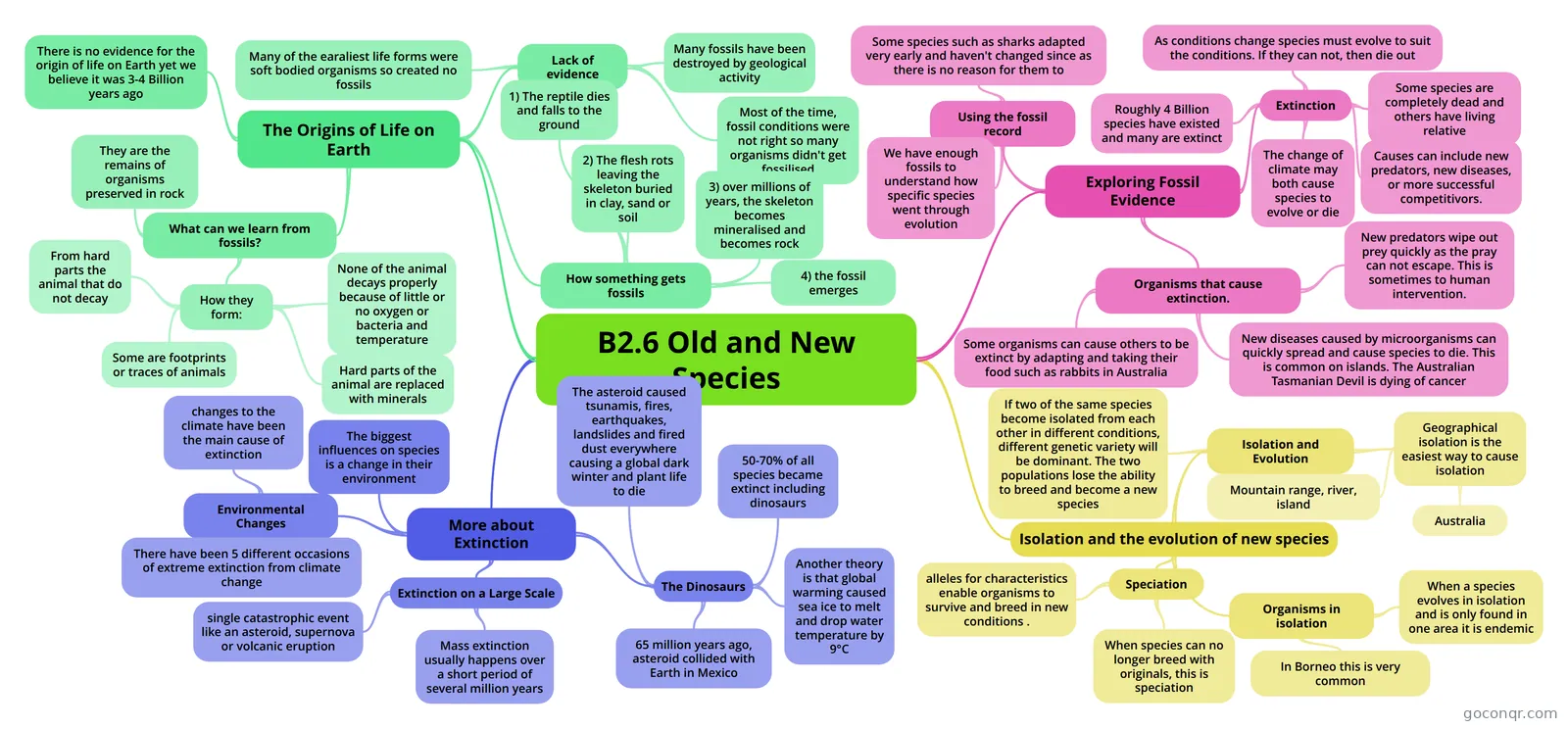
Mind map: Old and new species
Map content
B2.6 Old and New Species
The Origins of Life on Earth
- There is no evidence for the origin of life on Earth yet we believe it was 3-4 Billion years ago
- What can we learn from fossils?
- They are the remains of organisms preserved in rock
- How they form:
- From hard parts the animal that do not decay
- None of the animal decays properly because of little or no oxygen or bacteria and temperature
- Hard parts of the animal are replaced with minerals
- Some are footprints or traces of animals
- Lack of evidence
- Many of the earaliest life forms were soft bodied organisms so created no fossils
- Most of the time, fossil conditions were not right so many organisms didn't get fossilised
- Many fossils have been destroyed by geological activity
- How something gets fossils
- 1) The reptile dies and falls to the ground
- 2) The flesh rots leaving the skeleton buried in clay, sand or soil
- 3) over millions of years, the skeleton becomes mineralised and becomes rock
- 4) the fossil emerges
Exploring Fossil Evidence
- Using the fossil record
- We have enough fossils to understand how specific species went through evolution
- Some species such as sharks adapted very early and haven't changed since as there is no reason for them to
- Extinction
- Roughly 4 Billion species have existed and many are extinct
- As conditions change species must evolve to suit the conditions. If they can not, then die out
- Some species are completely dead and others have living relative
- Causes can include new predators, new diseases, or more successful competitivors.
- The change of climate may both cause species to evolve or die
- Organisms that cause extinction.
- New predators wipe out prey quickly as the pray can not escape. This is sometimes to human intervention.
- New diseases caused by microorganisms can quickly spread and cause species to die. This is common on islands. The Australian Tasmanian Devil is dying of cancer
- Some organisms can cause others to be extinct by adapting and taking their food such as rabbits in Australia
- Using the fossil record
More about Extinction
- The biggest influences on species is a change in their environment
- Environmental Changes
- changes to the climate have been the main cause of extinction
- There have been 5 different occasions of extreme extinction from climate change
- Extinction on a Large Scale
- Mass extinction usually happens over a short period of several million years
- single catastrophic event like an asteroid, supernova or volcanic eruption
- The Dinosaurs
- 65 million years ago, asteroid collided with Earth in Mexico
- The asteroid caused tsunamis, fires, earthquakes, landslides and fired dust everywhere causing a global dark winter and plant life to die
- 50-70% of all species became extinct including dinosaurs
- Another theory is that global warming caused sea ice to melt and drop water temperature by 9°C
Isolation and the evolution of new species
- Isolation and Evolution
- If two of the same species become isolated from each other in different conditions, different genetic variety will be dominant. The two populations lose the ability to breed and become a new species
- Geographical isolation is the easiest way to cause isolation
- Mountain range, river, island
- Australia
- Organisms in isolation
- When a species evolves in isolation and is only found in one area it is endemic
- In Borneo this is very common
- Speciation
- alleles for characteristics enable organisms to survive and breed in new conditions .
- When species can no longer breed with originals, this is speciation
- Isolation and Evolution
Information
- Description
- GCSE Biology (B2 ) Mind Map on B2.6 Old and New Species, created by mhancoc3 on 08/04/2014.
- Created by
- mhancoc3
- Views
- 122
- Tags
- Rating
More on History of Life and Extinction