
Mind map
Placebo & Justinius
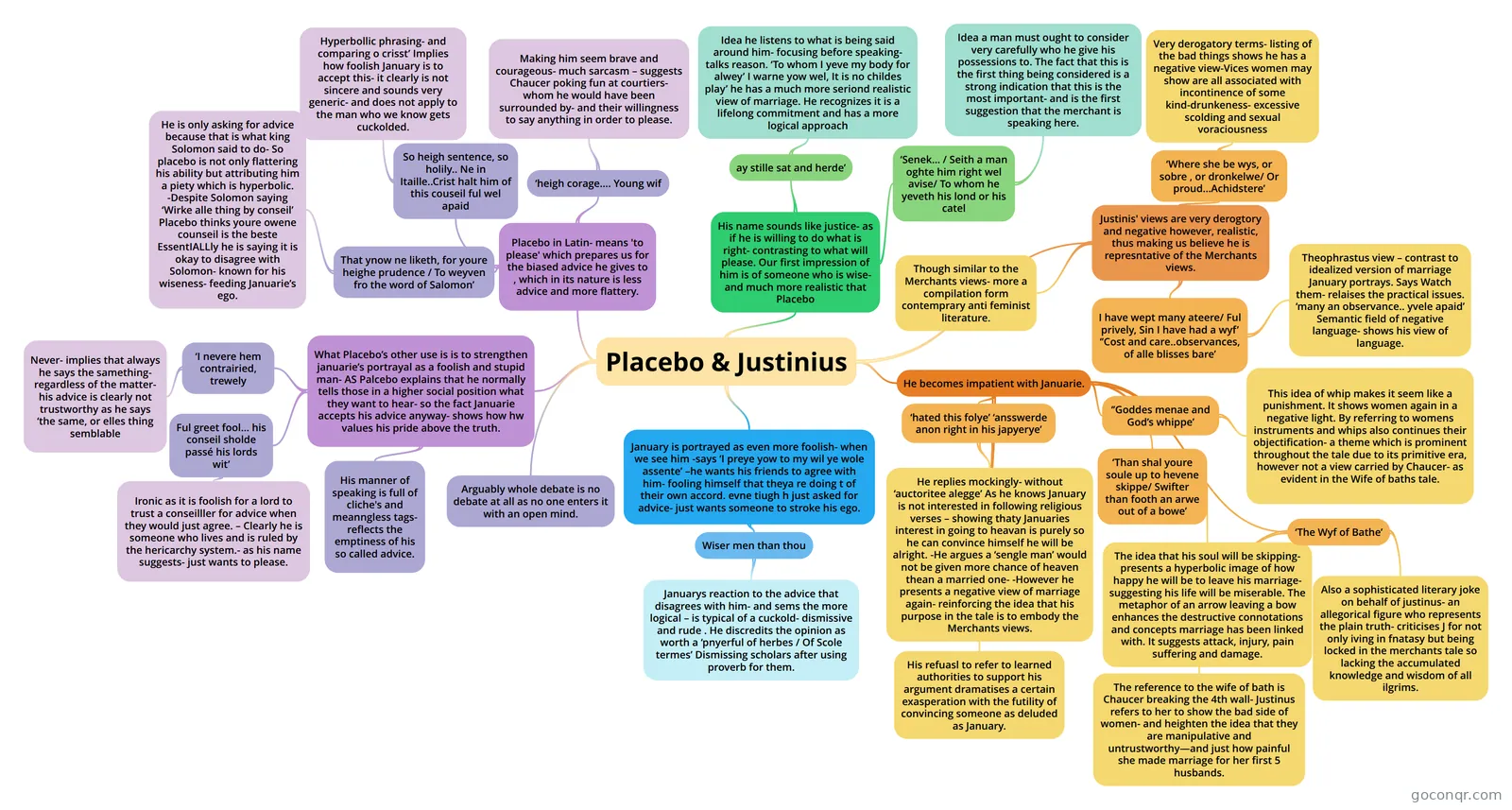
Mind map: Placebo and Justinius
Map content
Placebo & Justinius
Placebo in Latin- means 'to please' which prepares us for the biased advice he gives to , which in its nature is less advice and more flattery.
- That ynow ne liketh, for youre heighe prudence / To weyven fro the word of Salomon’
- He is only asking for advice because that is what king Solomon said to do- So placebo is not only flattering his ability but attributing him a piety which is hyperbolic. -Despite Solomon saying ‘Wirke alle thing by conseil’ Placebo thinks youre owene counseil is the beste EssentIALLly he is saying it is okay to disagree with Solomon- known for his wiseness- feeding Januarie’s ego.
- So heigh sentence, so holily.. Ne in Itaille..Crist halt him of this couseil ful wel apaid
- Hyperbollic phrasing- and comparing o crisst’ Implies how foolish January is to accept this- it clearly is not sincere and sounds very generic- and does not apply to the man who we know gets cuckolded.
- ‘heigh corage…. Young wif
- Making him seem brave and courageous- much sarcasm – suggests Chaucer poking fun at courtiers- whom he would have been surrounded by- and their willingness to say anything in order to please.
- That ynow ne liketh, for youre heighe prudence / To weyven fro the word of Salomon’
What Placebo’s other use is is to strengthen januarie’s portrayal as a foolish and stupid man- AS Palcebo explains that he normally tells those in a higher social position what they want to hear- so the fact Januarie accepts his advice anyway- shows how hw values his pride above the truth.
- ‘I nevere hem contrairied, trewely
- Never- implies that always he says the samething- regardless of the matter- his advice is clearly not trustworthy as he says ‘the same, or elles thing semblable
- Ful greet fool… his conseil sholde passé his lords wit’
- Ironic as it is foolish for a lord to trust a conseilller for advice when they would just agree. – Clearly he is someone who lives and is ruled by the hericarchy system.- as his name suggests- just wants to please.
- His manner of speaking is full of cliche's and meanngless tags- reflects the emptiness of his so called advice.
- ‘I nevere hem contrairied, trewely
His name sounds like justice- as if he is willing to do what is right- contrasting to what will please. Our first impression of him is of someone who is wise- and much more realistic that Placebo
- ay stille sat and herde’
- Idea he listens to what is being said around him- focusing before speaking- talks reason. ‘To whom I yeve my body for alwey’ I warne yow wel, It is no childes play’ he has a much more seriond realistic view of marriage. He recognizes it is a lifelong commitment and has a more logical approach
- ‘Senek… / Seith a man oghte him right wel avise/ To whom he yeveth his lond or his catel
- Idea a man must ought to consider very carefully who he give his possessions to. The fact that this is the first thing being considered is a strong indication that this is the most important- and is the first suggestion that the merchant is speaking here.
- ay stille sat and herde’
Justinis' views are very derogtory and negative however, realistic, thus making us believe he is represntative of the Merchants views.
- ‘Where she be wys, or sobre , or dronkelwe/ Or proud…Achidstere’
- Very derogatory terms- listing of the bad things shows he has a negative view-Vices women may show are all associated with incontinence of some kind-drunkeness- excessive scolding and sexual voraciousness
- I have wept many ateere/ Ful prively, Sin I have had a wyf’ ‘’Cost and care..observances, of alle blisses bare’
- Theophrastus view – contrast to idealized version of marriage January portrays. Says Watch them- relaises the practical issues. ‘many an observance.. yvele apaid’ Semantic field of negative language- shows his view of language.
- Though similar to the Merchants views- more a compilation form contemprary anti feminist literature.
- ‘Where she be wys, or sobre , or dronkelwe/ Or proud…Achidstere’
January is portrayed as even more foolish- when we see him -says ‘I preye yow to my wil ye wole assente’ –he wants his friends to agree with him- fooling himself that theya re doing t of their own accord. evne tiugh h just asked for advice- just wants someone to stroke his ego.
- Wiser men than thou
- Januarys reaction to the advice that disagrees with him- and sems the more logical – is typical of a cuckold- dismissive and rude . He discredits the opinion as worth a ‘pnyerful of herbes / Of Scole termes’ Dismissing scholars after using proverb for them.
- Wiser men than thou
He becomes impatient with Januarie.
- ‘hated this folye’ ‘ansswerde anon right in his japyerye’
- He replies mockingly- without ‘auctoritee alegge’ As he knows January is not interested in following religious verses – showing thaty Januaries interest in going to heavan is purely so he can convince himself he will be alright. -He argues a ‘sengle man’ would not be given more chance of heaven thean a married one- -However he presents a negative view of marriage again- reinforcing the idea that his purpose in the tale is to embody the Merchants views.
- ‘’Goddes menae and God’s whippe’
- This idea of whip makes it seem like a punishment. It shows women again in a negative light. By referring to womens instruments and whips also continues their objectification- a theme which is prominent throughout the tale due to its primitive era, however not a view carried by Chaucer- as evident in the Wife of baths tale.
- ‘Than shal youre soule up to hevene skippe/ Swifter than footh an arwe out of a bowe’
- The idea that his soul will be skipping- presents a hyperbolic image of how happy he will be to leave his marriage- suggesting his life will be miserable. The metaphor of an arrow leaving a bow enhances the destructive connotations and concepts marriage has been linked with. It suggests attack, injury, pain suffering and damage.
- ‘The Wyf of Bathe’
- The reference to the wife of bath is Chaucer breaking the 4th wall- Justinus refers to her to show the bad side of women- and heighten the idea that they are manipulative and untrustworthy—and just how painful she made marriage for her first 5 husbands.
- Also a sophisticated literary joke on behalf of justinus- an allegorical figure who represents the plain truth- criticises J for not only iving in fnatasy but being locked in the merchants tale so lacking the accumulated knowledge and wisdom of all ilgrims.
- His refuasl to refer to learned authorities to support his argument dramatises a certain exasperation with the futility of convincing someone as deluded as January.
- ‘hated this folye’ ‘ansswerde anon right in his japyerye’
Arguably whole debate is no debate at all as no one enters it with an open mind.
Information
- Description
- Mind Map on Placebo & Justinius, created by Saheefa Ishaq on 18/04/2017.
- Created by
- Saheefa Ishaq
- Views
- 53
- Rating