
Notas
FIRST CONDITIONAL
Conteúdo das notas (4)
Página 1
FIRST CONDITIONAL
The First Conditional is used to talk about real and possible situations in the future.
It contains TWO CLAUSES : Main clause - If clause.
IF CLAUSE is the "Conditional clause", or "Situation clause". It is written in PRESENT TENSE.
MAIN CLAUSE is the "Result clause. It is written in FUTURE SIMPLE using "WILL"
In the first conditional, the structure is generally:
if + present simple, will + base verb
Order:
The clauses can be reversed. If the main clause comes first, no comma is needed.
Ex.: If you study, you will pass.
You will pass if you study.
USAGE: the first conditional is used to express:
Possible future events: "If it's sunny, we'll go to the park."
Predictions: "If electric cars become cheaper, then more people will buy them."
Plans: "If I pass this exam, I'll celebrate."
Promises: "I'll call you if I need help."
Warnings: "If you're late, you'll miss the train."
Threats: "If you don't write your homework by tomorrow, you'll be in trouble."
Persuasion: "If you want, I'll cook dinner at home."
"Unless" = If not
Unless already means “if not”.So, we normally use it with a positive verb, not negative.
Unless-clause = positive verb.
Main clause = can be positive or negative (will / won’t).
Correct:
Unless you study, you will fail. (= If you don’t study, you will fail.)
Wrong:
Unless you don’t study, you will fail. (double negative → confusing!)
Página 2
Might vs. Will
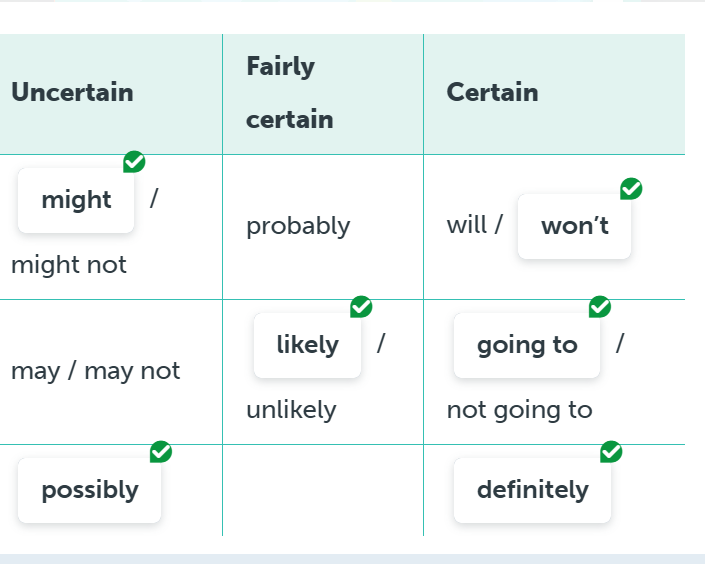
In the main clause (Result clause), we can use MIGHT instead of WILL:
When?
Will = certainty (future fact or strong prediction).
He will win the match. (= I’m sure, 100% certainty)
Might = possibility (uncertain, maybe yes/maybe no).
He might win the match. (= Maybe, 50% certainty)
Página 3
Adverbs of Certainty
Definitely, Probably, Possibly
We use adverbs to show how sure we are:
Definitely → 100% sure
Probably → about 70–80% sure
Possibly → about 50% sure
Word Order in affirmative sentences
With will → Adverb goes after will - might.
She will definitely call you.
They will probably be late.
He will possibly travel this summer.
With might → Adverb usually goes after might.
She might possibly come.
She might probably come. (Not correct, because might = uncertain, probably = quite certain)
Word Order in negative sentences
With will the adverbs of certainty come before won't
The store probably won't be open later.
He definitely won't be as good as his brother.
Página 4
Informações
- Descrição
- Notas sobre FIRST CONDITIONAL, criado por Jeess Alejandra em 20-08-2025.
- Criado por
- Jeess Alejandra
- Visualizações
- 80
- Avaliação