
Notas
Globalisation - created from Mind Map
Conteúdo das notas (1)
Página 1
What is it?
Globalisation means the greater integration of the global economy.
Jobs and wealth in one country are increasingly dependent on trade and investment from other countries.
Countries specialise in certain types of economic activity
Amount of trade in goods, services and money is increasing
World is connected by air travel, shipping routes, the internet
Changing employment structure
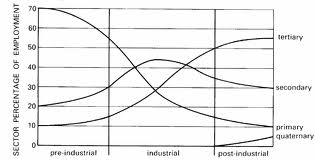
Countries are at different stages of economic development. The Clark-Fisher model shows this
In post-industrial economies, secondary industry declines and a new sector emerges (the quaternary sector) Which includes scientific research and biotechnology with computers
Pre-industrial: Primary- Fishing, farming, mining and forestry. Examples- Ethiopia, Nepal
Industrial: Secondary- Manufacturing goods in factories and workshops. Examples - China, Mexico
Post-industrial: Tertiary- Services such as education, retail, banking, health service and travel. Examples - UK, Japan
Contrasting employment sectors
As countries develop and move up stages throughout the Clark Fisher model, the changes are; An increase in pay/income, better working conditions and a change from informal to formal jobs.
Primary work in Ethiopia - Hard, labour intensive farm work, vulnerable to the weather, children in the family have to work. No pay, maybe a small small amount
Secondary work in China - Long hours, repetitive work, lots of overtime, only want workers under 30 years of age. £1000-£3000 a year
Tertiary work in the UK- Good working conditions with health and safety regulations, Paid holidays and pensions, unsociable working hours and high stress working environment. £20,000-£40,000 a year
Quaternary work in USA - Very good working conditions, high stress job with TNC demand to develop new products. £25,000- £100,000 a year
Global institutions and globalisation
In the developed world, secondary jobs have been lost, but industrialising countries in the developing world have gained jobs in the secondary sector.
In industrialising countries the number of people working in primary jobs have fallen, people have moved to cities to work in factories due to better pay
Some tertiary jobs like those in call centres have moved from the UK to places such as India.
Often referred to GLOBAL SHIFT
What has caused this? Three global institutions have helped create a more globalised world economy
WORLD TRADE ORGANISATION (WTO): Promotes free trade by persuading countries to reduce or remove trade barriers e.g. Taxes
INTERNATIONAL MONETARY FUND (IMF): Gives loans to developing countries for infrastructure and encourages countries to allow foreign investment to create new jobs
Transnational Corporations (TNCs) - Aim to reduce costs and increase profits by moving factories to cheaper locations. This creates new jobs in developing countries
Most important as they are such huge, global companies that they can influence whole economies. E.g. Mcdonald's has 34.,000 restaurants in 119 countries which employ 1.8 million people.
The impact of globalisation on different groups of people
More countries have become richer, especially in the developed world
About 300 million people in China have been lifted out of poverty
However in Africa incomes have not improved much at all
Male car factory workers in the USA - Ford and General Motors have shut factories in cities of the USA and moved them to Mexico and Brazil. Hundreds of thousands of male, well-paid workers have lost their jobs because of this.
Male coal miners in China- Coal has powdered China's economic growth providing jobs for 5 million coal miners. Up to 2000 miners die each year working 7-hour shifts underground for £5-£8 a day
Female factory workers in China- Women who work for Foxconn(makes iPads and iPhones for Apple earn about £180 a month. Live in dormitories within the factory and work up to 60 hours overtime a month, but pay is much higher than in the rural areas from which most workers migrated.
International trade and FDI
Money flows around the world in several ways; through trade in goods- through stock markets- when money from one country is invested in another (Foreign direct investment - FDI)
The share of world trade has increased for fuels like oil, coal and gas and raw materials such as chemicals, ores and minerals. Industrial countries need huge quantities of energy and raw materials for their factories.
Usually, a TNC will invest money from one country to another. Could be to open a mine, build a factory etc. 75% of FDI capital originates in developed countries
The drivers of change
Communications are cheap- fibre optic cables, satellites and technology.
Jet aircraft have reduced costs of travel
Container ships have revolutionised trades in goods, making it cheaper and more efficient
TNCs- large, wealthy, powerful and can transfer investment around the world
State-led investment: TNC investing in another country is supportive/partly owned by another countries government.
Try to maximise profits by reducing costs, and often move production to low cost places
Complex network of factories, offices, HQs, suppliers
China and India have set up free trade zones
TNCs can build factories cheap on these places
Reduces pollution
Secondary and Tertiary sector TNCs
Secondary
Tertiary
Dell
Designed in Texas, 90% directly sold to customers, sells 150,000 computers every day, large work forces, situated all around the world
Starbucks
Set in Seattle, annual revenue of $10.7 billion in 2011, has over 1,000 stores in America, situated all around the world, paper cups from Europe, Coffee beans from South America, Sugar in Bolivia, Shops in Singapore, Malaysia, Beijing, Japan, Korea
Globalisation
Informações
- Descrição
- Geography (Globalisation ) Notas sobre Globalisation - created from Mind Map, criado por georgia.somerville em 03-12-2013.
- Criado por
- georgia.somerville · dez 2013
- Atualizado
- 18 jan 2017
- Visualizações
- 650
- Tags
- Histórico
-
- Criado por georgia.somerville · 3 dez 2013
- Copiado para Nota por georgia.somerville · 3 dez 2013
- Avaliação