
Módulo 3 de 13 · Texto
Chapter 3
Features of Waves (3.1)
- Electromagnetic radiation
- a wave that travels at the speed of light
- the electric field is the sine wave and is measured in voltage
- magnetic field is the cosine wave
- quantized waves
- fixed ends of stationary wave restrict number and types of waveforms
- only discrete values of a continuous set are allowed
- node - region where amplitude is zero
- no motion
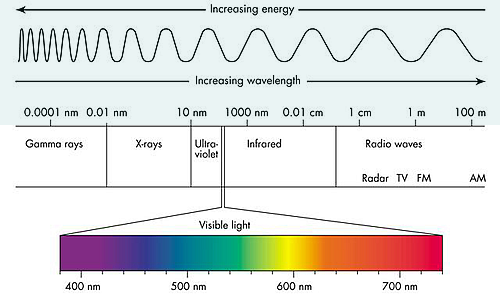
Energy, wavelength, frequency of a photon (3.1)
- wavelength goes in the opposite direction of frequency and energy
- frequency is represented by v
- wavelength is represented by lambda
- the visible light spectrum is 400-800nm
- blue is 400nm and red is 800nm
- https://www.cyberphysics.co.uk/graphics/diagrams/waves/EMSpectrumcolor.png
- one photon is equal to one light unit
- Energy is measured in joules
Photoelectric effect (3.1)
- minimum threshold to eject electrons is related to the frequency of light
- classical physics suggested the amplitude of a wave influences the energy but experimentally, it was discovered that it is the frequency
- there is a certain amount of energy required to hold the atom together
- in order to eject an electron, you must overcome the threshold energy
Orbit energy of e-, delta E, Bohr Model (3.1, 3.2)
- line spectra
- elements and molecules have emission spectra that correspond to a series of line
- each line is a single wavelength
- Rydberg equation (included in sheet)
- n refers to which orbit an electron might be in
- 1 over lambda
- https://i.stack.imgur.com/oDIES.jpg
- elements and molecules have emission spectra that correspond to a series of line
- wave particle duality
- light behaves both wavelike and particle-like
- wavelike property - interference patterns obtained when light passed through a double slit
- particle like property - photoelectric effect
- light behaves both wavelike and particle-like
- Bohr's atomic theory
- Bohr used the results of Planck and Einstein's experiments to develop a better atomic theory, making the following assumptions about an atom's electrons
- electrons travel in circular orbit around the nucleus
- energy proportional to distance
- orbits are quantized
- equation is included on the sheet
- E sub n
- Delta E
- Z is the nuclear charge
- energy is absorbed/emitted when orbits change
- Orbit transitions
- an electron moves to a higher level (n) when a specific quantity of energy is absorbed
- an electron moves to a lower level (n) when a specific quantity of energy is emitted
- the Bohr model fails with more than one electron, but was right about the following
- e- attracted to nucleus by the opposing charges of the particles
- e- energies are quantized
- e- energies increase as the distance from the nucleus increases
- discrete energies in spectra of elements result from quantized energy transitions of e- between levels
- Bohr used the results of Planck and Einstein's experiments to develop a better atomic theory, making the following assumptions about an atom's electrons

DeBroglie Wavelength (3.3)
- wavelength is equal to h over linear momentum
- linear momentum is equal to mass multiplied by velocity
- quantization of angular momentum, L, is equal to n multiplied by h
- wavelike properties are only important for small particles (electrons)
- Electron location and momentum
- Heisenberg Uncertainty Principle
- We can only know either the position or momentum of a particle at any given instant
- we can not know both in one instant
- consequence of wave-particle duality
- there are limitations governing the motions of quantum particles
- Heisenberg Uncertainty Principle
- Electron location and momentum
- schrodinger
- expanded on de Broglie's work and developed a wave equation that described and electron as a wave function, represented by psi
- psi are not physical waves but complex probability amplitudes
- psi squared is equal to the probability distribution (e- distribution)
- expanded on de Broglie's work and developed a wave equation that described and electron as a wave function, represented by psi
Quantum Theory, Quantum Numbers (3.3)
- a series of four quantum numbers describe the energies, locations and other properties of an electron in a given atom
- principle quantum number (n)
- discrete energy level
- energies increase as the distance from the nucleus increase
- atomic orbital
- which orbital
- corresponds to the row on the periodic table
- angular momentum quantum number (l)
- shape
- integers from 0 to n-1
- s, p, d, and f orbitals are 0, 1, 2, and 3, respectively
- when l is not equal to 0, the orbitals have directionality about the z axis described by the magnetic quantum number
- magnetic quantum number (m sub l)
- orientation
- integers from -l to l
- number of degenerate orbitals in subshell
- spin quantum number (m sub s)
- electronic spin
- overall one magnitude, two quantized states
- +1/2, -1/2
- spin states degenerate unless in external magnetic field
- principle quantum number (n)
Orbitals and Wave functions (3.3)
- pauli exclusion principle
- no two electrons can have the same two sets of electrons
- they have different quantum numbers in some way or another
- radial nodes
- there are certain distances from the nucleus at which the probability density of finding an electron located at a particular orbital is zero
- the number of nodes is equal to the energy level minus l minus 1
Electron Configurations (3.4)
- the total number of electrons in an atom populate these orbitals following a set of rules
- the end result is an electron configuration or orbital diagram
- hund's rule
- electrons spread out within a sub shell and have the same spin
- filled and half filled subshells are especially stable
- aufbau principle
- build up from lowest energy to highest
- valence electrons
- the electrons in the outermost principle quantum level of an atom (largest value of n)
- the 3de- are not counted as part of the valence shell
- full d and f shells are not considered part of the valence shell because they are not involved in reactions if they are full
- therefore, determination of the number of valence e- for any main group atom is simply the group number
- HOWEVER, atoms in the transition series do count the de- toward the valence shell
Periodic Trends (3.5, 3.6)
- periodic law - the properties of the elements are periodic functions of their atomic numbers
- nuclear charge
- many of the periodic trends involving e- can be qualitatively explained using the effective nuclear charge (Z sub eff) of the atom
- this is the pull exerted on a specific electron by the nucleus, taking into account any electron-electron repulsions
- Z sub off is equal to Z minus the shielding
- shielding is the e- repulsions
- many of the periodic trends involving e- can be qualitatively explained using the effective nuclear charge (Z sub eff) of the atom
- radii
- covalent radius - one half the distance between the nuclei of two identical atoms when they are joined by a covalent bond
- ionic radius - size of an ion
- increases as you go down and to the left
- ionization energy - Energy required to remove the most loosely bound e- in formation of cation
- as size increases, IE decreases
- it becomes easier to remove electrons
- increases as you go up and to the right
- watch for filled and half filled subshells
- as size increases, IE decreases
- electron affinity - energy change for adding an electron to gaseous atom in formation of an anion
- increases going up and to the right
- unit prefixes and conversions
- pico 10^-12
- nano 10^-9
- micro 10^-6
- milli 10^-3
- centi 10^-2
- kilo 10^3
Ionic and Covalent Bonds, including polyatomic (3.7)
- monatomic ions
- the majority of chemical reactions do not change the nucleus of an atom
- electrons can be transferred or shared
- groups
- alkali metals
- alkaline earth metals
- chalcogens
- halogens
- noble gases
- polyatomic ions
- usually have a negative charge
- binary bonding
- ionic
- metal and nonmetal
- groups of atoms held together by electrostatic interactions
- transfer of electrons
- molecular/covalent
- nonmetal and nonmetal
- groups of atoms held together by sharing electrons
- ionic