
Quiz
Session 1 - Body Fluid Compartments
Perguntas do quiz (27)
1Why does isobutene not dissolve in water?
- AIt is nonpolar.
- BIt is hydrophilic.
- CIt is polar.
- DIt forms hydrogen bonds with surrounding water molecules, repelling them.
2Which of the following is NOT true regarding the phospholipid bilayer membrane?
- AIt is characteristic of all animal cells.
- BIt separates an internal aqueous environment from an external aqueous environment.
- CIt consists of a nonpolar head group and two hydrophilic nonpolar fatty acid chains.
- DLecithins and spingomyelins are examples of phospholipids that can compose the membrane.
3Which of the following can readily pass through the phospholipid bilayer?
- ASmall, uncharged polar molecules
- BLarge, uncharged polar molecules
- CSmall, charged nonpolar molecules
- DLarge, charged nonpolar molecules
4Which of the following helps to stabilize the lipid portion of the membrane?
- ACholesterol
- BMembrane protein
- CAquaporin
- DIon channel
5Which of the following are the correct components to an average human's total body water (TBW)?
- A8% blood plasma, 25% interstitial fluid, 67% intracellular fluid
- B67% extracellular fluid, 33% intracellular fluid
- C33% interstitial fluid, 67% extracellular fluid
- D33% blood plasma, 67% extracellular fluid
6Evans blue dye is a tracer that binds to albumin. Using the dilution principle, which fluid compartments could we estimate the size of using Evans blue dye if we also know the the volume of the body's extracellular fluid? (Select all that apply)
- APlasma
- BIntracellular fluid
- CTotal body water
- DInterstitial fluid
7200 mg mannitol (a tracer that is non-metabolized and easily crosses the blood capillary wall, but not the cell membrane) is given intravenously to a 60 kg woman. A blood draw 6 hours later shows a plasma mannitol concentration of 0.015 mg/mL. What is the volume of this woman's ECF?
- A13 L
- B13,000 L
- C15 L
- D20 L
8To determine total blood volume, you need the plasma volume and _________.
- AHematocrit
- BWhole blood volume
- CWhite blood cell count
9Nitric oxide is a small, uncharged compound. Which of the following is the most likely way this compound will enter a cell?
- ASimple diffusion
- BFacilitated diffusion
- COsmosis
- DPrimary active transport
10Glucose transporters have a specific site for glucose and transport glucose into the cell if the concentration of glucose in the ISF if greater than in the intracellular fluid. This is an example of _________.
- AFacilitated diffusion
- BAquaporin
- CPrimary active transport
- DSimple diffusion
11Active transporters transport solutes into the cell _________ an electrochemical gradient and require __________.
- AAgainst, energy
- BWith, energy
- CAgainst, favorable ionic concentrations
- DWtih, favorable ionic concentrations
12For every hydrolyzed ATP molecule, ____________ are pumped out of the cell and ____________ are pumped into the cell with the sodium-potassium pump.
- A3 Na+ molecules, 2 K+ molecules
- B2 Na+ molecules, 3 K+ molecules
- C2 K+ molecules, 3 Na+ molecules
- D3 K+ molecules, 2 Na+ molecules
13How does the sodium-potassium pump regulate normal cell volume and pressure?
- AReducing osmotic particles inside the cell
- BIncreasing osmotic particles inside the cell
- CThe sodium-potassium pump plays no role in regulating cell volume and pressure
14Neutral amino acids are taken up in many cells by secondary active transport. The transporter involved transports Na+ down its electrochemical gradient into the cytosol, and the energy released by this _______ transport is used to transport the amino acid into the cell _________ a concentration gradient.
- Adownhill, uphill against
- Buphill, downhill against
- Cdownhill, with
- Duphill, with
15There are two types of secondary active transport, cotransport and countertransport. Which of the following are correct examples of cotransport? (Select all that apply)
- ANa+-amino acid transport
- BNa+-glucose transporter in intestinal epithelial cells
- CNa+-glucose transporter in red blood cells
- DCalcium ion-sodium ion exchanger in muscle cells
16Osmosis results in a(n) ________ in total volume in the compartment with the initially more concentrated solutes and a(n) _________ in total volume in the other compartment.
- Aincrease, decrease
- Bdecrease, increase
- Cincrease, increase
- Ddecrease, decrease
17What is the osmolarity of 1 mmole of NaCl in aqueous solution?
- A1 mOsm
- B2 mOsm
- C3 mOsm
- D4 mOsm
18What is the osmolarity of all body fluids?
- A290 mOsm/L
- BAll body fluids have a different osmolarity.
- C350 mOsm/L
- D120 mOsm/L
19A red blood cell has an osmolarity of 290 mOsm/L. You drop the red blood cell into a hypotonic solution of 50 mM NaCl (100 mOsm/L). What would you expect to occur?
- ANo change in RBC volume
- BThe RBC would shrink
- CThe RBC would lyse
- DThe RBC would increase in volume, but stay functional
20You have a patient suffering from dehydration. She has a severe headache, has had a syncopal episode, and her blood pressure is 84/54. She is unable to tolerate oral water. Which of the following is an appropriate treatment?
- A0.9% NaCl solution IV
- B5% dextrose solution IV
- Cpure water IV
21You have a patient who is considering running a marathon in January in Ohio. Which of the following would you recommend to avoid hyponatremia?
- ADrink only when thirsty
- BDrink only Gatorade to replace lost electolytes
- CDrink only water
- DDrink water and Gatorade at every possible opportunity
22Which of the following molecules is hydrophobic?
- ASucrose
- BGlycine
- CCholesterol
- DPotassium chloride
23Why can't albumin cross the lipid bilayer membrane?
- AIt's too big
- BIt's negatively charged
- CBoth of these
24Which of the following organs might be key to maintaining proper fluid compartment volumes? (Select all that apply)
- AKidneys
- BSkin
- CLungs
- DBrain
25Diabetic patients take insulin to reduce high blood glucose levels. If glucose levels then fall too low, which transporter would be the first to stop transporting glucose into the cells?
- AFacilitated diffusion glucose transporter
- BSecondary active Na+-glucose transporter
- CAquaporin
- DCalcium ion channel
26Compartments X and Y are separated by a semipermeable membrane. Which of the following diagrams best illustrates the level of the solutions at equilibrium when X is 100 mM NaCl and Y is pure water?
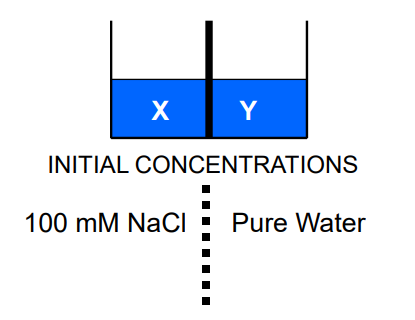
- A
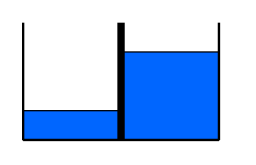
- B
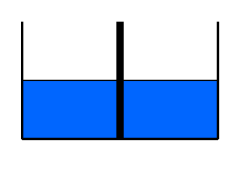
- C
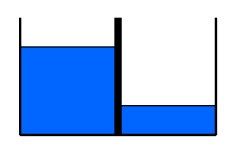
- A
27One healthy red blood cell (RBC) is dropped into a very large container filled with 50 mM NaCl and 100 mM CaCl2. Which of the following best illustrates the volume of the RBC at equilibrium?
- AHypertonic
- BIsotonic
- CHypotonic
Informações
- Descrição
- PA School Physiology Quiz sobre Session 1 - Body Fluid Compartments, criado por Kathleen Lonergan em 12-06-2019.
- Autor
- Kathleen Lonergan
- Idioma
- English
- Visualizações
- 317
- Etiquetas
- Avaliação
- Ainda sem avaliações Avalie este quiz