
Fluxograma
Electricity
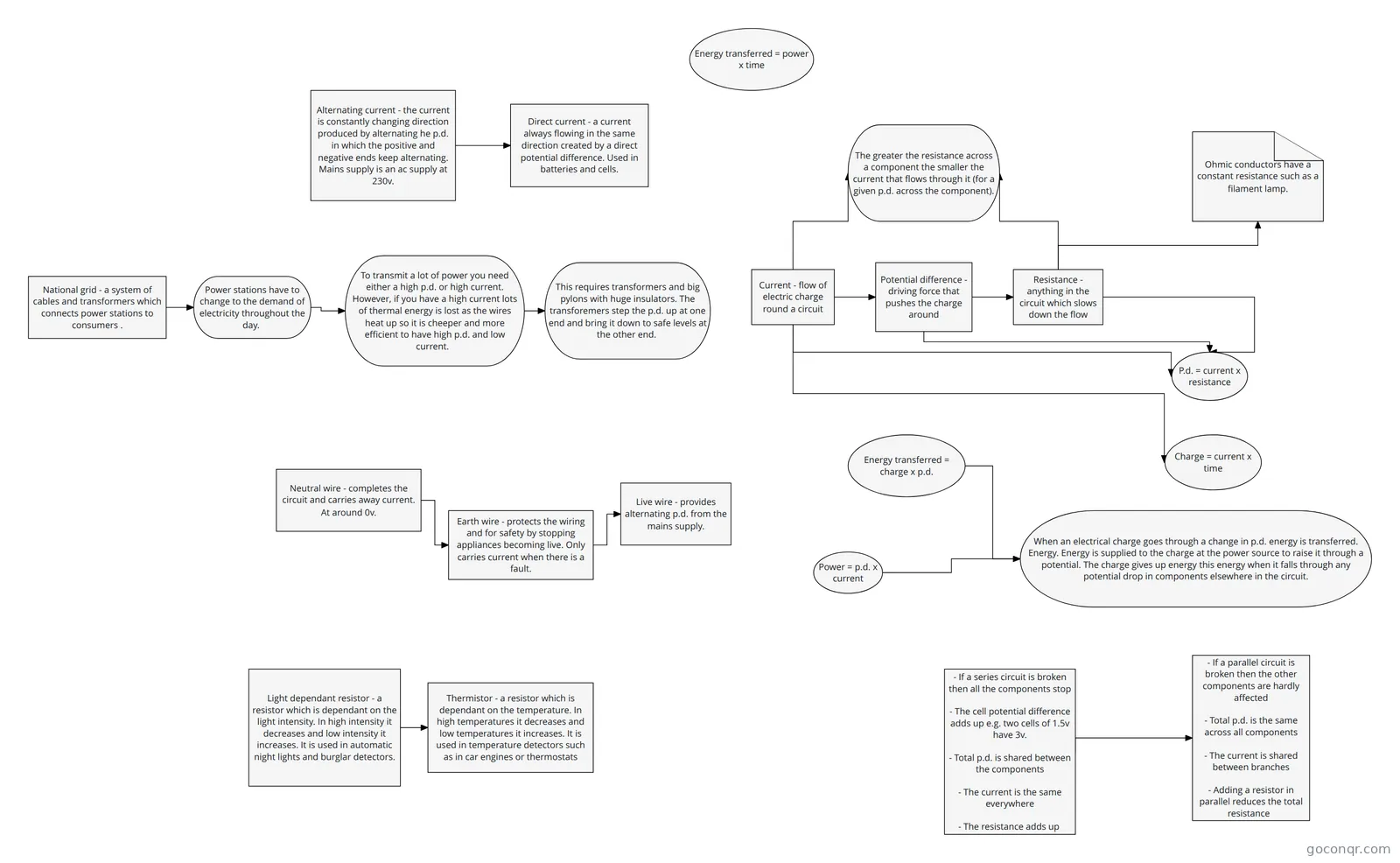
Flowchart: Electricity
Conteúdo do fluxograma
Current - flow of electric charge round a circuit
Potential difference - driving force that pushes the charge around
Resistance - anything in the circuit which slows down the flow
The greater the resistance across a component the smaller the current that flows through it (for a given p.d. across the component).
Charge = current x time
P.d. = current x resistance
Ohmic conductors have a constant resistance such as a filament lamp.
Alternating current - the current is constantly changing direction produced by alternating he p.d. in which the positive and negative ends keep alternating. Mains supply is an ac supply at 230v.
Direct current - a current always flowing in the same direction created by a direct potential difference. Used in batteries and cells.
Neutral wire - completes the circuit and carries away current. At around 0v.
Live wire - provides alternating p.d. from the mains supply.
Earth wire - protects the wiring and for safety by stopping appliances becoming live. Only carries current when there is a fault.
Energy transferred = power x time
Energy transferred = charge x p.d.
Power = p.d. x current
When an electrical charge goes through a change in p.d. energy is transferred. Energy. Energy is supplied to the charge at the power source to raise it through a potential. The charge gives up energy this energy when it falls through any potential drop in components elsewhere in the circuit.
Power stations have to change to the demand of electricity throughout the day.
National grid - a system of cables and transformers which connects power stations to consumers .
To transmit a lot of power you need either a high p.d. or high current. However, if you have a high current lots of thermal energy is lost as the wires heat up so it is cheeper and more efficient to have high p.d. and low current.
This requires transformers and big pylons with huge insulators. The transforemers step the p.d. up at one end and bring it down to safe levels at the other end.
Light dependant resistor - a resistor which is dependant on the light intensity. In high intensity it decreases and low intensity it increases. It is used in automatic night lights and burglar detectors.
Thermistor - a resistor which is dependant on the temperature. In high temperatures it decreases and low temperatures it increases. It is used in temperature detectors such as in car engines or thermostats
- If a series circuit is broken then all the components stop
- The cell potential difference adds up e.g. two cells of 1.5v have 3v.
- Total p.d. is shared between the components
- The current is the same everywhere
- The resistance adds up
- If a parallel circuit is broken then the other components are hardly affected
- Total p.d. is the same across all components
- The current is shared between branches
- Adding a resistor in parallel reduces the total resistance
Informações
- Descrição
- GCSE Physics Fluxograma sobre Electricity, criado por Leanne Painter em 07-09-2020.
- Criado por
- Leanne Painter
- Visualizações
- 5
- Avaliação