
Fluxograma
Molecular structure: atoms, subatomic particles and bonds
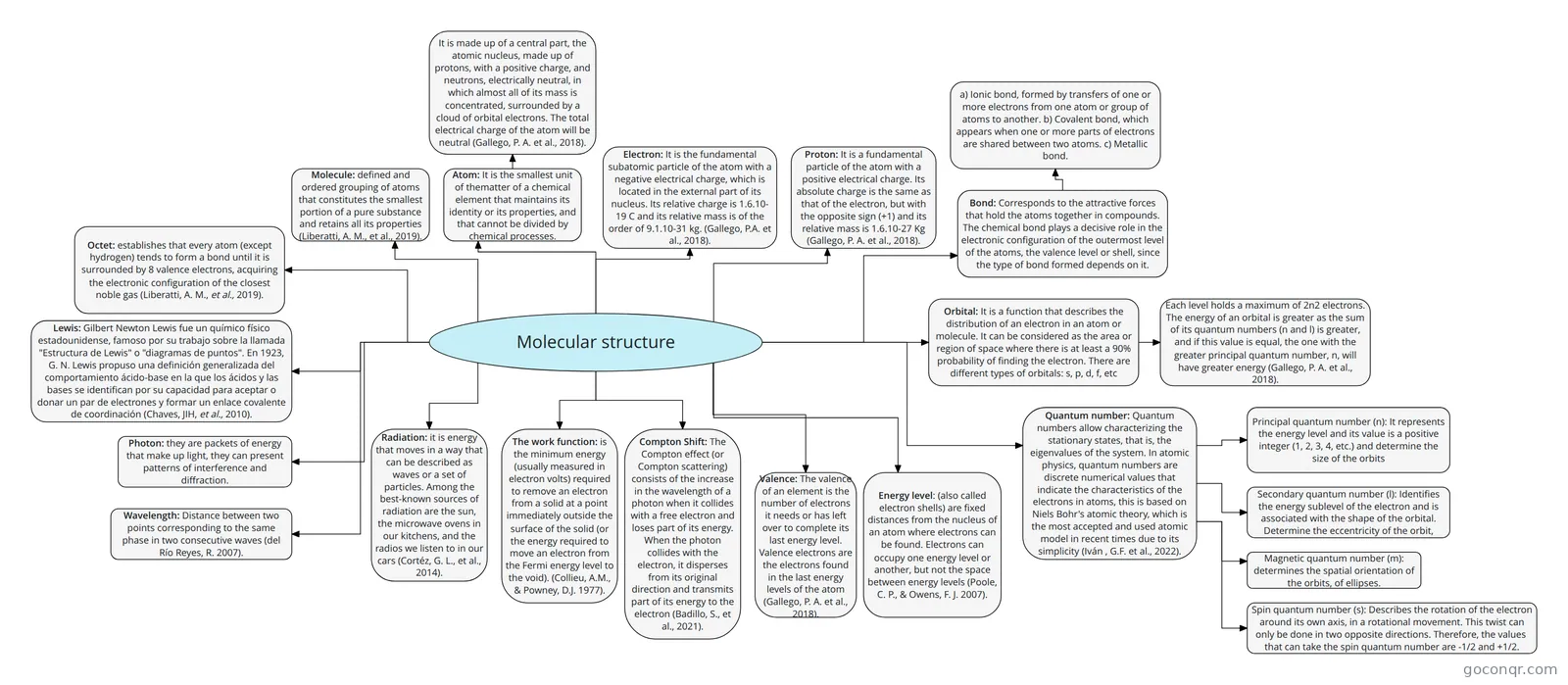
Flowchart: molecular structure
Conteúdo do fluxograma
Molecular structure
Molecule: defined and ordered grouping of atoms that constitutes the smallest portion of a pure substance and retains all its properties (Liberatti, A. M., et al., 2019).
Atom: It is the smallest unit of thematter of a chemical element that maintains its identity or its properties, and that cannot be divided by chemical processes.
It is made up of a central part, the atomic nucleus, made up of protons, with a positive charge, and neutrons, electrically neutral, in which almost all of its mass is concentrated, surrounded by a cloud of orbital electrons. The total electrical charge of the atom will be neutral (Gallego, P. A. et al., 2018).
Electron: It is the fundamental subatomic particle of the atom with a negative electrical charge, which is located in the external part of its nucleus. Its relative charge is 1.6.10-19 C and its relative mass is of the order of 9.1.10-31 kg. (Gallego, P.A. et al., 2018).
Proton: It is a fundamental particle of the atom with a positive electrical charge. Its absolute charge is the same as that of the electron, but with the opposite sign (+1) and its relative mass is 1.6.10-27 Kg (Gallego, P. A. et al., 2018).
Bond: Corresponds to the attractive forces that hold the atoms together in compounds. The chemical bond plays a decisive role in the electronic configuration of the outermost level of the atoms, the valence level or shell, since the type of bond formed depends on it.
a) Ionic bond, formed by transfers of one or more electrons from one atom or group of atoms to another. b) Covalent bond, which appears when one or more parts of electrons are shared between two atoms. c) Metallic bond.
Orbital: It is a function that describes the distribution of an electron in an atom or molecule. It can be considered as the area or region of space where there is at least a 90% probability of finding the electron. There are different types of orbitals: s, p, d, f, etc
Each level holds a maximum of 2n2 electrons. The energy of an orbital is greater as the sum of its quantum numbers (n and l) is greater, and if this value is equal, the one with the greater principal quantum number, n, will have greater energy (Gallego, P. A. et al., 2018).
Octet: establishes that every atom (except hydrogen) tends to form a bond until it is surrounded by 8 valence electrons, acquiring the electronic configuration of the closest noble gas (Liberatti, A. M., et al., 2019).
Lewis: Gilbert Newton Lewis fue un químico físico estadounidense, famoso por su trabajo sobre la llamada "Estructura de Lewis" o "diagramas de puntos". En 1923, G. N. Lewis propuso una definición generalizada del comportamiento ácido-base en la que los ácidos y las bases se identifican por su capacidad para aceptar o donar un par de electrones y formar un enlace covalente de coordinación (Chaves, JIH, et al., 2010).
Photon: they are packets of energy that make up light, they can present patterns of interference and diffraction.
Wavelength: Distance between two points corresponding to the same phase in two consecutive waves (del Río Reyes, R. 2007).
Radiation: it is energy that moves in a way that can be described as waves or a set of particles. Among the best-known sources of radiation are the sun, the microwave ovens in our kitchens, and the radios we listen to in our cars (Cortéz, G. L., et al., 2014).
The work function: is the minimum energy (usually measured in electron volts) required to remove an electron from a solid at a point immediately outside the surface of the solid (or the energy required to move an electron from the Fermi energy level to the void). (Collieu, A.M., & Powney, D.J. 1977).
Compton Shift: The Compton effect (or Compton scattering) consists of the increase in the wavelength of a photon when it collides with a free electron and loses part of its energy. When the photon collides with the electron, it disperses from its original direction and transmits part of its energy to the electron (Badillo, S., et al., 2021).
Valence: The valence of an element is the number of electrons it needs or has left over to complete its last energy level. Valence electrons are the electrons found in the last energy levels of the atom (Gallego, P. A. et al., 2018).
Quantum number: Quantum numbers allow characterizing the stationary states, that is, the eigenvalues of the system. In atomic physics, quantum numbers are discrete numerical values that indicate the characteristics of the electrons in atoms, this is based on Niels Bohr's atomic theory, which is the most accepted and used atomic model in recent times due to its simplicity (Iván , G.F. et al., 2022).
Principal quantum number (n): It represents the energy level and its value is a positive integer (1, 2, 3, 4, etc.) and determine the size of the orbits
Secondary quantum number (l): Identifies the energy sublevel of the electron and is associated with the shape of the orbital. Determine the eccentricity of the orbit,
Magnetic quantum number (m): determines the spatial orientation of the orbits, of ellipses.
Spin quantum number (s): Describes the rotation of the electron around its own axis, in a rotational movement. This twist can only be done in two opposite directions. Therefore, the values that can take the spin quantum number are -1/2 and +1/2.
Energy level: (also called electron shells) are fixed distances from the nucleus of an atom where electrons can be found. Electrons can occupy one energy level or another, but not the space between energy levels (Poole, C. P., & Owens, F. J. 2007).
Informações
- Descrição
- Fluxograma sobre Sem título, criado por Diana Benavides em 10-11-2022.
- Criado por
- Diana Benavides
- Visualizações
- 2
- Avaliação
Mais sobre Atoms and Molecules