
Matter and Its Properties
184 resources created by 174 users
This Matter and Its Properties page on GoConqr gathers community-made quizzes, mind maps, flashcards and notes, from states of matter and density to elements, compounds and mixtures, and physical and chemical changes. It's built for school students revising a topic and teachers after ready-made material. There are over 1,600 resources here, including more than 90 quizzes, over 1,000 mind maps and more than 300 flashcards, mostly at secondary level. Pick a quiz to find your gaps, then open a map to fill them.
Top Matter and Its Properties resources
-
27 questionsFinal Exam 1-4 The statement, Matter is neither creater nor destoryed is called
-
46 cardsChem 152 First Exam
-
18 questionsMatter Quiz Which of these statements BEST explains why chemistry is flexible?
-
30 cardsElements Compounds And Mixtures Mixtures, elements, compounds
-
Mind map Unit 1 - Matter - Concept Map N*** C***** - Block 4 This is an Honors Chemistry assignment. It is a concept map consisting of every key term in the chapter, as...
-
19 cardsChemistry - Grade 9 Review Grade 9 - Properties of Matter
-
Mind map Physical and Chemical properties of matter xdn't
-
13 questionsDensity Practice
Quizzes
See all 32 quizzes-
27 questionsFinal Exam 1-4 The statement, Matter is neither creater nor destoryed is called
-
18 questionsMatter Quiz Which of these statements BEST explains why chemistry is flexible?
-
13 questionsDensity Practice
-
5 questionsChapter 1 : Matter DK014 KMNS
-
16 questionsChapter 2: The Nature of Matter Study Guide What is the ability to dissolve in water and to conduct electricity ?
-
12 questionsChem Matter Test Review blah
-
20 questionsHonors Chemistry Quiz Which of the following is a physical property of paper?
-
5 questionsChemistry Module 1 Properties of Matter Year 11 Preliminary 2018
Mind maps
See all 101 mind maps-
Unit 1 - Matter - Concept Map N*** C***** - Block 4 This is an Honors Chemistry assignment. It is a concept map consisting of every key term in the chapter, as...
-
Physical and Chemical properties of matter xdn't
-
Physical and Chemical Properties of Matter
-
Physical and Chemical Properties of Matter By Jasdeep Singh and Gobind Singh
-
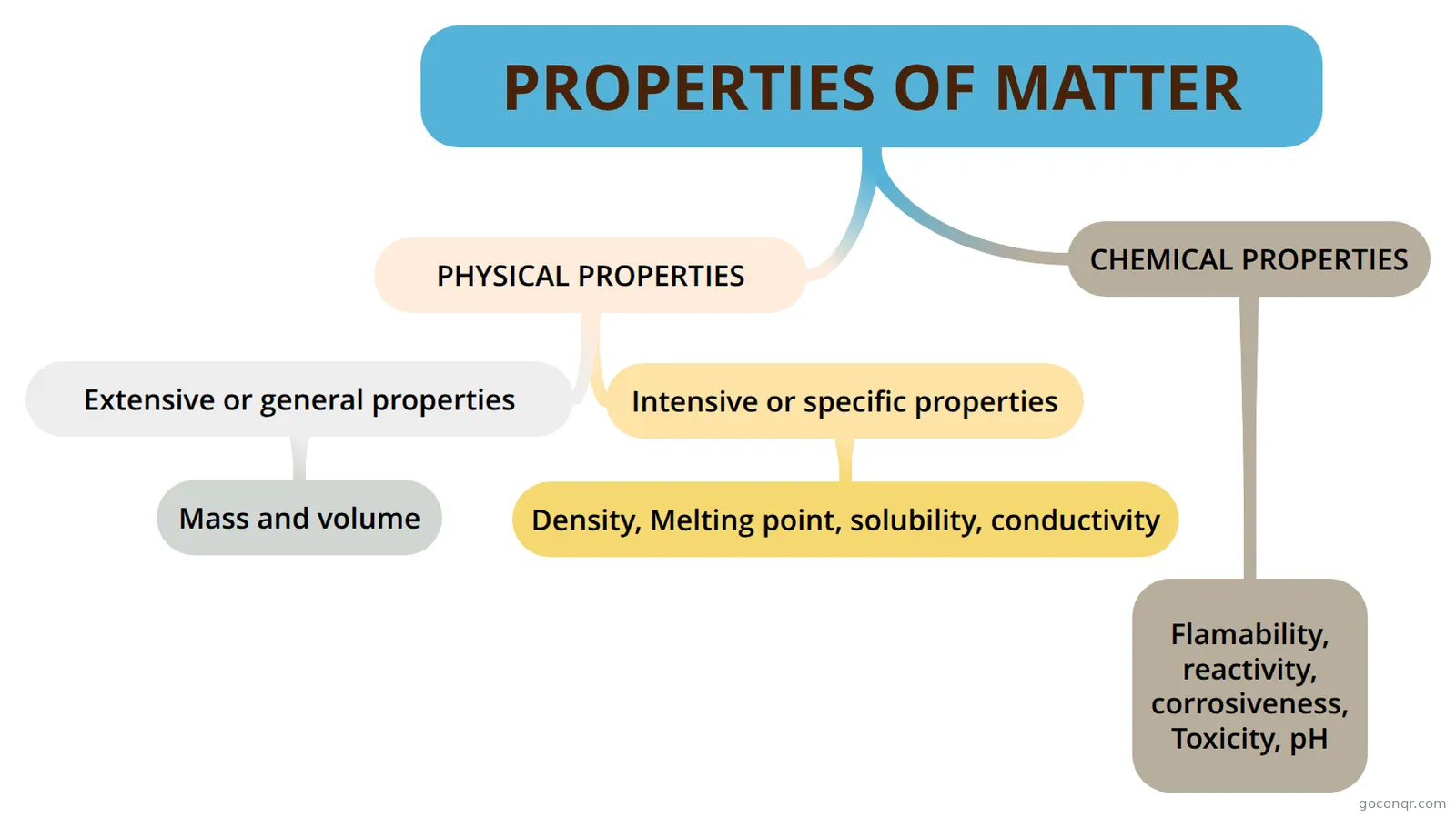 PROPERTIES OF MATTER
-
 PHYSICAL AND CHEMICAL CHANGES IN MATTER changes in matter
-
Sequence in Separating Mixtures Mind Map on Separating Components, created by joaquin.guevara0 on 03/08/2016.
-
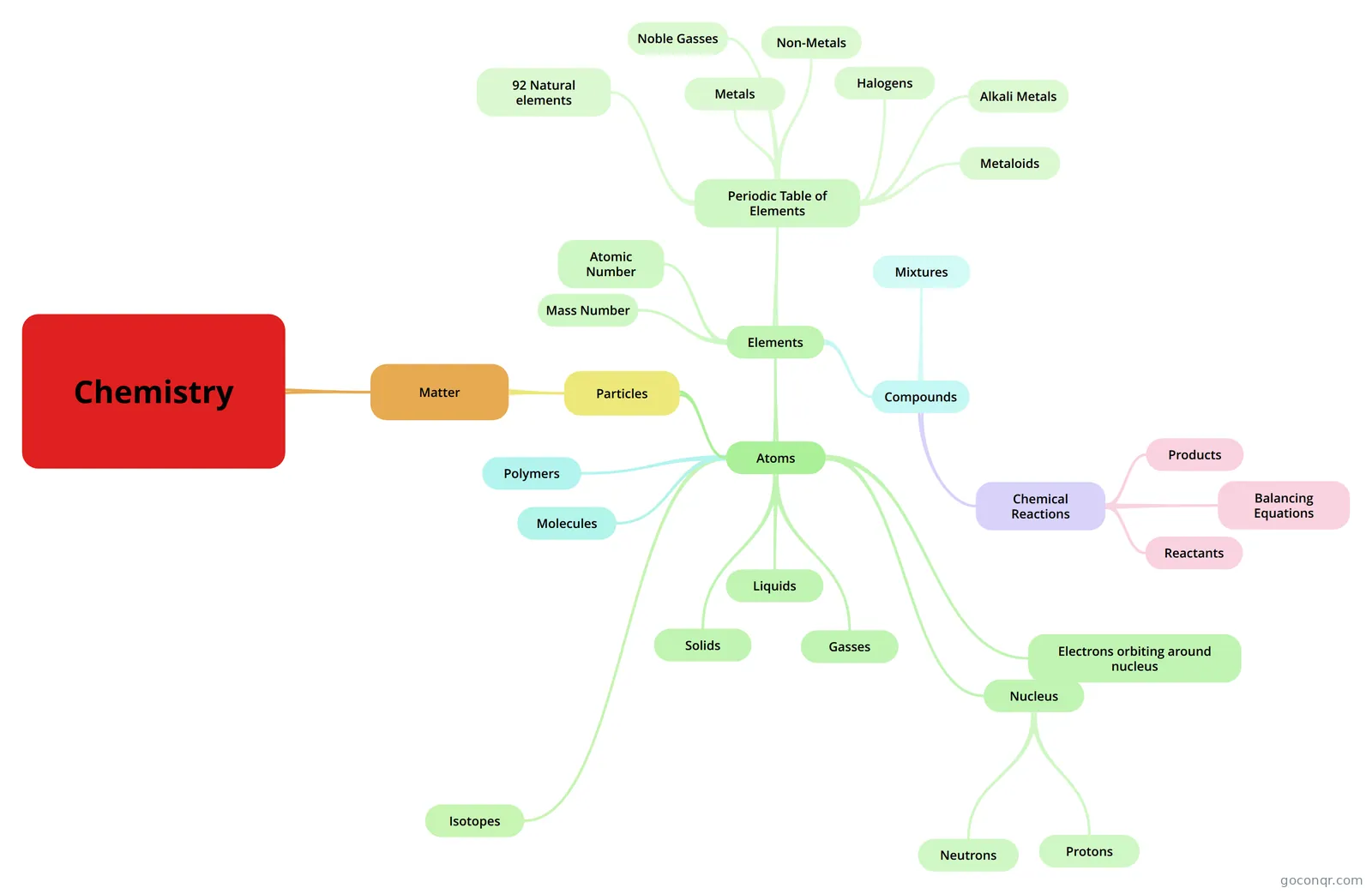 Chemistry
Flashcards
See all 40 flashcards-
46 cardsChem 152 First Exam
-
30 cardsElements Compounds And Mixtures Mixtures, elements, compounds
-
19 cardsChemistry - Grade 9 Review Grade 9 - Properties of Matter
-
129 cardsscience~chemistry what are qualitative properties
-
42 cardsStates of matter, how to graph scientific data and the Periodic table Q.What is a Heterogeneous mixture?
-
10 cardsChemistry Part 1 - Class Nine: Viscosity Chemistry Part 1: Class Nine - Viscosity You will need: purified water syrup/honey glycerine mini funnel ra...
-
64 cardsChemistry It is a study of matter, its properties, composition, structure, transformation from one to form another, a...
-
39 cardsMatter and Change 39 vocab
Notes
-
CH. 1, Lesson 1: Describing Matter MATTER- Anything that has mass and takes up space. (Do not confuse "matter" with "mass". There is a difference, described later on....)4 types of matter: Solid, liquid, gas, plasma.SUBSTANCE- A single kind of matter t...
-
Science 9: Unit 2 - Matter and Chemical Change Science 9: Unit 2 - Matter and Chemical Change Topic 1.1 - Lab Safety WHMIS is a system of labelling used for dangerous materials used in the workplace. It stands for Workplace Hazardous Material Information Syst...
-
Science Study Notes •Name the states of matter and the processes from one state to another. •Using the KMT explain what happens to the particles in each state. •On cooling and heating curves, identify: boiling, vaporisation, ...
-
science chemistry test review Chemistry test review ( summary) DEFINE MIXTURE : a substance made by mixing other substances together. PURE SUBSTANCE: Pure substance are made of only one type of atom or molecule, and the purity of a substance is th...
-
Chapter 1: Measuring Up Definitions Matter = Anything that has mass and takes up spaceUnit = Quantity that describes the measurement being madeSignificant Figure = A digit in a measurement that contributes to the measurement's precisionWeigh...
-
Atoms Each element is made of Atoms Atoms are made form two different particles, Protons, and neutrons. Protons have a positive charge ( + ). Neutrons have no charge they are neutral. Orbiting around the nucleus are Electro...
-
Atoms - Chemistry Atoms:The Nucleus: - Centre of the atom.- Contains PROTONS and NEUTRONS.- Due to the protons it has a positive charge.- Nearly the whole mass of the atom is concentrated in the nucleus.The Electrons:- Move AROUND...
-
Particles Chemical change is any change that results in the formation of new chemical substances. At the molecular level, chemical change involves making or breaking of bonds between atoms. These changes are chemical: iron...
Slides
More Chemistry topics
About Matter and Its Properties
GoConqr OriginalWhat the page covers
This unit sits in the Matter and Its Properties strand of Chemistry. The resources start with the basic question of what matter is, then move to how it is classified and how its properties are described. Many were made by GoConqr users, so the wording and style vary from one to the next.
- Classifying matter: pure substances, mixtures, elements and compounds, plus homogeneous and heterogeneous mixtures.
- Properties: physical and chemical properties, extensive and intensive properties, and density.
- Changes: physical and chemical changes, and separating mixtures.
Where to start
Begin with the quiz Chapter 1: Matter DK014 KMNS. It opens with the idea that matter is anything that occupies space and has mass, then asks you to complete diagrams and tables. It shows quickly what you already know.
Next, read one of the mind maps called Physical and Chemical Properties of Matter. They split properties into physical and chemical types and give examples such as size, colour, texture, hardness and odour. The map called PROPERTIES OF MATTER adds extensive and intensive properties, with mass, volume, density, melting point and solubility.
Classification and density
The flashcard deck Elements Compounds And Mixtures asks why matter is not classified by physical features such as colour. The deck Chemistry - Grade 9 Review covers pure substances, mixtures and the particle theory of matter. For numbers work, try the quiz Density Practice, which starts from density as the ratio of mass to volume.
Using quizzes and maps together
- Take a quiz cold and note what you miss.
- Open a mind map on that topic and read its branches.
- Test yourself with a flashcard deck.
- Retake the quiz and compare.
Some resources mention GCSE Chemistry, AP Chemistry or ESO, so check the title and contents against your own course. Teachers can pick a map or quiz to use as it is. Choose one resource now and see how far it takes you.
Frequently asked questions
Which quiz should I try first?
Try Chapter 1: Matter DK014 KMNS. It begins with the definition of matter, as anything that occupies space and has mass, and then asks you to complete diagrams and tables. For a more specific topic, Density Practice focuses on mass, volume and density.
What do the mind maps on this page cover?
Several maps called Physical and Chemical Properties of Matter set out physical and chemical properties with examples. Others cover states of matter, classification of matter, pure substances and mixtures, physical and chemical changes, and the sequence for separating mixtures.
Are the resources free to use?
Yes. Every resource listed here is free to open, study and take, with no account needed. They were made by GoConqr users, not by GoConqr itself, so it is worth checking that a resource matches your course before you rely on it.
Which levels and exams do these resources suit?
Most of the resources are at secondary level, with a small share at other levels. Some mention GCSE Chemistry, AP Chemistry or ESO. They are useful for school students revising and for teachers looking for ready-made quizzes, maps and flashcards.
Can I save my scores or make my own resources?
A free account saves your quiz scores and lets you make your own quizzes, mind maps, flashcards and notes. That is handy if you want to turn a topic like mixtures or physical changes into a set of cards written in your own words.
What if I can't find the topic I need?
Look through the related titles first, since topics such as atoms, isotopes, metals and non-metals, and vapour pressure appear in notes and maps here. If your topic is still missing, you can build your own mind map or flashcard deck with a free account.