
Waves
Slides do conjunto (2)
-
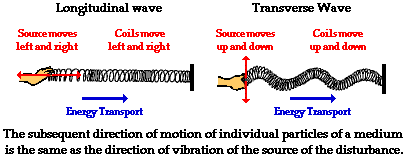
- There are 2 types of waves, longitudinal and transverse waves.
- Longitudinal waves require a medium to travel through, therefore they cannot travel in a vacuum, for example space. The direction of the travelling wave (particle motion) is parallel to the direction of energy transfer. Examples of longitudinal waves are sound waves, seismic primary waves (in earthquakes), and ultrasound. In the diagram, the sections where the particles are 'bunched up' are compressions and the other sections where the particles are spread out are called rarefractions.
- Transverse waves do not all require a medium to travel, meaning some can travel through vacuums. The direction of particle motion is perpendicular to the direction of energy transfer. Examples of transverse waves are water waves, light waves, x-rays and all electromagnetic waves.
-
- Frequency refers to how often the air particles vibrate per second. The time period is the time interval of a wavelength and is measured in seconds. It is how long the wave travelled for. To work out frequency, you do the number of cycles completed divided by how many seconds the wave travelled for. The longer the time period, the lower the frequency, and vice versa. Frequency is measured in Hertz, Hz. For example, if wave completed 5 cycles in 1 second, its frequency would by 5/1, 5Hz.
- Speed of a wave is calculated by multiplying the wavelength of the wave by its frequency. For example, if a wave had a frequency of 5hz and a wavelength of 2m, then its speed would be 10m/s.
Informações
- Descrição
- Slides sobre Waves , criado por Fatima Hussain em 02-05-2018.
- Criado por
- Fatima Hussain
- Visualizações
- 37
- Tags
- Avaliação