
Flashcards
Maths for Information Theory

Flashcards do conjunto (15)
- 1How many bits per byte?8
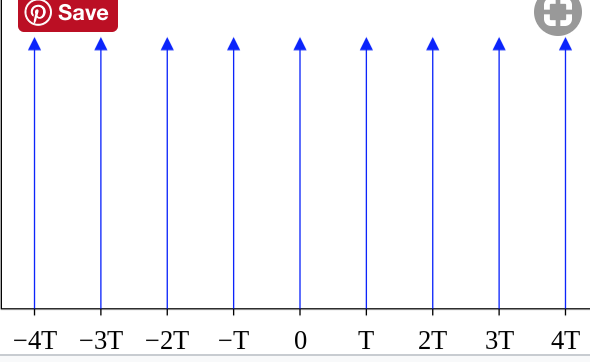
- 2Describe an 'Impulse Train' or 'Dirac Delta function'
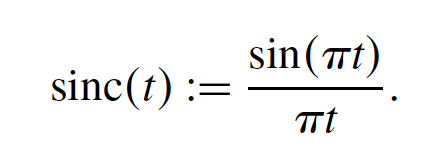
- 3Define sinc(t)
- 4What is the relationship between frequency and wavelength?frequency x wavelength = velocity
(velocity = c for electromagnetic waves)) - 5Phase reversal is equivalent to a phase shift of ...?λ/2 (half the wavelength).
- 6What is the Dirac delta function?The function is zero everywhere but x=0, where it is infinitely great ie. the limit pictured. As this limit it is considered to have area=1 under the curve.

- 7Describe the nature of this functionIt is the delta function shifted so that the peak happens at t=a.

- 8—= x(a)
This is the sifting property of the dirac delta function.
- 9What is the fourier transform of the DD function?(by the sifting property)


- 10Laplace TransformWhere s=σ+jω is complex
- 11What does the Laplace transform do?It converts linear differential equations
in t into algebraic equation in s, which provides a method for solving them. - 12In signal processing, how is the energy Es of a continuous-time signal x(t) defined?

- 13Define the Frobenius inner product for two same-dimension matrices A and B

- 14Define the Cauchy inequalitywhere denotes the inner product of vectors u and v.

- 15What is represented by O terminologyEg. O(9x^3-5x^2+4)=x^3, or for approximating error terms:

Informações
- Descrição
- PhD Comms (Maths) FlashCards sobre Maths for Information Theory, criado por L H em 30-01-2018.
- Criado por
- L H · jan 2018
- Atualizado
- 6 mar 2018
- Visualizações
- 0
- Avaliação
Mais sobre Analog and Digital Signals