
Flashcards
Exam 2
Flashcards do conjunto (140)
- 1Main Types of Causative Noxious stimuli related to Pulpitis-Bacterial (caries)
-Mechanical (trauma, iatrogenic damage from dental procedures)
-Thermal (extensive cavity preparation, large uninsulated metal restoration) - 2What is the crossover point from reversible to irreversible pulpitis?Invasion of pulp by bacteria
- 3Early widespread formation of secondary dentin seen in association with...Progeria
- 4Prevalence of Dental Calcificationsapproximately 20% of radiographs
- 5Increased prevalence of dental calcifications in context of...chronic pulpal irritation
- 6What percent of condensing osteitis cases regress with extraction/treatment of the involved tooth?~85%
- 7Main characteristics of acute inflammation-Exudation of fluid/plasma proteins
-Migration of polymorphonuclear leukocytes (neutrophils) - 8Abscesses are most frequently due to infection with...bacteria that are pyogenic (pus-producing)
- 9Periapical fibrous scar most commonly occurs when...facial and lingual cortical plates are destroyed by initial periapical insult
- 10Most dental abscesses perforate...buccally (thinner bone)
- 11Maxillary lateral incisors, palatal roots of maxillary molars, and mandibular 2nd-3rd molars frequently drain...palatally/lingually
- 123 most common clinical presentations of Actinomycosis-Cervicofacial (55%)
-Abdominal (20%)
-Thoracic (15%) - 13Which is affected most frequently by osteomyelitis, the maxilla or mandible?Mandible (poorly vascularized)
- 14What is the gender predilection of osteomyelitis?Male (75%)
- 15Most common cause of Proliferative periostitisperiapical inflammation
- 16Proliferative periostitis is frequently seen in which decades?1st-3rd
- 17Most frequent cases of CST (cavernous sinus thrombosis)-Surgery
-Trauma
-Sinusitis
(less than 10% caused by odontogenic infection) - 18Odontogenic cysts are encountered relatively commonly in dental practice: 2 most common cystsRadicular >50%
Dentigerous ~20% - 19What percent of newborns present with gingival cysts?50-75%
- 20Hyperplastic dental follicles result from...progressive enlargement of Reduced Enamel Epithelium in spite of arrested tooth eruption
- 21Dentigerous cysts represent HDFs in which...the REE has transformed into stratified squamous epithelium
- 22In what decades are HDFs and Dentigerous cysts most common?2nd-3rd decades
- 23In what decades are lateral periodontal cysts most common?Uncommon odontogenic cyst; however, most frequently seen in 5th-7th decades
- 24Lateral periodontal cysts are treated by conservative excision, what are the chances of recurrenceRare
- 25Radiographic presentation of lateral periodontal cyst is characteristic but not pathognomonic for LPC...Keratocystic odontogenic tumor
Ameloblastoma
Glandular odontogenic cyst - 26Where do 80% of gingival cysts of the adult occur? In what decades is it frequently seen?-Facial gingiva in mandibular canine-premolar region
-5th-6th decades - 27In what decades are Orthokeratinized Odontogenic cysts common?3rd-4th decades w/ male predilection
- 28Where do 90% of OOCs occur? How many resemble dentigerous cysts radiographically?-posterior mandible/ramus
- >50% - 29OOCs are treated with conservative surgical excision; what is the prognosis/recurrence rate?Excellent prognosis with low recurrence rate (<5%)
- 3080% of glandular odontogenic cysts occur in (maxilla/mandible)?? 60% occur in (anterior/posterior) portion of the jaws??-Mandible
-Anterior - 31In what decades are glandular odontogenic cysts most common? What is the recurrence rate?-5th-7th decades
-15-30% - 32Primordial cyst is a clinical term only, most often are ...but can be any of a variety of cystsKeratocystic Odontogenic Tumors
- 33What age are Mandibular buccal bifucation cysts seen? Most cases are associated with... What percent of cases are bilateral?-4-14yr
-Erupting 1st permanent molar
-25% - 34Odontogenic tumors: general considerations LocationPredilection for posterior mandible
- 35Odontogenic tumors: general considerations AgePredilection for middle-aged or elderly adults
- 36Odontogenic tumors: general considerations TreatmentConservative excision sufficient
- 37Location of Compound odontomaanterior maxilla
- 38Location of Calcifying cystic odontogenic tumorAnterior maxilla/posterior mandible
- 39Location of Adenomatoid odontogenic tumorAround impacted canine, usually maxillary
- 40Location of odontogenic fibromaAnterior maxilla/posterior mandible
- 41Location of Odontogenic myxomaPosterior mandible/maxilla
- 42Location of squamous odontogenic tumorPredilection for roots of teeth, equally distributed throughout the jaw bones
- 43Age of Odontomas1st-3rd decades
- 44Age of KCOTwide age range but a slight predilection for younger patients (2nd-4th decades)
- 45Age of unicystic ameloblastoma1st-3rd decades
- 46Age of ameloblastic fibroma and related tumors1st-3rd decades
- 47Age of Calcifying cystic odontogenic tumor2nd decade
- 48Age of odontogenic myxoma2nd-4th decades
- 49Age of Cementoblastoma2nd-3rd decades
- 50What is the most common odontogenic neoplasm?Odontoma
- 51Odontoameloblastomaextremely rare; ameloblastoma developing from odontogenic epithelium of an odontoma
- 52Gender predilection for KOT/KCOTmale
- 53What percent of KCOT/KOT are associated with impacted teeth? Which is more common, uniloculated or multiloculated?30%
Uniloculated - 54Recurrence rate of KCOT with curettage? Less than 10% of KCOTs occur in context of what disease?30%
(lower recurrence rates with more aggressive treatment)
Nevoid basal cell carcinoma syndrome - 55In what decades is Ameloblastoma most common?4th-5th decades
- 56Ameloblastoma is characterized by what genetic mutation?BRAF or other mutations of MAPK signaling pathway
- 57What are the 5yr survival rates of Ameloblastic Carcinoma with/without metastasesWith= 20%
Without= 70% - 58How common are the following tumors of the Ameloblastoma Family of Tumors? -Ameloblastoma -Unicystic ameloblastoma -Peripheral ameloblastoma -Ameloblastic Carcinoma -Metastasizing Ameloblastoma75-85%
13-21%
1-4%
<1%
<<<1% - 5980% of Ameloblastic fibroma cases are diagnosed when? 80% are associated with...-prior to completion of odontogenesis (<22yr)
-Impacted tooth/teeth (usually the 2nd mandibular molar) - 60What mutations is Ameloblastic fibroma associated with?BRAF mutations
- 61Ameloblastic fibrosarcoma: -Rate of metastasis -Recurrence rate -Mortatlity rate-low metastasis <5%
-high recurrence 37%
-mortality of 19% - 62How common are the following Odontogenic ghost cell tumors -CCOT -Dentinogenic ghost cell tumor -Ghost cell odontogenic carcinoma>90%
5%
<5% - 63Odontogenic ghost cell tumors, craniopharyngioma, and pilomatrixoma have identical mutations in what gene?CTNNB1 (Beta-catenin) gene
dysregulation and independent activity of Wnt/Beta-catenin signaling pathway results - 64Which is more aggressive? CCOT or Dentinogenic ghost cell tumorDentinogenic ghost cell tumor
- 65All cases of Calcifying epithelial odontogenic tumor (Pindborg tumor) have...amyloid
- 66What % of CEOTs are associated with an impacted tooth?60%
- 67Adenomatoid odontogenic tumor: (AOT) -Gender -Tooth -Location2/3 female
2/3 impacted canine
2/3 maxilla - 68Describe the capsule related to AOTVery thick fibrous capsule
(recurrences extremely rare) - 69What is the most common hybrid tumor?AOT & CEOT
- 70What is the most common extraosseous odontogenic neoplasm?Peripheral odontogenic fibroma (50% of cases)
- 71Location and age predilections of Peripheral odontogenic fibromaEqual distribution between maxilla/mandible; predileciton for incisor/cuspid area
2nd-4th decades - 7250% of Cementoblastoma cases involve the...mandibular 1st molar
- 73What odontogenic carcinoma has an identical chromosomal translocation as salivary hyalinizing clear cell carcinoma?Clear cell odontogenic carcinoma
- 74What percent of newborns have palatal cysts?50-75%
- 75Hyposalivation vs. Xerostomia-Hyposalivation= objective decrease in salivary flow (measurable)
-Xerostomia= subjective complaint of dryness (how the patient feels) - 76Gender predilection of Sjogren SyndromeFemale (9:1)
- 77Acute bacterial parotitis is a common cause of... Currently most commonly seen in...-Sialadenitis (salivary gland inflammation)
-Elderly patients taking many medications - 78What % of HIV-infected individuals are affected by HIV salivary gland disease?5%
- 79Mucocele is a common condition exclusively affecting...intraoral minor salivary glands
(lower lip 80%) - 80Mucoceles of the ventral tongue affect...glands of Blandin-Nuhn
- 81Mucoceles of the retromolar pand-very rare
-a mucocele-like presentation should raise suspicion for a mucoepidermoid carcinoma - 82What % of people have a defect in the midportion of their mylohyoid35-50%
- 83Common sites of salivary duct cyst (mucous retention cyst)-Parotid
-Mandibular vestibule/lower lip/buccal mucosa
-Floor of the mouth
-Paranasal sinuses (mucous retention cyst) - 84Where are 70-90% of sialoliths located?Submandibular gland
- 85Gender predilection of Necrotizing Sialometaplasia3:1 male predilection
- 86Where are 60-70% of salivary gland tumors?Parotid gland
(Parotid >> minor > submandibular > sublingual) - 87...comprises approximately half of all (benign and malignant) salivary gland tumorsPleomorphic adenoma
- 88Most salivary gland malignancies are what grade? Peak incidence... Gender predileciton...-low grade
-5th-7th decades
-Female predilection - 89% of Benign vs. Malignant: -Parotid -Mino/Submandibular -Sublingual-75% benign, 25% malignant
-40-60%
-10-30% benign, 70-90% malignant - 90Most common salivary gland tumor in infantsHemangioma
- 91Most common salivary gland tumor in children, adolescents, and adultsPleomorphic adenoma
- 92Most common salivary gland malignancy in children, adolescents, and adultsMucoepidermoid carcinoma
- 93Most common intraoral locations of salivary gland neoplasmsPalate, upper lip, buccal mucosa
- 9480% of pleomorphic adenomas occur in...the parotid (tail in superficial lobe most common location)
- 95Malignancy occurs in what % of pleomorphic adenomas?5-10%
(1.6% present <5yr; 9.5% present >15yr)
Time period for malignant transformation approx. 20yr - 96Mucoepidermoid carcinoma is the most common... (4 things)Salivary gland malignancy
Intraoral salivary gland malignancy
Pediatric salivary gland malignancy
Intraosseous salivary gland malignancy - 97Mucoepidermoid carcinoma is the ...salivary gland neoplasm2nd most common
(10-15% of all salivary gland neoplasms; 30% of all salivary gland malignancies - 98What % of mucoepidermoid carcinomas occur in major salivary glands?50%
90% in the parotid - 99Mucoepidermoid carcinoma is associated with what genetically?CRTC1-MAML2 t(11;19)(q21;p13) translocation
- 100What tumor has a well-established association with smoking?Warthian tumor (male predilection less strong today)
- 101Acinic cell carcinoma: -5-yr survival rate -most common in... -...most common pediatric salivary malignancy-91%
-Parotid
-2nd most common - 102Which salivary malignancy is characterized by a striking tendency for perineural invasion?Adenoid Cystic Carcinoma
- 103Overal survival rates of Adenoid cystic carcinoma: -5yr -10yr -15yr-60-90%
-29-80%
-29-55% - 104Cribriform ('swiss cheese') microscopic growth patternAdenoid cystic carcinoma
- 105Canalicular Adenoma; striking predilection for... (location, gender, age)-Upper lip
-Females (4:1)
-Elderly (7th decade) - 106Salivary gland malignancy occurring near exclusively in minor salivary glandsPolymorphous (low-grade) adenocarcinoma
- 107...mutations in over 70% of Polymorphous adenocarcinoma casesPRKD1
- 108Secretory carcinoma -genetics -gender-exhibits ETV6-NTRK3 t(12;15) translocation
-slight male predilection - 109Salivary duct carcinoma: -distant metastases in what % of patients? -what % of patients die within 5yr-50-70%
-60-80% - 110Lichen Planus -age -gender4th-6th decades
slight female predilection; marked female predilection in oral cavity - 1114 p's of Lichen PlanusPurple
Pruritic
Polygonal
Plaques - 112What is the most common dermatologic disorder to affect the oral cavity?Oral Lichen Planus
- 113Most common cause of desquamative gingivitisGingival Lichen Planus
- 114What is the most common type of pemphigoid and what decades is it seen in? What % of patients develop oral mucosal lesions?Bullous pemphigoid
7th-9th decades
10-20% - 115Most common vesiculobullous disease of the oral cavity and the age group it is seen inMucous membrane pemphigoid
7th-8th decades - 116What is the 2nd most common cause of desquamative gingivitisMucous membrane pemphigoid
- 117What is needed in order to diagnosis MMP?Submission to pathology in Michel medium
- 118Pemphigoid vs. PemphigusPemphigoid= autoantibodies against hemidesmosomal proteins of the basement membrane zone that link epithelium to connective tissue
Pemphigus= autoantibodies against desmosomal proteins (keratinocyte-keratinocyte adhesion) - 11980% of all cases of pemphigus and the ages its most seenPemphigus vulgaris
middle-aged (5th-6th decades) - 120Location of pemphigus vulgaris in the oral cavity-Buccal/labial mucosa most commonly involved
-palatal and gingival mucosa may also be affected - 121What is the least common cause of desquamative gingivitis?Pemphigus vulgaris
- 122Biopsy of Mucous membrane pemphigoid vs. Pemphigus vulgaris-MMP= sub-epithelial clefting
-PV= intra-epithelial clefting - 123Mortality of Pemphigus vulgaris: -prior to immunosuppressants -currently70-90%
5-15% - 124Nikolsky Sign MMP vs PVNegative in MMP
Positive in PV - 125What % of Erythema multiforme cases arise secondary to drugs? What % of patients have erosions or bullae of mucosal membranes?10%
70% - 126Erythema Multiforme: -Age -Recurrence rateYoung adults
35-40% - 127Most common pigmentation encounteredPhysiologic (ethnic) pigmentation
- 128What % of smokers present with "smoker's melanosis"20-25%
- 129Tetracycline/Minocycline should be avoided in...pregnancy and children up to 8yr old
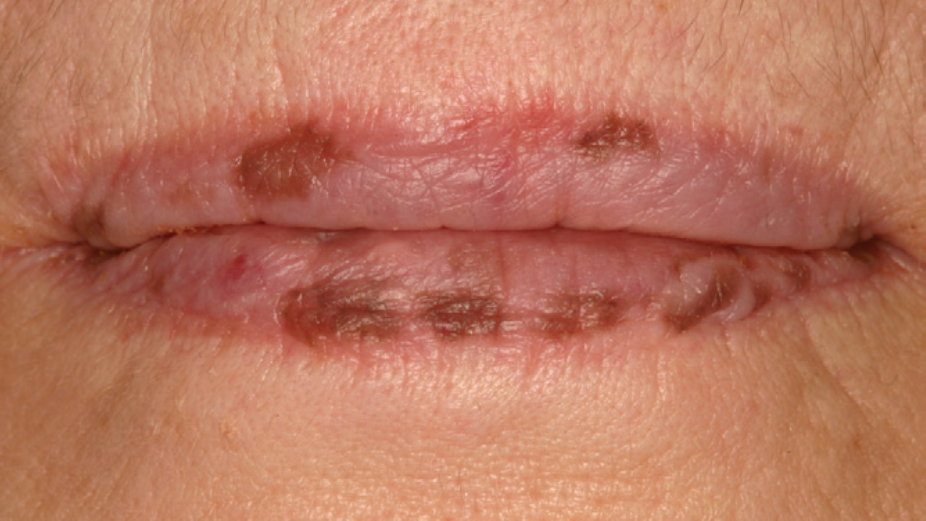
- 130Most common of melanin-producing lesions of the oral cavityMelanotic macule
(> melanocytic nevus > melanoma) - 131Most common location of Malanotic maculesLower lip vermilion
gingiva
hard palatal mucosa - 132Most common cause of multifocal hyperpigmentationMultiple idiopathic melanotic macules
- 133Melanoacanthosis is most common in...young adult, black females
buccal mucosa most common site - 134Melanoacanthosis treatmentunnecessary, but biopsy required for diagnostic purposes
(lesions usually enlarge rapidly over a period of weeks and resolve over a matter of months) - 135Most common causes of lip hyperpigmentationVarix and Melanotic macules
- 136Melanotic vs. MelanocyticMelanotic= excess melanin deposition by melanocytes
Melanocytic= hyperplasia of melanocytes; usually accompanied by excess melanin deposition - 137Melanocytic nevi of the oral cavity -most commonly diagnosed in what decades -most common variantsMuch less common than on the skin; rarity necessitates biopsy
-3rd-6th decades
-Intramucosal and blue nevi - 138What is the 6th most common cancer in North America and the most serious form of skin cancer?Melanoma
- 139Mucosal Melanoma -common or rare? -recurrence rate -overall survival rate-Rare (1-2% of melanomas)
>50% Recurrence
<30% Overall survival - 140Mucosal melanoma of the oral cavity has a predilection for what 2 locations?Gingiva and Hard palatal mucosa (>70%)
Informações
- Descrição
- NDBE Oral Path FlashCards sobre Exam 2, criado por Laura Gennaro em 05-03-2018.
- Criado por
- Laura Gennaro
- Visualizações
- 14
- Avaliação