
Flashcards
Data Link Layer
Flashcards do conjunto (44)
- 1Asynchronous Protocols>Method of Serial Data Transfer
>Treat each character in a bit stream independently
>Use stop and start bits to FRAME data unit
e.g. X Modem or Y Modem - 2Synchronous Protocol>Take whole bit stream and chop it up into characters of equal size
>Faster than asynchronous transmission
>Two types:
Character Orient, Bit Orient - 3Synchronous Protocol {Character Oriented}>Interprets transmission frame as stream of 8-bit characters
>Control info in form of existing char encoding sys E.G:
Char = NUL, ASCII = NULL
Char = WACK, ASCII = DLE;
AD: Easy to comprehend
DIS: Not as efficient as Bit Orient - 4Synchronous Protocol {Bit Orient}>Interpret frame of packet as successions of individual bits made meaningful by placement within frame.
>Control info one or multiple bits - 5Binary Synchronous Communication (BSC)Character Oriented, half-duplex link protocol using stop and wait ARQ flow control, and error correction
Divides frames into two types: Data and Control - 6(BSC) Data frames IUsed to transmit information but may contain control frames relevant to that info
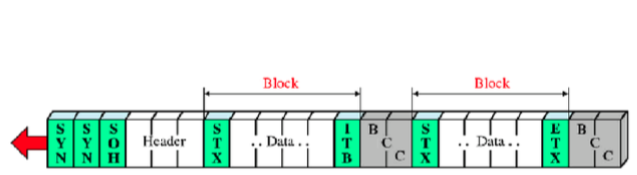
- 7(BSC) Data frames IISYN used by receiver to synch time with sending device
STX tells receiver that next byte starts data until EXT reached
BCC block check count - one-byte, two-byte CRC
Entire thing is block, message divided into multiple blocks
>Each block except last one starts with STX and ends with ITB
>Last one starts with STX and ends with EXT
>All followed by BCB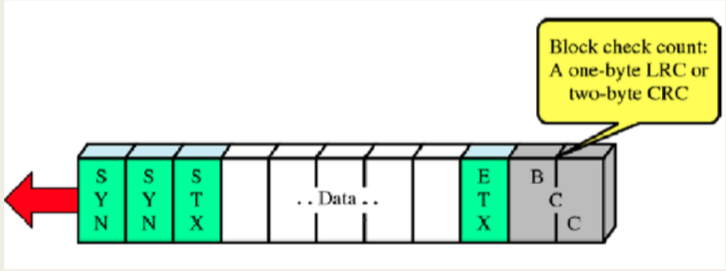
- 8(BSC) Data frames IIIProblems:
>Require address
>SN at least 0 or 1 for stop and wait
>Probability of error increases with block length
>If retransmission required, entire frame must be retransmitted - 9(BSC) Data frames IVMultiblock Frame
>Entire message in one frame
>Several frames can carry continuation of one message
>ETX is in all frames but last, where ETB used instead
>Receiver will ACK each frame separately but cannot take control of link until get EXT. - 10(BSC) Control FramesUsed to exchange info between communicating devices via sending commands or soliciting info from another device
E.g. establish initial connection, control flow of transmission, request err corrections, disconnect device - 11BIT ORIENT PROTOCOLByte Orient - bits organised into predefined patterns (chars)
Bit Orient - more info in shorter frames, sees data stream as no more than a stream of bits with not meaning
Categorised into:
SDLC (Synch Data Link Control)
HDLC (High Level Data Link Control)
LAPs (Link Access Protocol) - 12HDCL - 1DLL protocol that supports half and full duplex over point to point and multi-point links
Systems using HDLC defined by their station types, configs and response mode - 13HDCL - Station Type [Primary]MASTER station, has complete control of links in point to point and multi line configs.
Frames issued by primary stations are called commands. - 14HDCL - Station Type [Secondary]Primary issues commands to secondary, and secondary sends responses.
Primary maintains seperate logical link with each secondary station - 15HDCL - Station Type [Combined]Both issue commands or responses - behave as primary or secondary depending on situation
- 16HDCL - Config Type [Unbalanced] Station types can be connected in three diff configsMaster-slave system where there is one primary and rest secondary
Can be point to point, but more useful in multipoint where 1 primary serves multiple secondary - 17HDCL - Config Type [Balanced]Both stations will be of combined type - connected by single line controlled by either station
- 18HDCL - Config Type [Symmetric]Each physical station consists of two logical stations (primary and secondary)
>Seperate line links primary aspect of physical station to secondary aspect.
>Behaves like unbalanced but control can shift between two aspects - 19HDCL - Data Transfer Mode [NRM]Normal Response Mode
>Use in unbalanced configs - primary initiate data transfer to secondary but secondary may only transmit in response to command - 20HDCL - Data Transfer Mode [ARM]Asynch Response Mode
>Secondary may initiate a transmission without permission from primary when channel is idle.
>All transmissions from secondary must be relayed through primary - 21HDCL - Data Transfer Mode [ABM]Asynch Balance Mode
>All stations are equal so only combined stations connected point to point used.
>Either combined station can initiate transmission without the others perm - 22HDCL - Frame TypesI-Frames: Info frames used to transport user data and related control
S-Frames: used only to transport control
U-Frames: Unnumbered frames reserved for system management (managing the link) - 23—Frame Structures
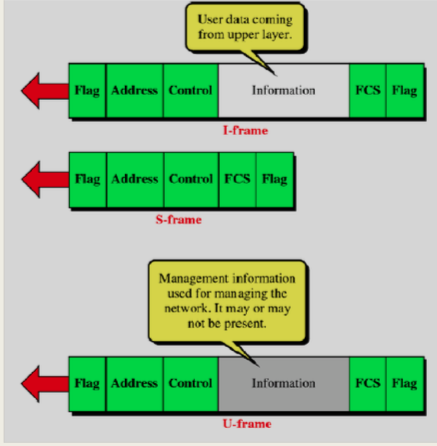
- 24Frame StructureFlag field is 8 bit sequence
Addr Field - [one or several bytes long] contains addr of secondary station to receive frame (not needed for Point to Point Links). If several bytes long, all will end with 0 except end one (1). - 25Frame Structure (cont.)Control Field - one or two byte seg used for flow management
CF = 0 = I-Frame
CF = 10 = S-Frame
First and second bit = 1 then = U-Frame
ALL I/S/U Frames contain P/F bit - 26Frame Structure (cont.)I-Frame
Contain 3-bits flow and error control
Control field contains:
N(S) for SN
N(R) for P/F bits
S-Frame
Control field contains N(R) but not N(S). Do not have N(S) because do not need to transmit data. Two bits proceeding P/F carry error and flow control
U-Frame
Neither N(S) or N(R)
Have two code fields:
>one 2 bits and 3 bits flanking P/F
>These codes identify type of U frame and function - 27Frame Structure (cont.)P/F bit has dual purpose: it means poll when frame is send by primary station to secondary |||| means final frame is sent by secondary to a primary
>Info fields only present in I-frames and U-frames
>FCS [Frame Check Sequence] is error detecting code calculated from remaining bits in frame - 28HDCL - Operations I [Initialisation]>First side or other initialises the DL so that frames may be exchanged properly.
>Initialisation procedure signals the other side that initialisation is requested, and what mode (NRM, etc.), and what bit sequence numbers are used
>If accepted by other side, HDCL module will send UA (unnumbered acknowledgement) frame back to initiating side. If rejected, then DM (Disconnect Mode) frame sent. - 29HDCL - Operations II [Data Transfer]>Two sides exchange user data and the control information to excessive flow.
>Both sides send begin to send user data in I-Frames
>SNs either modulo 8 or modulo 128 depending on whether 3 or 7 bit sequence used.
>RR (Receiver Ready) frame used when no reverse user data to carry acknowledgement.
>RNR (Receiver Not Ready) accepts I-Frames asking the peer entity to suspend transmissions of I-frames.
>REJ (Reject) indicates go back and ARQ, and SREJ (Selective Reject) is used to request retransmission of single frame. - 30HDCL - Operations II [Disconnect]Either HDCL module initiate disconnect.
- 31LAPs [LINK ACCESS PROCEDURE]Has various types, each of which are subnets of HDLC for specific purposes
- 32LAPB [Link Access Procedure Balanced]Used for connecting a station to a network and is subnet of HDLC that provides ABM
- 33LAPD [Link Access Procedure D]>Another subnet of HDLC
>LAPD restricted to ABM and always use -bit SN
>FCS of LAPD always 16bit CRC
>Address field of LAPD is 16 bit field that contains two sub addresses - 34LAPM [Link Access Procedure for Modems]Designed to do asynch to synch conversion, error checking and retransmission
- 35LAPs - LLCLogical Link Control
>Part of standards for controlling operation over LAN
>Link control functions divided between MAC and LLC layers - 36LAPs - LLC format>CRC is 32 bit
>DSAP and SSAP - Destination and Source service access point addresses
>Control field - limited to 7 bit SNs
>Offers three services: connection oriented mode, unacknowledged connectionless and ack's connectionless - 37LAN Access TechniquesLAN is community of users who share interconnecting medium
{MAC} Media Access Control protocol handles this function:
Two types of LAN - broadcast and switched - 38Broadcast and SwitchedBroadcast - all users received transmitted info. Random access control and controlled access contention
Switch - employs forwarding and logic switching tables - 39RANDOM ACCESS ICSMA
Carrier sense multiple access - listens to media and transmits only if no transmissions are already taking place
CSMA/CD
Adds collision detection - if collision occurs, sends jamming signal to cease transmission and waits a RANDOM amount of time before retransmitting - 40ALOHA protocolPurpose of ALOHA is to determine which competing station will get the next chance at accessing the multi access channel at the MAC layer
- 41Pure AlohaUser can transmit at any time but risks collision with other users messages
Transmit and wait (2Tprop) for ACK
Drops all packets after K attempts - 42Slotted AlohaReduces chance of collision by dividing channel up into time slots and user can only send at the beginning of a time slot
- 43Possibilities when channel sensed to be idleCSMA nonpersistent - if idle, transmit; if not, wait random time and re sense
CSMA I-persistent - if busy, continue listening and transmit once idle
CSMA p-persistent - if idle, transmit with probability P - 44—
Informações
- Descrição
- FlashCards sobre Data Link Layer , criado por Eric Wojcik em 09-06-2018.
- Criado por
- Eric Wojcik · jun 2018
- Atualizado
- 9 jun 2018
- Visualizações
- 0
- Avaliação