
Flashcards
IPM_III
Flashcards do conjunto (24)
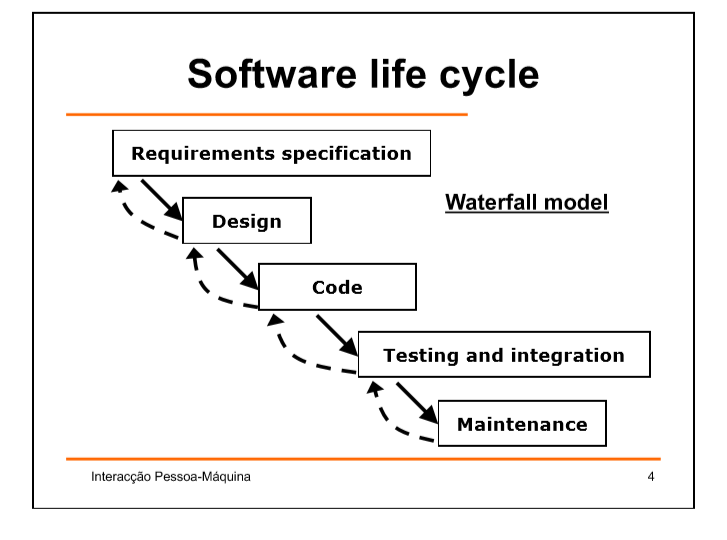
- 1Waterfall Model
- 2Describe the Requirements specification- designer and customer try to establish what should be implemented
- involves collecting information concerning the users and the working environment or domain in which the final product will function
- Use a language that both users and developers understand - 3Mention some important aspects of the working domain- function that the software should perform
- details about the environment in which it must operate
- people it will potentially affect - 4Describe the Design Cycle- Establish how the system should be implemented, in order to fulfill the requirements specification
- Produce an appropriate detailed description of interface design, in order to be implemented in a programming language - 5Why isn´t the Waterfall Model appropriate for interactive systems interface design?- users only participate in the requirements specification and testing
- Late detection of errors causes expensive and long lasting rectifications
- no support for really iterative processes - 6Iterative Design (Spiral Model)
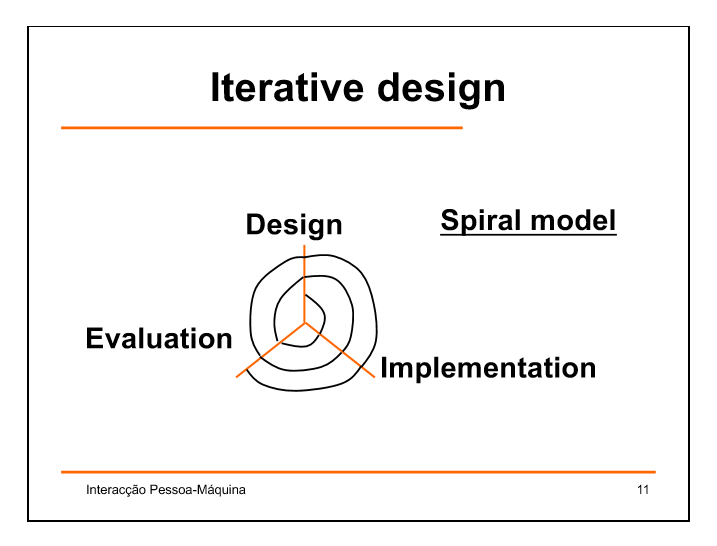
- 7Describe the positive aspects of the spiral Model- First iterations – low cost prototypes (Paralel design of alternatives)
- Subsequent iterations (more elaborated prototypes)
- Every prototype is evaluated (users involved in every iteration)
- More iterations -> better interfaces - 8User - Identify some of the main characteristics one should know about the Users- age, gender, ethnicity
- Education
- Physical abilities
- General computer experience
- Domain experience
- Application experience
- Work environment and social context
- Communication patterns - 9Mention some techniques to obtain this information- Questionnaires
- Interviews
- Observation - 10Task Analysis - What does it consist of?- What users do?
- Why they do it?
- How they do it?
- What they must know?
- What tools they use? - 11What would be a recommended approach for this Analysis?- Identify the individual tasks the system should perform
- What must be done to make it possible? (Pre-Conditions)
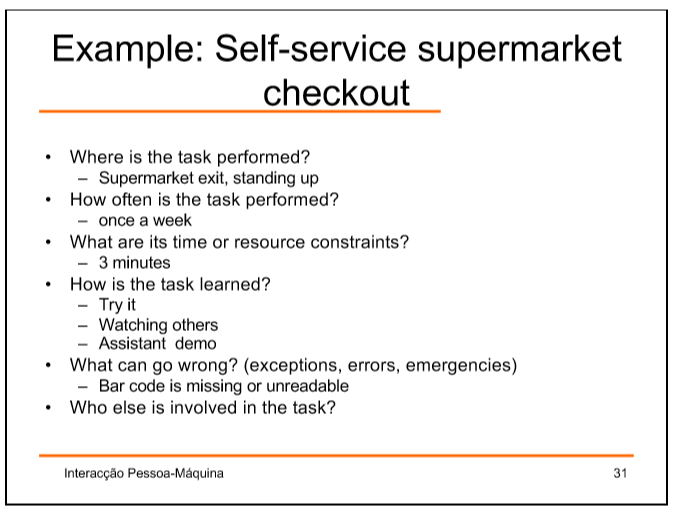
- What steps are involved in doing the task? (Sub-Tasks) - 12Example - Super-Market checkout
- 13Observation- Real environment (animals in a zoo) versus controlled environment (video).
- Passive (watch and hear - record) versus active (ask) - 14Some of the dangers of Direct Observation- Duplicate bad existing procedures
- Failing to capture good existing procedures
!! - Know why they do it and not just what they do - 15Types of Interviews- Structured
- Non structured
- Semi-structured - 16Contextual Inquiry- Combines interviewing and observation in the user's actual work environment, discussing actual work products
- Fosters strong collaboration between the designers and the user
- User shows how and explains (master)
- Interviewer watches and ask questions (Apprentice) - 17Participatory Design- Have access to a pool of representative users.
- Include representative users directly in the design team. - 18Why should you periodically refresh your pool of users?- users become less representative as they understand the proposed system structure
!! - Changing users representative involves spending time explaining the project to new users - 19What are the main information collection techniques for task analysis?- Direct observation
- Interviews with users
- Contextual inquiry
- Participatory design
- Expert advice
- Documentation analysis
- Logging - 20Hierarchical task analysis
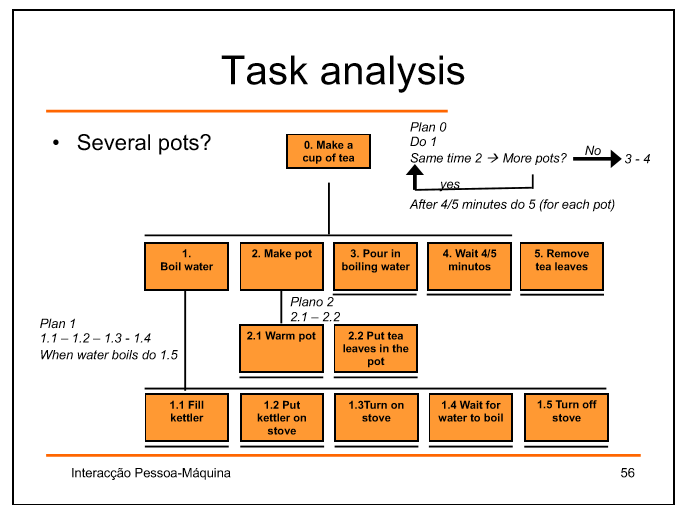
- 21In the context of Hierarchical Task analysis what are the possible types of tasks?- Fixed sequence (plan 2)
- Optional tasks (add sugar as task 6)
- Waiting for events (plan 0 e 1)
- Cycles (plan 0)
- Time-sharing (task 1 and 2 can be done at the same time)
- Discretionary (no imposed order or level of accurancy) - 22Task Scenarios are...narratives that describe:
-Actors;
-Objectives;
-Tools;
-Thoughts/Actions/Events (sequence) to achieve the goals - 23Enunciate some of the benefits of detailing Task Scenarios- Scenarios describing the actual situation may help to define new scenarios
- Provide test cases
- repetitive references to an object or behaviour may suggests its importance or relevance in the context - 24What are some of the Applications of doing Task Analysis- User guide production
- Requirements specification
- Detailed interface design