
Flashcards
Key definitions in GCSE Chemistry
Flashcards do conjunto (26)
- 1What is an atomAn atom is the smallest piece of an element that can exist.
- 2What is the Atomic Number?The number of protons in the nucleus of an atom
is called the atomic number. - 3What is the Mass Number?The number of protons plus the number of neutrons
is called the mass number. - 4What is an Isotope?Atoms of the same element may have different numbers
of neutrons. These are called isotopes. - 5What is Relative Atomic Mass?The mass number of any one atom will be a whole number.
The relative atomic mass is the average mass number
for all of the isotopes of that element. - 6What is the Difference between an Atom and an Ion?If an atom loses or gains electrons it is no longer called an atom.
It is called an ion. An ion has a full outer shell of electrons.
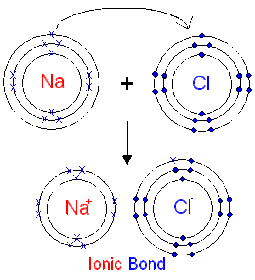
An ion is either positive or negative because it has an electric charge. - 7Show reaction between chlorine and sodium using electron diagramsWhen an atom of chlorine reacts
it will gain one electron from sodium.
The outer shell of chlorine will then
have 8 electrons and be full.
The chloride ion will have an extra electron and
therefore an extra negative charge (shown as a - sign). - 8What is Covalent Bonding?When non-metals react with non-metals they share electrons
and form a covalent bond. Covalent means sharing. - 9What is a Molecule?A molecule is substance containing two or atoms joined by covalent bonds
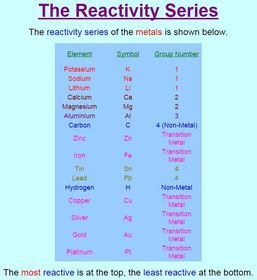
- 10What is the reactivity series
- 11Write the word equation for the reaction between sodium and hydrochloric acidsodium + hydrochloric acid ==> sodium chloride + hydrogen.
- 12What is a displacement reaction?Displacement reaction occurs when a metal takes the place of a less reactive metal in a metal salt solution
Fe(s) + CuSO4(aq) ==> FeSO4(aq) + Cu(s) - 13what is an Anion?Anion is a negatively charged ion
- 14What is Oxidation?Oxidation is a process whereby an atom or ion loses one or more electrons..
- 15what is ReductionReduction is a process whereby an atom or ion gains an electron
- 16O. I. L. R. I. G. stands forOxidation Is Loss, Reduction Is Gain - of electrons.
- 17What is an acid?Any substance that produces Hydrogen ions (protons). Acids have a pH less than 7
- 18In this equation which is the acid? HCl + H20 ==> H30+ + Cl-HCl and H3O+
- 19What is the difference between a STRONG acid and WEAK acid.A Strong acid is completely ionised and all the acid is in the form H+
- 20What is a Mole?Number of Carbon(12) atoms in 12g of C(12)
Value is 6x10(exp23) - 21How many moles sodium in 5g of sodium chloride?Relative formula mass NaCl is 58g
therefore moles=5/58
Answer 0.086 - 22What mass of NaO will be formed by burning 20g in air?moles Na =20/23
4Na + O(2)=2Na(2)O
therefore 1 mole sodium oxide is formed for 2 moles Na = 10/23 moles
RFM Na(2)O = 62
mass Na(2)O formed = 62*10/23
Answer 26.97g - 23What is empirical formulaSimplest proportion of elements in a compound
Molecular compounds it may not necessarily be the same as the the RMM - 24What is Avogadro's LawAvogadro's Law says that the same volume of gas
contains the same number of particles.
It does not matter what gas you have,
they all contain the same number of particles
provided that they are at the same temperature and pressure. - 25Definition of concentration of a SolutionConcentrations can be expressed as
the number of moles in a particular volume
or the number of grams in a particular volume. - 26Formula for converting moles to massmoles = mass ÷ RFM
mass = moles x RFM
RFM = moles x mass
Informações
- Descrição
- CHEMISTRY FlashCards sobre Key definitions in GCSE Chemistry, criado por Ronak Thakrar em 14-11-2014.
- Criado por
- Ronak Thakrar
- Visualizações
- 76
- Tags
- Avaliação