
Flashcards
Further Definitions
Flashcards do conjunto (23)
- 1E8-standard:The E8 standard tests are diagnostic tests that take place every 3 years in the 4th form of AHS in Austria. The three skills listening, reading and writing are tested. The test is not used for grading and only the students have access to their individual results. Teachers can only have a look at the overall results.
- 2Educational standard:An educational standard is a definition of a proficiency level for a certain target group at a certain time. It includes ‘concretely formulated learning results/goals’ that are expressed in the curriculum, with the idea of basic competences at its core. They follow a top-down approach and can be defined for different levels. An example for an educational standard in Austria would be the Maturalevel in English at B2. This standard was not prescribed by Europe but chosen by the Austrian education system.
- 3Common European Framework: = GERS (Gemeinsamer Europäischer Referenzrahmen für Sprachen) = a Competence ModelThe CEFR was designed to provide a “common basis for explicit description of objectives, content and methods” for the study of modern languages, within a wider purpose of “elaboration of language syllabuses, curriculum guidelines, examinations, textbooks, etc.” across Europe.
The CEFR is the basis for the educational standards that describe the expected English proficiency at a certain point. It is used to set standards and based on the communicative language teaching approach. It was published by the Council of Europe, originally for adults, and is a competence model which provides proficiency levels based on the understanding of communicative language competence. In the CEFR the four competences listening, reading, speaking and writing are defined in levels A1 to C2. (Basic User, Independent User, Proficient User (B2 in English = Maturaniveau) - 4Method vs. MethodenMethod vs. Methoden: Language Teaching vs: General pedagogics: slightly different definition
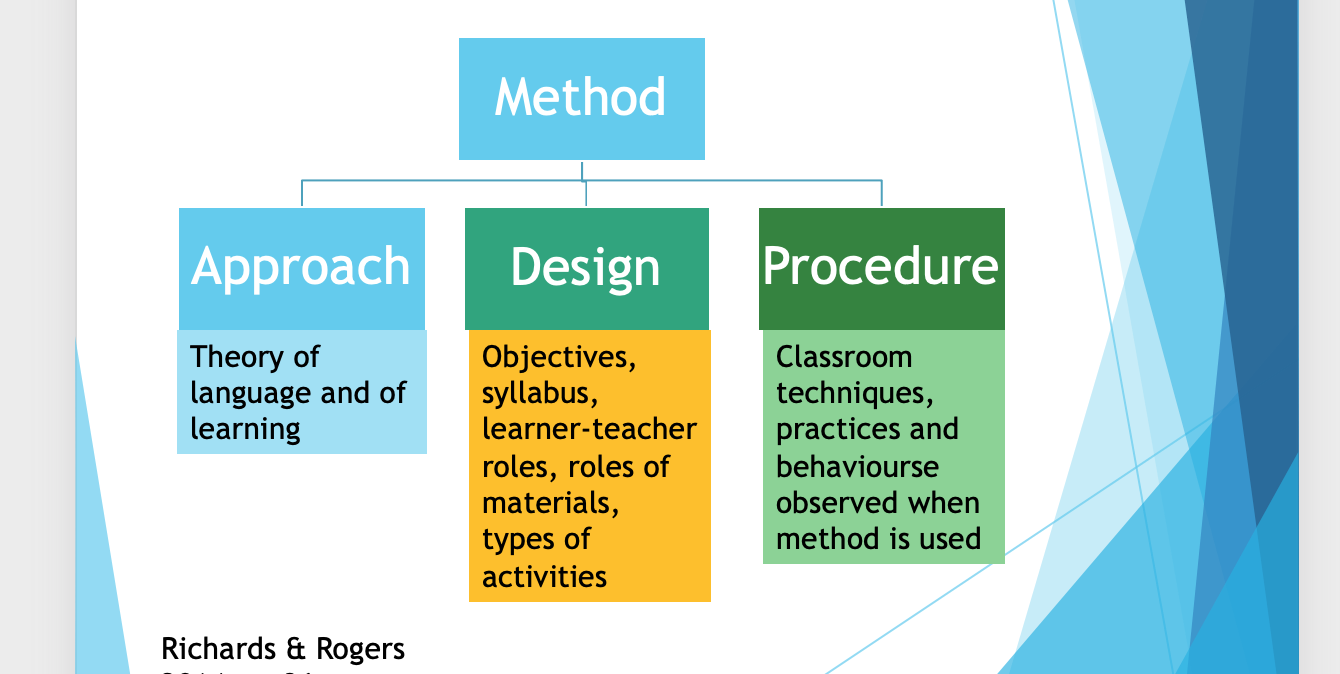
Methodenvielfalt: how to do things (in German and general —> verschiedene Sozialformen, Methodische Zugängen); Wie ich etwas durchführe (how), Gruppenarbeit etc, Powerpoint, Text und Bild - 5in English Language Teaching: Method:Practical realization of an approach & related to approach and design
—> descriptive;
We mean something bigger, more complex:
CLT, how to learn a language, ideas, aims and objectives etc —> more than in general pedagogy
Method: approach + design + procedure - 6TESOLteaching English to speakers with other languages (international association)
- 7Monolingual Principleinstructional use of the target language (TL) to the exclusion of students’ home language (L1), with the goal of enabling learners to think in the TL with minimal interference from the L1.
= direct method - 8arguments FOR multilingual language instruction:● pre-existing knowledge is understood as the foundation of all learning (prior knowledge is encoded in L1)
● Translation skill
● a focus on cognate connections can support knowledge of TL vocabulary
● research supports bilingual dictionary use
● Legitimizing students’ L1 affirms students identities - 9Designoverall instructional design (what kind of rules; instructions that are feasible)
- 10ProcedureStep by step descriptions (macro and micro), sometimes needs to modified quickly, transitions between activities → e.g. Lesson Plan (?)
- 11Approachtheoretical approach: theoretical connecting undermining my language teaching —> theoretical; theory about language and language learning; how you understand language
- 12Methodpractical realization of an approach
- 13Techniquepretty much the same as activities: type of exercise/activity used in language classroom to achieve objectives
- 14Competence BiemansA competence is “the capability of a person (or organization) to reach specific achievements. Personal competencies comprise integrated performance-oriented capabilities, which consist of clusters of knowledge structures and also cognitive, interactive, affective and where necessary psychomotor capabilities, and attitudes and values, which are required for carrying out tasks, solving problems and more generally, effectively functioning in a certain profession, organization, position or role.”
- 15Competence definition more user friendlyA competence consists of multiple skills (abilities to do something). There also exist different levels of competences, for example, the language levels A1 to C2 in English. In Austria the education system has set a standard at the B2 competence level for the Matura. The teaching is also competency-oriented.
- skills are part of a competence (ability to do something)
- origin: industry - efficiency, competence is more like a construct → more than a skill
- since 2007: competency-oriented teaching
- definition by Weinert in German - 16Examples of supporting multilingual students in the linguistically diverse EFL classroom-) Create positive climate for a multilingual classroom (e.g.: my language profile); positive attitude towards diversity
-) If you deal with a linguistically mixed classroom, rely on English as much as possible. Do
not make the learning of English dependent on students’ knowledge of German
-) Acknowledge, value and demonstrate your students’ ability to use more languages
-) Utilize materials that acknowledge students’ cultures and languages (e.g.: posters, signs in classroom)
-) support diversity in the classroom: Acknowledge, value and demonstrate your students ability to learn more languages (e.g.: multilingual text production; design dual language projects; teach dictionary skills → autonomy)
-) Keep a multilingual library (Provide bilingual dictionaries in students’ languages; Encourage students/parents to bring along books and materials in their home language; Assign the English version of these books as a reading task) - 17CLT: Communicative Language Teaching:- meaning over structure (successful communication is more important than grammar) → communicative proficiency rather than a mastery of structures
- Learning language is learning to communicate, and communication must be effective (effectiveness - mastery)
- Misconceptions: Teachers are more challenged
- There is not a real alternative for CLT atm
- CLT is learner-centered and experience-based - 18Methodology: the “how” of teaching, describes classroom practices (Thornbury 2006)
- 19Methods in ELT
- 20LANGUAGE TEACHING METHODSGrammar-Translation Method
Audiolingual Method
Total Physical Response
CLT ... - 21Why do we evaluate methods?-To establish if a method is suitable for teaching English … in a specific context? i.e. for specific learners, for their learning aims, in their culture(s)?
-To understand how a method links in with our knowledge of (language) learning?
-To find a better method – or the ‘best’ method?
-To understand teachers’ actions and their engagement with a particular theory?
-To develop as teachers by engaging with diverse methods? A basis for REFLECTION and comparison - 22Communicatice CompetenceLinguistic competence
Pragmatic competence
Discourse competence
Strategic competence
Fluency - 23—
Informações
- Descrição
- Principles of ELT Methodology FlashCards sobre Further Definitions, criado por Lisza Neumeier em 27-01-2020.
- Criado por
- Lisza Neumeier
- Visualizações
- 0
- Avaliação