
Teaching English as a Foreign or Second Language
866 resources created by 790 users
This Teaching English as a Foreign or Second Language page on GoConqr gathers community-made mind maps, flashcards, flowcharts, slides, notes and quizzes, from SIOP and ESL approaches to teaching listening, songs and ESP. It's built for university students and professional candidates preparing for exams such as oposiciones or TKT, and for teachers after ready-made material. There are over 800 resources here, including more than 700 mind maps, drawn from over 700 contributors. Pick a topic, try a quiz, then see what you can recall.
Select topic
- English Language Learners and Learning Support22
- English Language Teaching Methods and Approaches51
- Communicative Language Teaching12
- Content-Based Instruction, SIOP and CALLA46
- Teaching English to Young Learners15
- Classroom Management and Activities13
- English Teaching Materials and Resources30
- English for Specific Purposes101
- Teaching Listening and Speaking45
- Teaching Reading and Writing7
- Teaching Grammar, Vocabulary and Pronunciation24
- Culture and Intercultural Competence6
- Critical Thinking in English Language Teaching5
Top Teaching English as a Foreign or Second Language resources
-
Mind map Ali Ali is an ELL in grade 3
-
Mind map ESL Approaches & Methods
-
14 cardsTEMA 17: Songs as a poetic vehicle and a literary creation in the English classroom. Types of songs. Techniques of the use of songs for phonetic, lexical and cultural learning. TEMA 17 Definition of songs and poetry
-
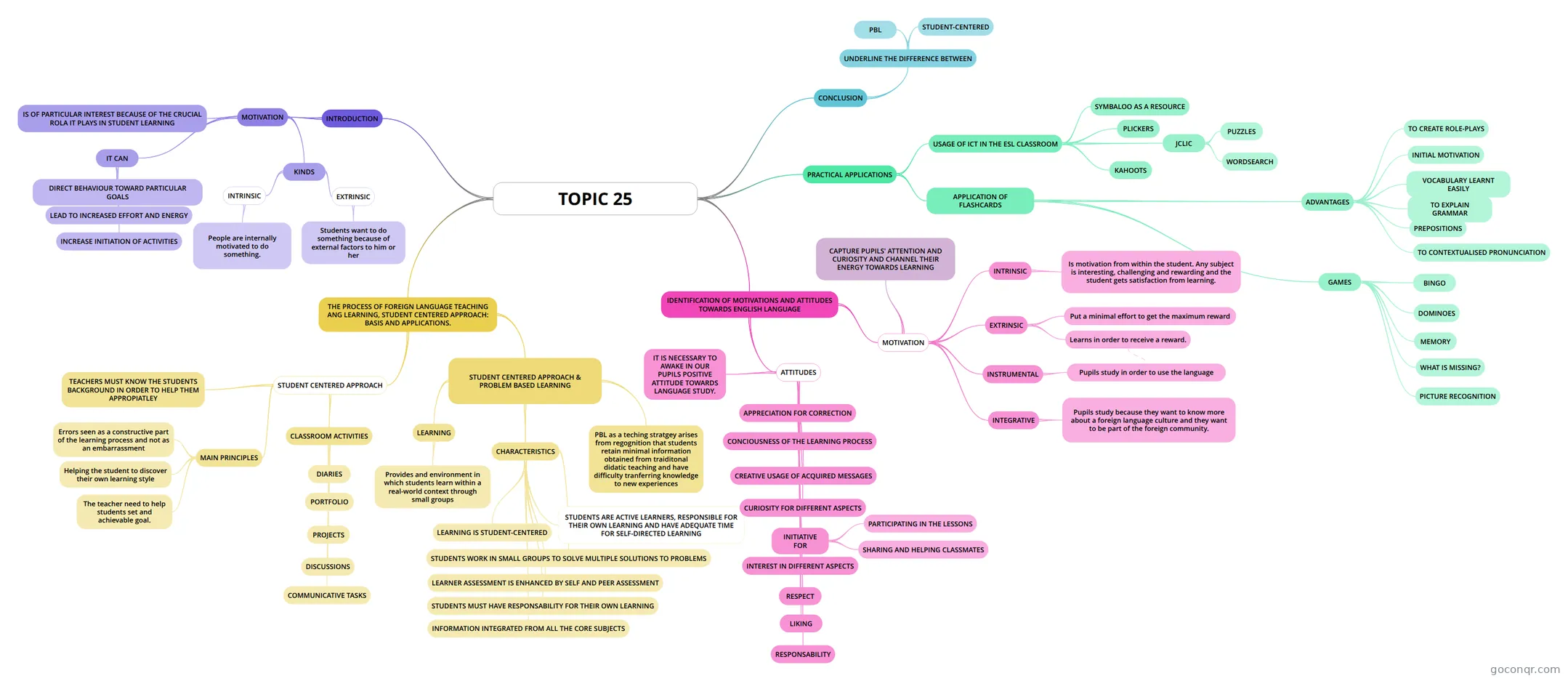 Mind map TOPIC 25
-
Mind map 5 PRINCIPLES FOR SUCCEEDING WITH ADOLESCENT ENGLISH LEARNER Compiled from the article of Scaffolding Success, by Aída Walqui.
-
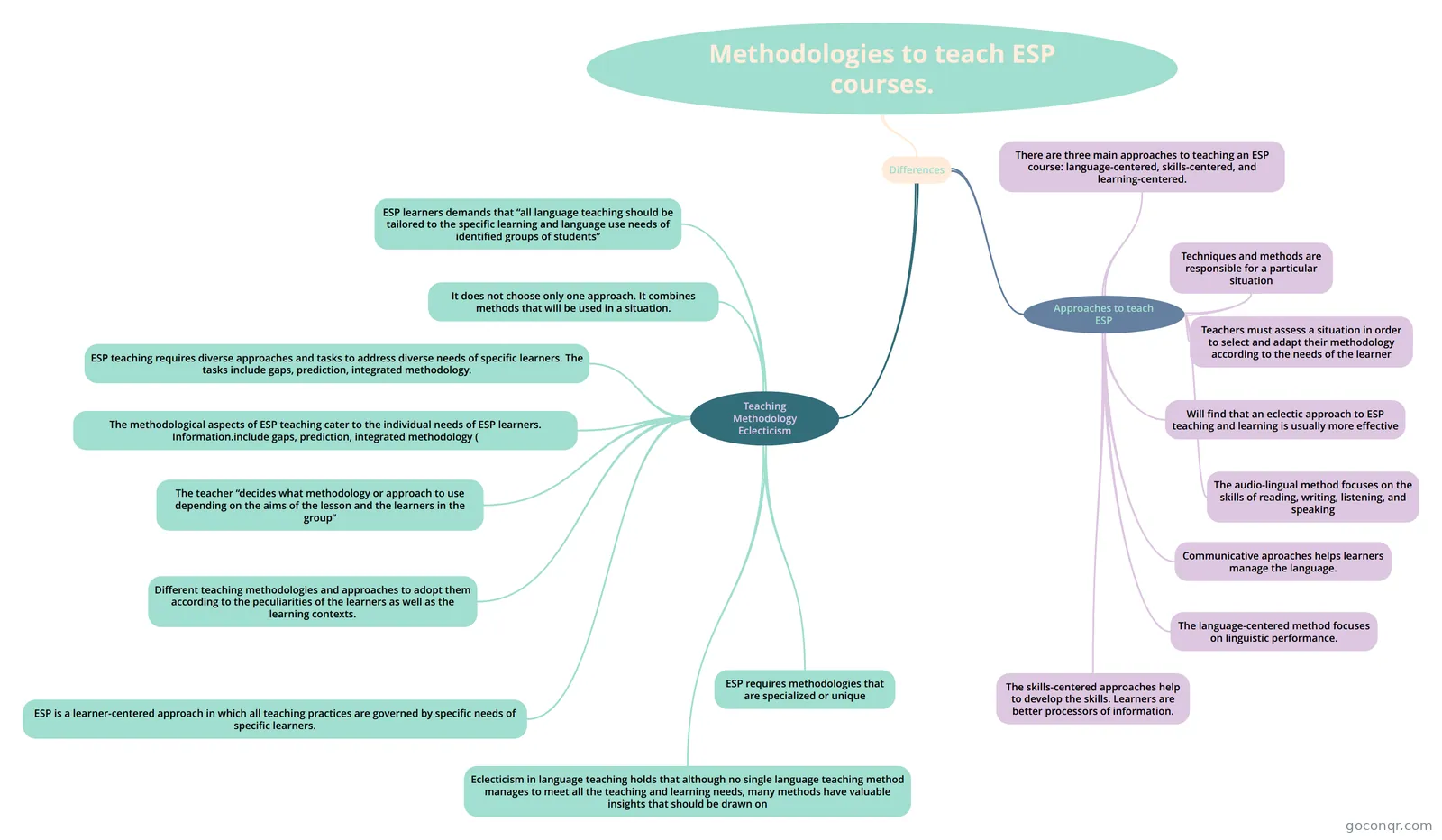 Mind map Methodologies to teach ESP courses. Differences exist in the approaches to teaching ESP courses as you have recently studied in this first part.
-
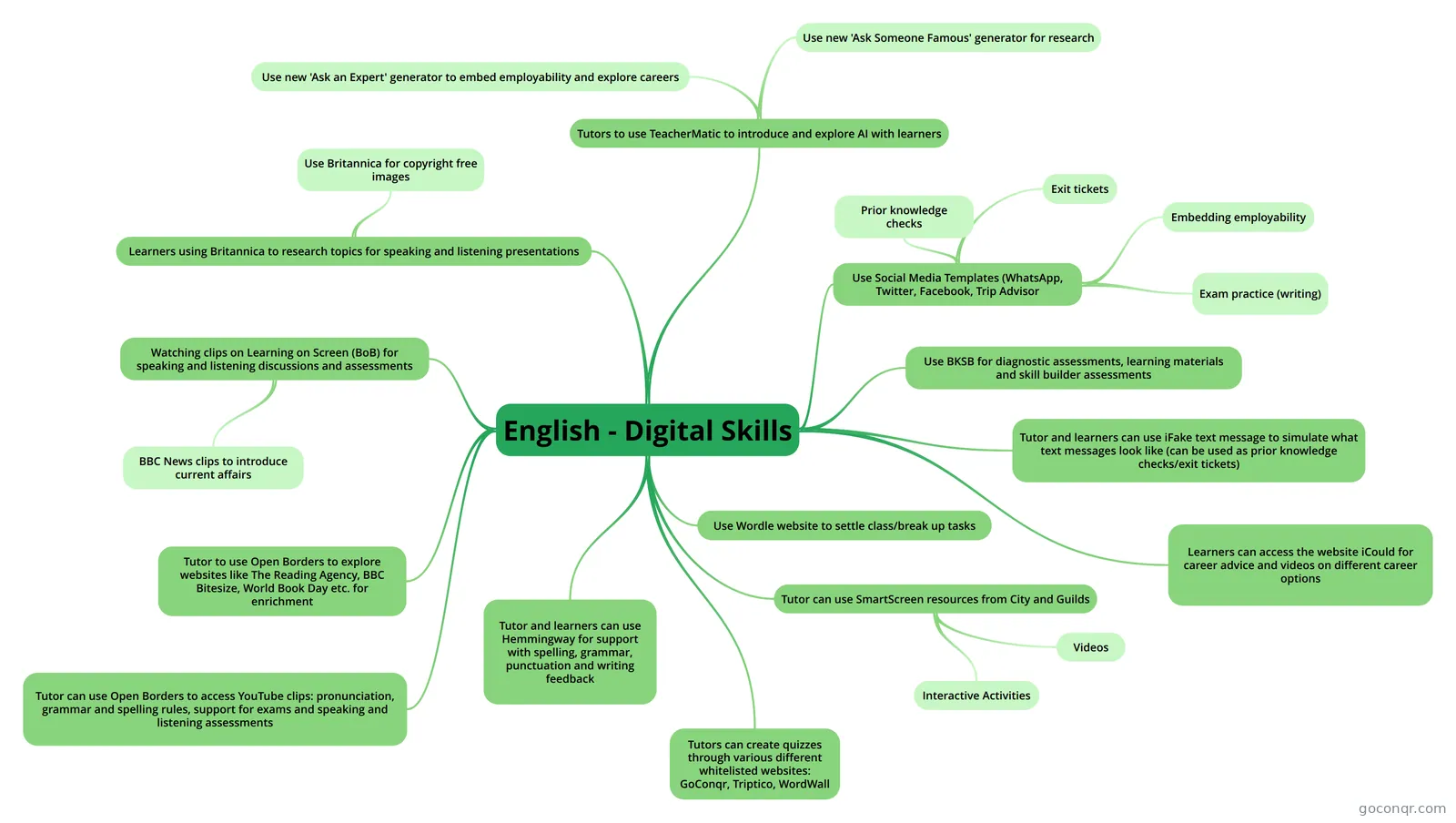 Mind map English - Digital Skills
-
Mind map ESP Mental Map about ESP [English for Specific Purposes]: Its developments and evolution, the different types a...
Quizzes
-
5 questionsThe eclectic approach According to the eclectic approach the parts of the language cannot be isolated
-
21 questions1. Questions
-
5 questionsUnit 4 1. What is the primary goal of Project-Based Learning (PBL) in teaching English as a foreign language?
-
7 questionsUnit 3 1. What is one of the primary focuses of socio-professional factors in TEFL?
-
5 questionsUnit 5 1. Communicative competence consists of which interrelated competencies?
-
14 questionsPEDAGOGICAL AND TECHNOLOGICAL UNIVERSITY OF COLOMBIA DISTANCE STUDIES FACULTY FIRST EVALUATION 8TH SEMESTER SUBJECT: INGLÈS PARA LA EDUCACIÒN SECUNDARIA 1. Organize the following statements
-
5 questionsSIOP Model Quiz What makes the SIOP Model Effective?
-
1 questionsUntitled Which of Ms. Snider's strategies is likely to be most effective in facilitating the English Language Learne...
Mind maps
See all 766 mind maps-
Ali Ali is an ELL in grade 3
-
ESL Approaches & Methods
-
TOPIC 25
-
5 PRINCIPLES FOR SUCCEEDING WITH ADOLESCENT ENGLISH LEARNER Compiled from the article of Scaffolding Success, by Aída Walqui.
-
Methodologies to teach ESP courses. Differences exist in the approaches to teaching ESP courses as you have recently studied in this first part.
-
English - Digital Skills
-
ESP Mental Map about ESP [English for Specific Purposes]: Its developments and evolution, the different types a...
-
Teaching English with Music
Flashcards
See all 21 flashcards-
14 cardsTEMA 17: Songs as a poetic vehicle and a literary creation in the English classroom. Types of songs. Techniques of the use of songs for phonetic, lexical and cultural learning. TEMA 17 Definition of songs and poetry
-
23 cardsFurther Definitions
-
23 cardsState of art Materials development State of Art Materials Development
-
26 cardsEDTE251 Things to Remember (English)
-
11 cardsEffective SIOP Instruction These are the nine different types of Effective SIOP Instructions.
-
17 cardsTEMA 19: Techniques for animation and creativity as a resource for learning FL. Drama in everyday situations and representing tales, jokes, etc. Group work for creative activities. Teacher's role. TEMA 19 Techniques for animation and creativity
-
21 cardsTeaching Listening Techniques How to train your students to develop a listening skill?
-
21 cards1. Cards Approach refers to...
Flowcharts
See all 38 flowchartsNotes
See all 17 notes-
English Language Listening Proficiency Skills SKILL 1.1 - Methods today require an interaction on the part of the listener (nod of the head, etc.) - Listening Journal: the listener summarizes what he/she listened to such as a TV program, a video, mov...
-
Teaching English (ESL Classroom Activities) 08/22/2017 Notes - Games can help adults feel less anxious and enjoy learning, POSITIVE EMOTIONS = RELAXED and CONFIDENT! CHINESE PROVERB: "I hear, I forget. I see, I understand. I do, I remember." -...
-
Methodology - creado desde un Mapa Mental 1. Teaching theories 2. Theories of Learning 12. GRAMMAR
-
WHY USE LITERATURE - creado desde un Mapa Mental Stories as scaffolding Children literature in ELT and ELF classrooms How to choose a story?
-
Skills Teaching & Technology - created from Mind Map Vocabulary Teaching Writing Teaching Grammar Teaching
-
Textbook Analysis. TEXTBOOKS ANALYSIS. Name of Textbook: Primary Communication Box. Target population: Designed to children around 7 - 12 years old (Primary). 1- What sort of approach does the book appear t...
-
How develop skills writing with the technology. - creado desde un Mapa Mental Mobile learning to imporve writing in ESL teaching. Improving writing literacies through digital gaming literacies: Facebook gaming in the composition classroom. A-mobile-based learning tool to improve writing skills ...
-
TEACHING VOCABULARY INTRODUCTION In this summary your will learn and explore the various methodologies that can be incorporated in the teaching vocabulary items in a language classroom, also what are the characteristics, acti...
Slides
See all 15 slidesTopics in Teaching English as a Foreign or Second Language
More Education and pedagogy (incl. teaching methods, curriculum, educational psychology) topics
About Teaching English as a Foreign or Second Language
GoConqr OriginalWhat the page covers
Most of this page is made up of mind maps, and they range widely. Some deal with methods: ESL Approaches & Methods covers CALLA, the Sheltered Method and related approaches, while ESP and the map on methodologies to teach ESP courses look at needs analysis and eclectic teaching. Others look at learners, such as the profile of an eight-year-old newcomer called Ali, or the map on young learners and teenagers.
Where to start
If you want a broad overview first, open ESL Theories or SLA Theories & Processes. Then move to the maps on approaches and methods, which several contributors have made in their own way, so you can compare them.
- Read an overview map of theories and methods.
- Pick a skill, for example the maps on teaching listening or pronunciation.
- Look at a classroom model such as SIOP, which has flashcards, flowcharts and slides.
Exam-focused material
Some resources are clearly written with Spanish oposiciones in mind. The flashcard deck on songs as a poetic vehicle in the English classroom covers types of songs and techniques for phonetic, lexical and cultural learning. Another deck looks at animation, drama and creative group work. The quiz on the eclectic approach is a quick check on how methods can be combined.
Using quizzes and maps together
Read a map first, then take a quiz to see what stuck. If an answer surprises you, go back to the branch it came from. Flashcards are handy for definitions and short lists, such as the difficulties of teaching listening. Flowcharts help you see the order of a process, like the communicative process in the EFL classroom.
Where it fits
This unit belongs to the strand Language Learning and Teaching Approaches, within Education and pedagogy. Choose one resource that matches what you are revising today, and then make a map or deck of your own to fill any gaps.
Frequently asked questions
Which resource should I open first?
For a wide view, try the maps called ESL Theories and SLA Theories & Processes. Then look at ESL Approaches & Methods, which sets out methods such as CALLA and the Sheltered Method. Once you have the big picture, move on to a skill such as listening or pronunciation.
What do the mind maps cover?
They cover approaches and methods, second language acquisition, ESP, teaching listening and speaking, pronunciation, materials, and working with young learners and teenagers. Others describe individual learners, such as Ali, or look at cultures, digital skills and critical thinking in the EFL classroom.
Are there resources for exams?
Yes. Some resources mention oposiciones, oposiciones Inglés and TKT. The flashcard decks on songs and on creative techniques for learning a foreign language are written in that style. Check each resource to see whether it matches your syllabus.
Is there anything on the SIOP model?
Yes. SIOP has its own flashcard decks, flowcharts and slide sets, including effective points of SIOP instruction and the traits of effective SIOP teaching. They are a good way to study one classroom model in several formats.
Are the resources free, and who made them?
Every resource listed here is free to open, study and take, with no account needed. They were made by GoConqr users, not by GoConqr. If you want to save quiz scores or make your own maps, flashcards and notes, you can add a free account.
What if my topic is missing?
Look through the related maps and flowcharts first, as a topic may sit inside a wider resource. If it is still missing, you can make your own mind map, flashcards or quiz and use it for revision.