
Flashcards
SIT772 - SQL 2
Flashcards do conjunto (37)
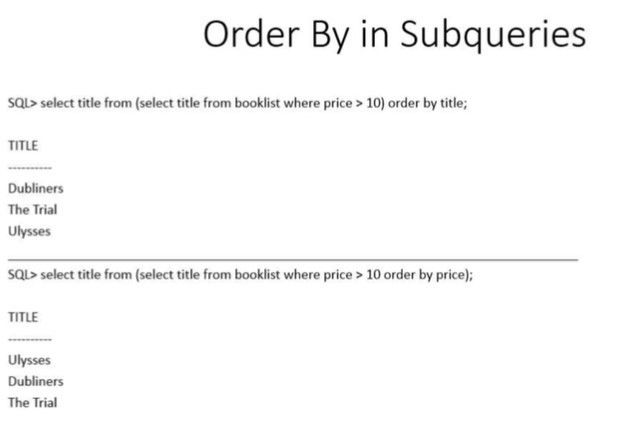
- 1ORDER BY subqueries
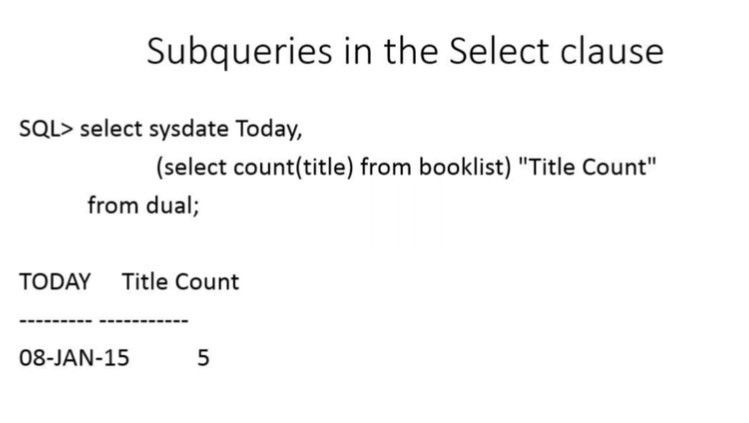
- 2SUBQUERY IN THE SELECT CLAUSE
- 3Which of the following is not a relational database management system? a) Microsoft Office Excel b) IBM DB2 c) Oracle 12c d) Microsoft Accessa) Microsoft Office Excel
- 4Which of the following is not associated with a table? a) Rows b) Spreadsheets c) Datatypes d) Columnsb) Spreadsheets
- 5A row can also be referred to as what? a) a line b) a record c) a column d) a tableb) a record
- 6A query statement does not: a) Begin with the word. b) Retrieve data from the database. c) Exist in the standard SQL database language. d) Retrieve data in rowsc) Exist in the standard SQL database language.
- 7Oracle 12c OCP 1Z0-061 SQL Fundamentals Page 3 Page 3 of 19 Which of the following can SQL can be used for? a) Query the database b) Update, and delete table rows c) Access the database and its objects d) All of the aboved) All of the above
- 8Oracle 12c OCP 1Z0-061 SQL Fundamentals Page 3 Page 3 of 19 Which of the following can SQL can be used for? Query the database Update, and delete table rows Access the database and its objects All of the above Why is Oracle is called an ORDBMS? a) It is an object relational database system. b) It implements all object-oriented systems of a database. c) It is a fully relational database system. d) Features all object-oriented and all relational database features.a) It is an object relational database system.
- 9Once created, which of the following is an object type is available to? a) Java. b) SQL. c) Both A and B. d) Neither A nor Bc) Both A and B.
- 10At a minimum, a SQL query must contain which of the following? a) A SELECT clause and a FROM clause. b) A SELECT clause. c) An SQL clause. d) One or more tables.a) A SELECT clause and a FROM clause.
- 11The DUAL table contains which of the following? a) No rows and no columns. b) One row and no columns. c) No rows and one column. d) One row and one column.d) One row and one column.
- 12What is the title of the column in the DUAL table? a) Square b) Title c) Dummy d) xc) Dummy
- 13What is the DUAL table used for? a) To store date. b) To store frequently used data. c) To act as an index. d) For the performance of SQL operations and calculations.c) To act as an index.
- 14What does SYSDATE return? a) The date on the server. b) The date on the user computer. c) Todays date. d) Tomorrows date.a) The date on the server.
- 15What does CURRENT_DATE return? a) The date on the server. b) The date on the users computer. c) The date in the time zone of the database session making the call. d) The date in the time zone of the database session making the call.c) The date in the time zone of the database session making the call.
- 16Which of the following is a command line tool? a) SQL*Plus b) SQL*Developer c) Both a and b d) None of the abovea) SQL*Plus
- 17Which keyword does NOT begin a SQL statement clause? a) Into b) Select c) Where d) Group bya) Into
- 18A relationship in which one occurrence of an entity is represented by a single occurrence of another entity is called what? a) One-to-one relationship. b) One-to-many relationship. c) Many-to-many relationship. d) All of the above.a) One-to-one relationship.
- 19What is the process of eliminating redundancy and speeding up data retrieval called? a) Objectification b) Justification c) Normalization d) None of the abovec) Normalization
- 20What is the owner of the data dictionary called? a) SYSTEM b) SYS c) OWNER d) None of the aboveb) SYS
- 21What is the collection of all objects owned by a user called? a) Object Collection. b) Owner Pool. c) System. d) Schema.b) Owner Pool.
- 22Which of the following data type is numeric? a) CHAR b) VARCHAR2 c) DATE d) INTEGERd) INTEGER
- 23Which of the following is true? a) All primary keys are unique b) All primary keys are numeric c) All primary keys are ordered numerically d) None of the abovea) All primary keys are unique
- 24What will the DISCONNECT command do? a) Shut down the database. b) Close all tables in the database. c) Cause the computers shut down. d) Disconnect the user issuing the command from the database.a) Shut down the database.
- 25What happens when disconnecting from the database? a) A commit occurs automatically. b) All connected users are disconnected. c) The database is shutdown. d) None of the above.a) A commit occurs automatically.
- 26A table contains a row id for which of the following? a) Column in each row b) Row in each table c) Row in a table d) None of the above.b) Row in each table
- 27Oracle 12c OCP 1Z0-061 SQL Fundamentals Page 13 Page 13 of 19 Which of the following describes an Oracle row id? a) Polynomial. b) Base-64 number. c) 32 digits long. d) All of the above.b) Base-64 number.
- 28What is a ROWNUM? a) The number of rows in a database. b) The number of a row in the order it was returned in a dataset. c) A Base-64 number. d) All of the above.b) The number of a row in the order it was returned in a dataset.
- 29When using the DISTINCT keyword which of the following occurs. a) No values in a column will be displayed. b) No values in a column will be repeated. c) Only repeated values in a column can be displayed. d) No numeric values in a column will be displayedb) No values in a column will be repeated.
- 30Oracle 12c OCP 1Z0-061 SQL Fundamentals Page 14 Page 14 of 19 When using the DISTINCT keyword which of the following occurs. No values in a column will be displayed No values in a column will be repeated Only repeated values in a column can be displayed No numeric values in a column will be displayed What is Oracle 12c syntax for SQL queries based on? a) SQL/86 b) SQL/92 c) SQL/2015 d) None of the abovec) SQL/2015
- 31In SQL*Plus, the following SQL syntax would produce a column header of "name": a) SELECT strName name FROM tblMain; b) SELECT strName.FROM tblMain; c) SELECT strName:name FROM tblMain; d) None of the above.a) SELECT strName name FROM tblMain;
- 32SELECT age name FROM tblMain WHERE age = 21; This query shows what type of join? a) Inner join b) Outer join c) Non- equijoin d) Equijoind) Equijoin
- 33WHERE tblOne.Column1 = tblTwo.Column2(+). The above syntax would come from a: a) Left outer join b) Right outer join c) Inner join d) Equijoinb) Right outer join
- 34To return all rows from joined tables, including null values on either side of the join, use a: a) Left outer join b) Right outer join c) Full Outer Join d) Left Right Joinc) Full Outer Join
- 35One could use the following function to determine the number of characters in a string: a) CONCAT b) LOWER c) NITCAP d) LENGTHd) LENGTH
- 36Which function appends two strings? a) APPEND(x, y) b) CONCAT(x, y) c) JOIN(x,y) d) None of the aboveb) CONCAT(x, y)
- 37In the numeric column, tons received, what would the COUNT() function return? a) The total of the tons received. b) The total number of rows returned. c) The total columns containing tons_received. d) None of the aboveb) The total number of rows returned.
Informações
- Descrição
- Oracle SQL FlashCards sobre SIT772 - SQL 2, criado por Amber Saxon em 11-02-2020.
- Criado por
- Amber Saxon
- Visualizações
- 2
- Avaliação