
Flashcards
integument
Flashcards do conjunto (51)
- 1primary functions of the integumentary system1. protection
2. other barrier (from UV rays, chemicals)
3. metabolic (synthesize vit D, aids in calcium absorption, produces enzymes)
4. cutaneous sensation
5. thermoregulation
6. non-verbal communication - 2minor functions of the integumentary system1. blood reservoir (can hold up to 33% of the body's blood)
2. excretion (water, NaCl, ammonia, urea, uric acid) - 3merkel receptorexteroceptor that responds to lite pressure
- 4meissner's corpusclesexteroceptor that responds to:
vibration
lite touch & pressure
tactile sensation (distinguishing btwn 1 or 2 touches) - 5pacinian corpusclesexteroceptor that responds to deep pressure
- 6ruffin cylinderexteroceptor that responds to stretching of the skin
- 7free nerve endingsexteroceptor that responds to pain, temp, and irritation (such as itching)
- 8cells that make up the epidermiskeratinocytes
stem cells
melanocytes
dendritic cells
exteroreceptors - 9keratinocytessynthesize keratin (protein that gives the epidermis its super tough protective properties)
found in the majority of the epidermis - 10stem cellsundifferentiated cells that turn into keratinocytes
found in the stratum basale - 11melanocytessynthesize the melanin pigment and continually shed melanosomes from their tips (look like spiders)
found in the stratum basale - 12dendritic cells (aka Langerhans cells)act as a biological barrier against toxins, microbes, and other pathogens (look like stars)
found in the middle 2 layers of the epidermis (anywhere you have stratified squamous tissue) - 13exteroreceptors (tactile cells)associated with nerve fibers
found in the stratum basale (there are few) - 14layers of the epidermissuperficial
I
stratum corneum
stratum lucidum
stratum granulosum
stratum spinosum
stratum basale
I
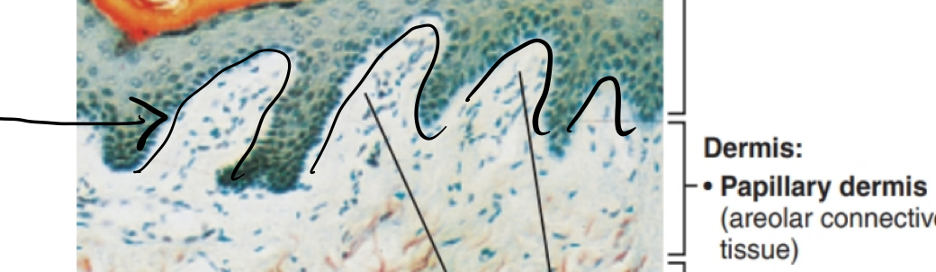
deep - 15stratum corneum20-30 layers thick (contains dead keratinocytes)
contain: keratin & proteins (that protect against abrasion) and glycolipids (make it waterproof) - 16stratum lucidumOnly found in THICK SKIN (soles of feet and palms of hands)
it looks like a clear layer
contains a few layers of dead keratinocytes - 17stratum granulosum1-5 layers thick
this is where keratinocytes undergo keratinization (filling up with keratin)
has an accumulation of granules including keratohyaline and lamellar (helps maintain waterproofness) -- these give it its dark appearance - 18stratum spinosum"prickly" layer that is around 5 layers thick
contains adult keratinocytes and dendritic cells - 19stratum basalebase of the epidermis (deepest layer) that is a single row of stem cells (that turn into keratinocytes) and melanocytes
- 20layers of the dermispapillary
reticular - 21papillary layercontains loose areolar connective tissue and has dermal papillae
- 22reticular layermakes up 80% of the dermis
contains dense irregular connective tissue
this layer causes "flexure lines" where skin cannot easily slide (crease in elbow, folds on hands) - 23primary features of the hypodermisadipose & areolar connective tissue
NOT technically part of the skin
it is not uniformly distributed (different amounts of hypodermis can be found in different parts of the body) - 24primary feature of the epidermisepithelial cells
is part of the skin - 25primary feature of the dermisdense connective tissue that is vascularized (contains blood)
is part of the skin
the boundary btwn dermis and hypodermis is NOT distinct - 26primary functions of the hypodermisprotection
storage
insulation
anchors the skin to the underlying structures (ex: muscles) - 271st degree burnminor burn (sunburn)
damages the epidermis - 282nd degree burndamages the epidermis AND dermis
causes blistering and gets rid of hair - 293rd degree burndamages the epidermis, dermis, AND hypodermis (subcutaneous tissue)
- 30factors that contribute to skin colormelanin (red, yellow, brown, black pigments)
carotene (yellow/orange pigments that accumulate in stratum corneum)
hemoglobin (pigment in red blood cells) - 31cyanosisblue discoloring of the skin
happens when hemoglobin is poorly oxygenated - 32erythemapink discoloring of the skin
is emotional related: embarrassment
or can be caused by fever, inflammation, infection - 33pallor (blancing)white discoloring of the skin
can be caused by emotional stress, low BP, or anemia - 34jaundiceyellowing of the skin
caused by a buildup of bilirubin and can indicate issues with the liver - 35ecchymosesbruising of the skin (different colors)
results from damage to the surrounding tissues and blood vessels - 36function of hairsense particles on the skin
(found everywhere except palms/soles, nipples, lips, some parts of genitalia) - 37structure of hair roots3 layers:
medulla
cortex
cuticle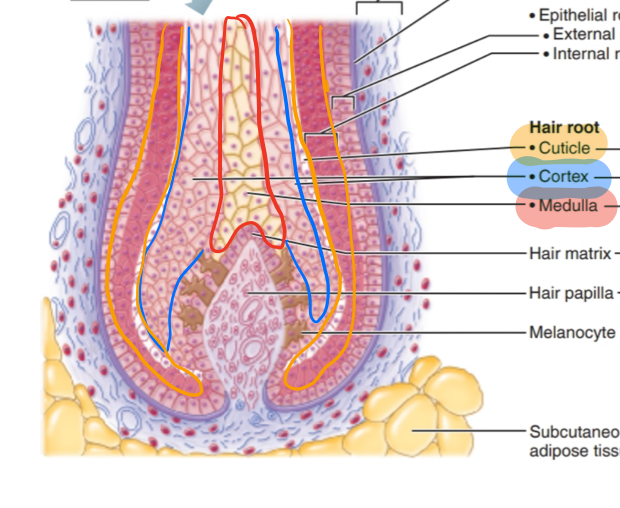
- 38structure of hair follicleat the bottom is the hair bulb (what holds the hair down) which contains the hair follicle receptor and hair papilla
the outer walls are formed by the dermis and epidermis and have 3 layers (out to in):
1. peripheral connective sheath
2. glassy membrane
3. epithelial root sheath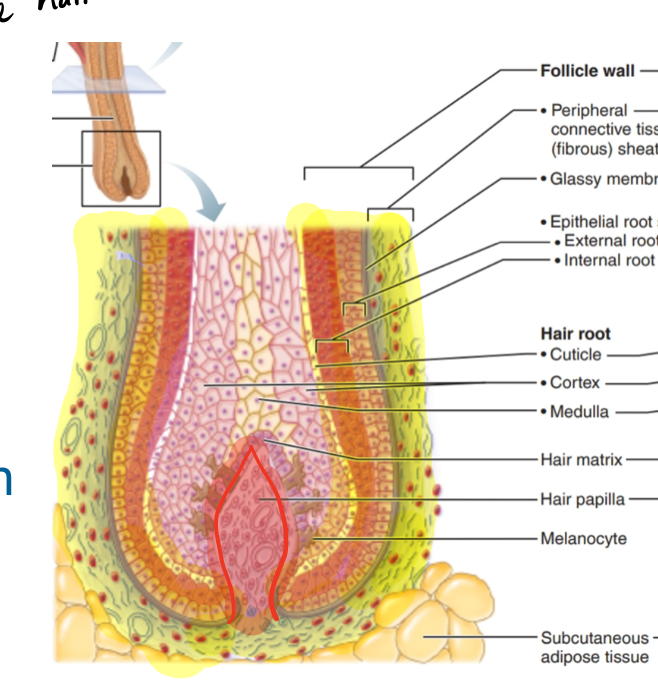
- 39Arrector Pili mmsmooth muscle that produces goose bumbs and releases sebum (oil)
there is one Arrector Pili connected to every hair - 40structure of nailsnail root- the embedded portion (we cant see this)
nail plate- visible portion of nail (that we get painted)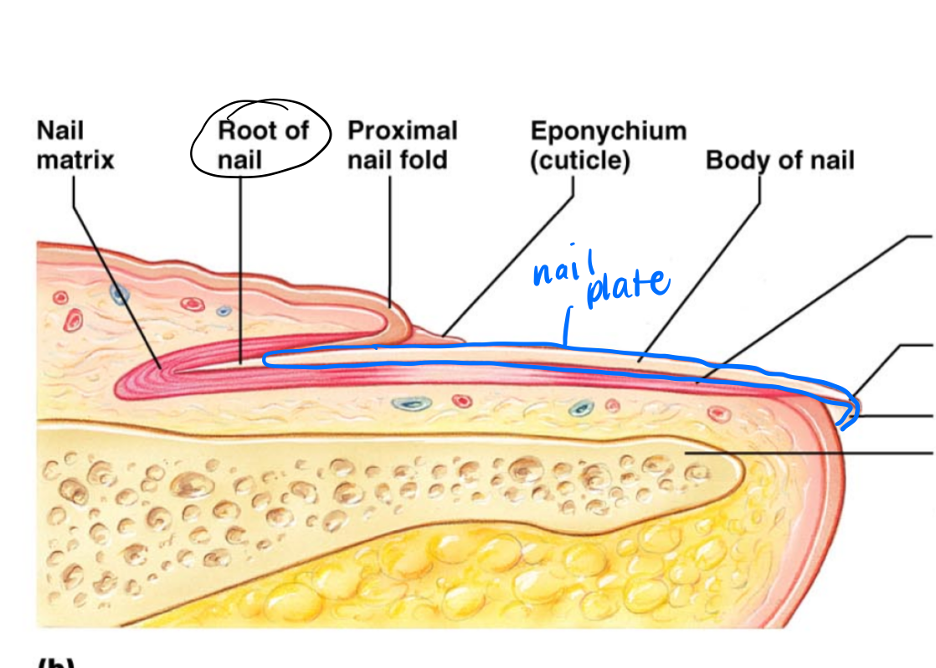
- 41features of nailsconsists of hard keratin
appear pink because they are full of rich capillaries (blood) - 42types of sweat glandseccrine and apocrine
- 43features of eccrine glandsuse merocrine secretion method and secrete to the skin's surface
located everywhere but mainly places that get sweaty (palms, soles, forehead) - 44function of eccrine glandstemperature control
- 45features of apocrine glandsuse merocrine method of secretion to secrete to the upper part of the hair follicle
located in armpits, anus, genitals
include ceruminous glands (secrete earwax) and mammary glands (secrete milk) - 46function of apocrine glandsact as sexual scent glands
- 47features of sebaceous glandsuse holocrine secretion method and secrete to the upper part of the hair follicle
located everywhere except palms and soles - 48functions of sebaceous glandslubricate skin and hair
help prevent water loss
antibacterial properties - 49key characteristics of basal cell carcinomamost common type that is characterized by dome shaped nodules with a central ulcer
located in areas with high exposure to the sun: face, hands, etc. - 50key characteristics of squamous cell carcinomasecond most common type that is characterized by scaly red papule (rash)
this type grows rapidly but responds well to treatment
located on scalp, ears, lips, hands - 51key characteristics of melanomamost dangerous type that is characterized by a brown/black patch
a third begin from preexisting moles
spreads very easily
Informações
- Descrição
- AP KAAP309 FlashCards sobre integument , criado por Erin Dacey em 12-09-2021.
- Criado por
- Erin Dacey
- Visualizações
- 1
- Avaliação