
Flashcards
04Handout 01
Flashcards do conjunto (36)
- 1is an interconnection of electrical components. These electrical components include resistors, inductors, capacitors, generators (or sources), transformers, diodes, transistors, and many more.electrical circuit
- 2It is a special way of expressing very large or very small numbers. It is scientifically used to represent accuracy and precision of data in decimal form.Scientific Notation
- 3is an international measurement language and a basis of standard of measurement that some countries follow for quantity and counting purposes. This particular system of units can be derived into other measurable units through combination and/or formulation.International System of Units (SI)
- 4Quantity Basic Unit Symbol Length ____ ___ Mass __ __ Time ___ __ Charge __ __ Temperature ___ __ Luminous Intensity __ __Quantity Basic Unit Symbol
Length Meter 𝑚
Mass Kilogram 𝑘𝑔
Time Second 𝑠
Charge Coulomb 𝐶
Temperature Kelvin 𝐾
Luminous Intensity Candela 𝐶𝑑 - 5Quantity B.U Symbol Equivalent Force __ ___ __ Work/Energy __ ___ __ ElectricCurrent __ ___ __ Power __ ___ __Quantity B.U Symbol Equivalent
Force Newton 𝑁 𝑘𝑔 • 𝑚/𝑠²
Work/Energy Joule 𝐽 𝑘𝑔 • 𝑚²/𝑠²
ElectricCurrent Ampere 𝐴 𝐶/s
Power watt 𝑊 𝑘𝑔 • 𝑚²/𝑠³ - 61) 600,000 𝑚 -> km and mm1) 600,000 𝑚 = 600 × 103 𝑚
= 600 𝑘𝑚
= 600,000 × 103 𝑚
= 600,000,000 𝑚𝑚 - 72) 0.279 𝐿𝑖𝑡𝑒𝑟𝑠 -> ml2) 0.279 𝐿𝑖𝑡𝑒𝑟𝑠 × 1000 𝑚𝐿 = 279 𝑚𝐿
- 83) 126.8 𝑘𝑔 -> g3) 126.8 𝑘𝑔 = 126.38 × 10³ 𝑔𝑟𝑎𝑚𝑠
= 126,380 𝑔𝑟𝑎𝑚𝑠 - 91) How much force is needed to move a 7 𝑘𝑔 mass by 9.8 𝑚/𝑠2?𝑭 = 𝒎𝒂
𝐹 = 7 𝑘𝑔 × 9.8 𝑚 = 68.6 - 102) What is the equivalent power if 25 𝐽 of work is done for 10 𝑠?𝑷 =E/ 𝒕
𝑃 = 25 𝐽/10 𝑠 = 2.5 𝑊 - 11Elements of an Atom • Atom – • Proton – • Neutron – • Electron –Elements of an Atom
• Atom – the basic unit of matter; can be built up into elements
• Proton – positively charged particle
• Neutron – neutral charged particle
• Electron – negatively charged particle - 12is a fundamental property of matter to describe force interactions among particles. measured in coulombs (C).Electric charge
- 13two kinds of chargepositive and negative.
- 14formula for the charge of an electron𝒆 = −𝟏. 𝟔𝟎𝟐 × 𝟏𝟎−𝟏𝟗 𝑪.
- 15the current in movement corresponding to time.charge
- 16formula used to find the charge whenever current𝑸 = 𝑰𝒕 (𝑪𝒉𝒂𝒓𝒈𝒆 = 𝑨𝒎𝒑𝒆𝒓𝒆 × 𝑻𝒊𝒎𝒆 𝒊𝒏 𝑺𝒆𝒄𝒐𝒏𝒅𝒔)
- 17• It is the time rate of change of charge measured in amperes (𝐴). • Whenever there are unlike charges transferred into a conductive medium, there is movement of charge. Thus, it creates ___.electric current
- 18Current equivalent𝒊 ≜ 𝒅𝒒 , in which 1 𝐴 = 1 𝐶𝑜𝑢𝑙𝑜𝑚𝑏/𝑠𝑒𝑐
- 19types of electric currentalternating current and direct current
- 201) What current must flow if 0.24 𝐶𝑜𝑢𝑙𝑜𝑚𝑏𝑠 is to be transferred in 15 𝑚𝑠?𝑰 = 𝑸/𝒕= 0.24 𝐶 / 15 × 10−3 𝑠𝑒𝑐= 16 𝐴
- 212) If a current of 10 𝐴𝑚𝑝𝑠 flows for four (4) minutes, find the quantity of electricity transferred.𝑸 = 𝑰𝒕
= 10 𝐴 × (4 min×60 𝑠𝑒𝑐/1 𝑚𝑖𝑛)
𝑄 = 2400 𝐶 - 22measure the distance of the flow in which energy transfer is exerted. This energy transfer, or work, is performed by an __external electromotive force (emf).
- 23is the energy required to move a unit charge from a reference point (−) to another point (+),Voltage/potential difference
- 24volt formula𝐯 ≜ 𝒅𝒘/𝒅𝒒.
𝑉 = J/𝐶 - 251) Moving charge 𝑞 from point 𝑏 to point 𝑎 requires 25 𝐽. Find the voltage drop 𝑣𝑎𝑏 (the voltage at 𝑎 positive with respect to 𝑏) if (a) 𝑞 = 5 𝐶 and (b) 𝑞 = −10 𝐶.(a) 𝑉 =25 𝐽/ 5 𝐶= 5 𝑣
(b) 𝑉 = 25 𝐽 = −2.5 𝑣 - 262) An energy source forces a constant current of 2 𝐴 for 10 𝑠 to flow through a light bulb. If 2.3 𝑘𝐽 is given off in the form of light and heat energy, calculate the voltage drop across the bulb.𝑸 = 𝑰𝒕
𝑄 = 2𝐴 × 10𝑠 = 20 𝐶
𝑽 = ∆𝒘/∆𝒒
𝑉 = 2.3 𝑘𝐽/20C = 115 𝑉 - 27• This confirms the fact that the total power supplied to the circuit must balance the total power absorbed. capacity to do work measured in joules (𝐽).Energy
- 28is the time rate of expending or absorbing energyPower
- 29Power formulaP = dw/dt = dw/dq x dq/dt = vi
- 30states that charge can neither be created nor destroyed, only transferred.law of conservation of charge
- 31states that energy cannot be created nor destroyed, must be obeyed in any electric circuit.law of conservation of energy
- 32A mass of 1000 𝑘𝑔 is raised through a height of 10 𝑚 in 20 𝑠. What is a) the work done and b) the power developed? (Earth’s gravitational acceleration = 9.81 𝑚/𝑠².)a.) 𝑭 = 𝒎𝒂
𝐹 = 1000 𝑘𝑔 × 9.81 𝑚/𝑠2
𝐹 = 9,810 𝑁
𝑾 = 𝒇𝒅
𝑊 = 9,810 𝑁 × 10 𝑚
𝑊 = 98,100 𝑁𝑚 𝑜𝑟 98.1 𝑘𝐽
b.) 𝑷 = 𝑾/𝒕
=98.1𝑘𝐽/20 𝑠
𝑃= 4,905 𝑤𝑎𝑡𝑡𝑠 𝑜𝑟 4.905 𝑘𝑊 - 33different elements or components which make up a device or a system. These elements or components are the basic building blocks of a circuit.Circuit Elements
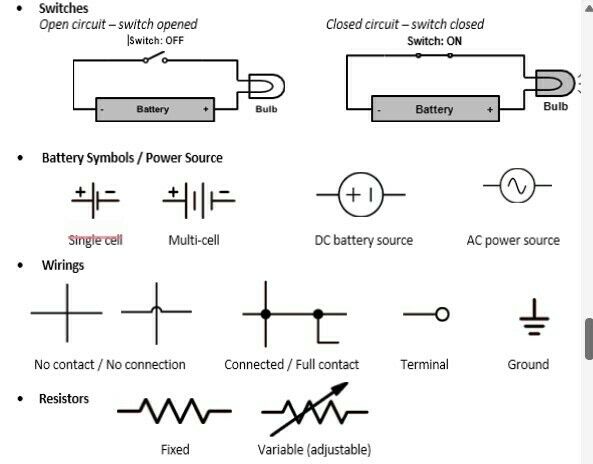
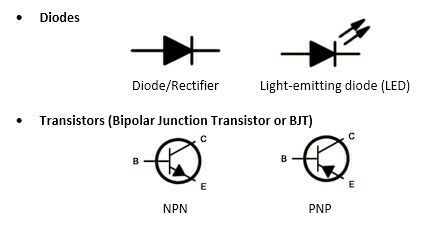
- 34is a simplified graphical representation of components or elements in a system of circuits.Circuit Diagram or Schematic
- 35• Switches Open circuit Closed circuit • Battery Symbols / Power Source Single cell Multi-cell DC battery source AC power source • Wirings No contact / No connection Connected / Full contact Terminal Ground • Resistors Fixed Variable (adjustable)
- 36• Diodes Diode/Rectifier Light-emitting diode (LED) • Transistors (Bipolar Junction Transistor or BJT) NPN PNP
Informações
- Descrição
- normal Robot Dynamics Fundamentalss FlashCards sobre 04Handout 01, criado por Eljin Aguilar em 03-03-2025.
- Criado por
- Eljin Aguilar
- Visualizações
- 0
- Avaliação