
DC Circuits and Circuit Analysis
174 resources created by 128 users
This DC Circuits and Circuit Analysis page on GoConqr gathers community-made quizzes, mind maps, flashcards, slide sets and notes, from resistor colour codes and Ohm's law to Kirchhoff's laws, Thevenin and Norton, and inductors and capacitors. It's built for university students and professional candidates, school students, and teachers after ready-made material. There are over 150 resources here, including more than 30 quizzes and over 50 mind maps, from school level to university. Pick a topic, try a quiz to find your gaps, then revise with the maps.
Select topic
- Electric Charge, Current, Voltage and Power11
- Circuit Symbols and Diagrams11
- Circuit Components and Power Sources8
- Resistance and Resistors9
- Ohm's Law and Kirchhoff's Laws8
- Series and Parallel Circuits15
- Circuit Theorems7
- Inductors and Inductance12
- Capacitors and Capacitance5
- Differentiation and Integration in Circuits10
- Electrical Loads and Control9
- AC Circuits and Transformers14
Top DC Circuits and Circuit Analysis resources
-
35 questionsCURRENT ELECTRICITY What are the minimum requirements to cause the flow of current?
-
23 cardsResistance (Mod. 1 pt6) Resistance flashcards....
-
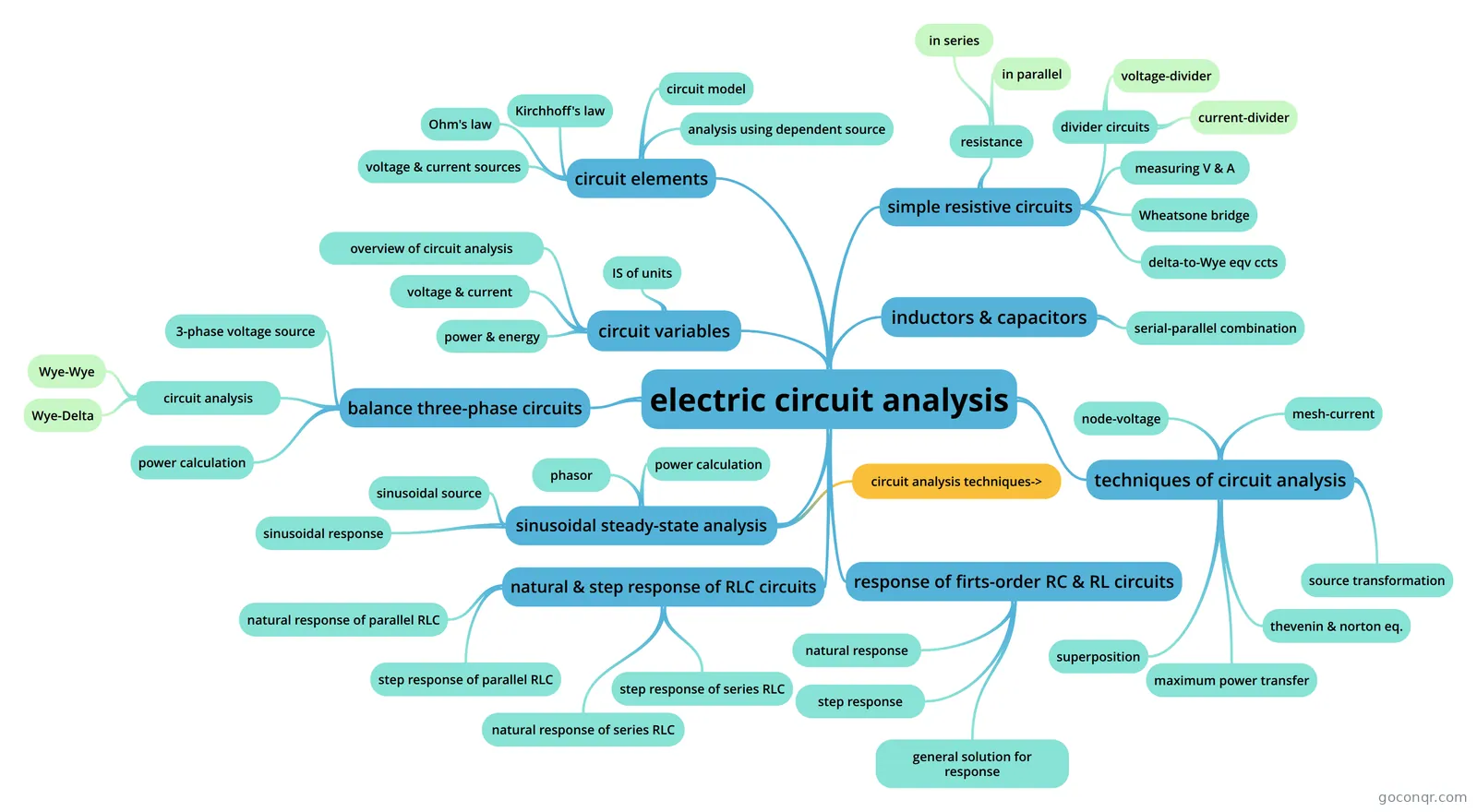 Mind map electric circuit analysis
-
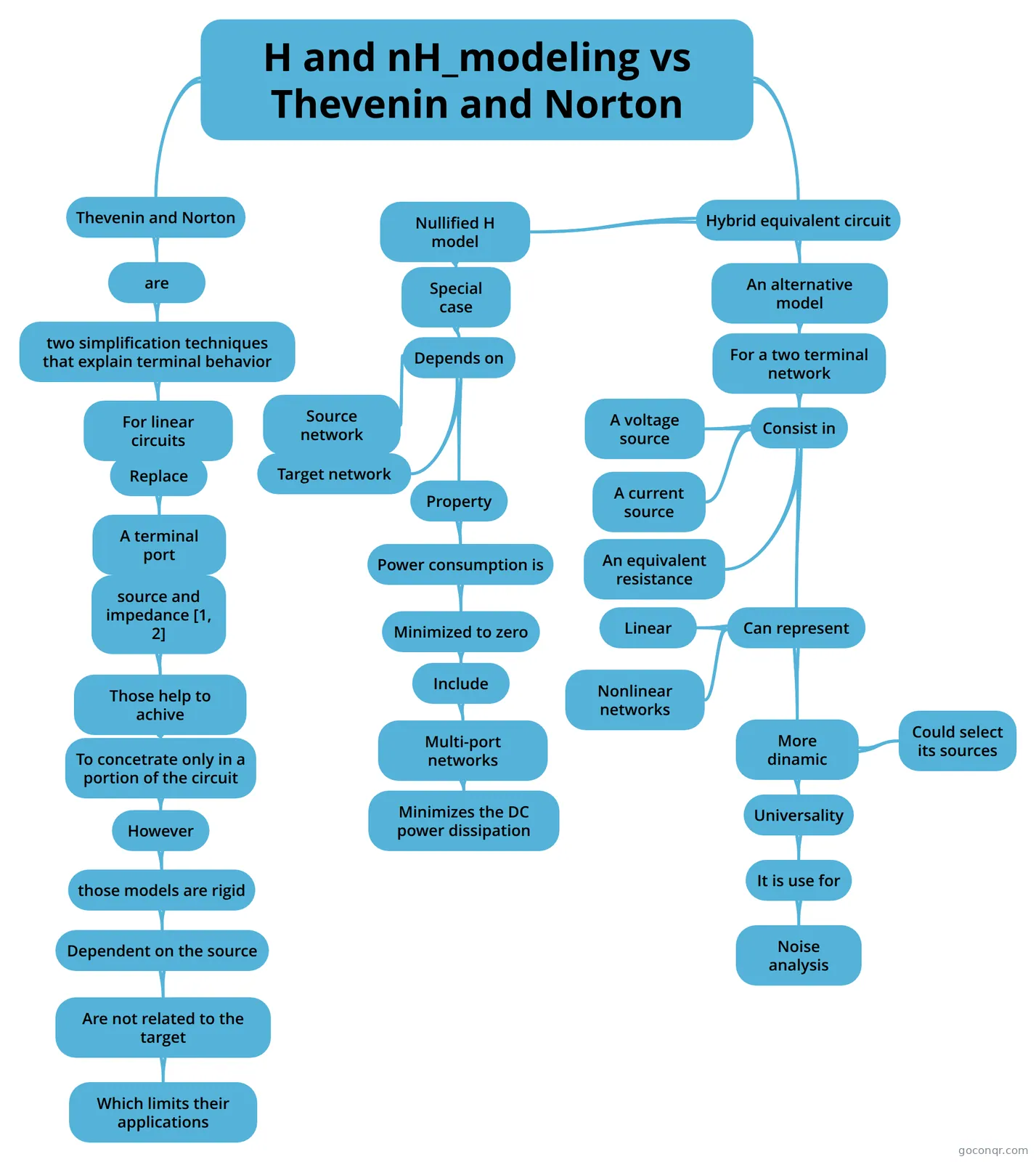 Mind map H and nH_modeling vs Thevenin and Norton differences between H and nH_modeling and Thevenin and Norton
-
25 questions⚡︎🔌💡 0.4 — Supplementary Quiz What is the main learning philosophy behind this course?
-
33 cardsResistor Color Codes Hopefully this will help you memorize resistor color codes etc. (I recommend shuffling the flashcards befor...
-
9 cardsElectrical and Electronic Circuit Symbols A range of electrical and electronic circuits symbols (European symbols).
-
125 questionsUntitled According to Kirchhoff's voltage law, adding up all of the voltage drops around any DC-circuit closed loop ...
Quizzes
See all 36 quizzes-
35 questionsCURRENT ELECTRICITY What are the minimum requirements to cause the flow of current?
-
25 questions⚡︎🔌💡 0.4 — Supplementary Quiz What is the main learning philosophy behind this course?
-
125 questionsUntitled According to Kirchhoff's voltage law, adding up all of the voltage drops around any DC-circuit closed loop ...
-
55 questionsBCT 56-110 56. For the given circuit, , if the power absorbed by resistor RX is 20 mW, find RX:
-
34 questionsPrinciples of basic electrical circuits Look at the following question
-
34 questions1_Principles of basic electrical circuits Look at the following question
-
34 questionsPrinciples of basic electrical circuits - Outcome 2 Look at the following question
-
34 questionsPrinciples of basic electrical circuits Look at the following question
Mind maps
See all 64 mind mapsFlashcards
See all 50 flashcards-
23 cardsResistance (Mod. 1 pt6) Resistance flashcards....
-
33 cardsResistor Color Codes Hopefully this will help you memorize resistor color codes etc. (I recommend shuffling the flashcards befor...
-
9 cardsElectrical and Electronic Circuit Symbols A range of electrical and electronic circuits symbols (European symbols).
-
36 cards04Handout 01 is an interconnection of electrical components. These electrical components include resistors, inductors, c...
-
70 cardsBasic EE - Exam I
-
34 cardsDC Circuits
-
31 cardsDefinition of Symbols in Electronic Circuit Diagrams Flash about symbols in electronic circuit diagrams.
-
33 cardsAC Circuits How do you calculate the mean value of a periodic signal?
Flowcharts
Notes
See all 12 notes-
Electronics Notes
-
Untitled Methods of Analysis of Resistive Circuits Node voltage with Current Sources Analyzing a circuit containing n nodes will require n-1 KCL equations. One way to obtain equations is to apply KCL to all nodes but one...
-
Untitled Circuit Theorems A source transformation allows us to replace a voltage source and series resistor by a current source and parallel resistor. Doing so doesn't change the current or voltage. Superposition says that the...
-
Electric Circuits Fundamentals A circuit consists of electrical elements connected together in a closed path so that an electric current may flow continuously. Electric Circuits -Introduction- Current
-
Resistive Circuits Resistive Circuits Circuit Topology: Kirchhoff's Laws
-
Lesson Two - created from Mind Map Electric current (E.C) is the flow of electric charge (E.ch) in free electrons form Conventional current flow - From positive (+) to negative (-) Ability of a charged particle to do work is an electric potential. Two ...
-
Three phase circuits Three Phase Circuits When there are multiple armature windings, which are displaced from other by equal angles, generating multiple independent voltage waves (same as the number of armature windings separated by equal...
-
Basic Electronics Q:What is Resistance.Give an Example? Resistance: Resistance is the opposition that a substance offers to the flow of electric Current. It is represented by the uppercase letter R. The standard unit o...
Slides
Topics in DC Circuits and Circuit Analysis
More Electrical and electronic engineering topics
About DC Circuits and Circuit Analysis
GoConqr OriginalWhat the page covers
The resources sit in the Electrical Principles and Circuit Theory strand of Electrical and electronic engineering. They start with the basics: circuit variables, circuit elements and simple resistive circuits. They then move on to analysis techniques, inductors and capacitors, and first-order RC and RL responses. The mind map on electric circuit analysis lays out that whole route in one view.
Where to start
If the vocabulary is new, begin with the flashcards. Electrical and Electronic Circuit Symbols and Resistor Color Codes help you read diagrams, while the Resistance deck covers resistor types. The notes on electric circuits fundamentals define a circuit as electrical elements connected in a closed path, then build up current and related quantities.
Moving into analysis
- Work through the slide sets on calculating circuit resistance and on resistivity.
- Use the flashcards on Ohm's law and on Kirchhoff's laws to fix the rules in mind.
- Open the mind map on Thevenin and Norton, which explains how a source and impedance at a terminal port can replace a linear circuit.
- Look at the maps on inductors and on differentiation and integration in circuit analysis for the more advanced ideas.
Using quizzes with maps
Read a mind map first, then test yourself. The quiz called Principles of basic electrical circuits asks about power in resistive circuits and about resistors in combination. CURRENT ELECTRICITY checks the basics of conductors and resistance. When an answer is wrong, go back to the matching map or deck and look at that branch again.
Who it suits
Most of the material is at university level, with a good share aimed at professional candidates and a smaller share for school students. Teachers can pick out maps, slide sets and quizzes to set as revision tasks.
Choose one quiz today, see what you remember, and then make your own flashcards from the gaps.
Frequently asked questions
Which resource should I open first?
If you are new to the topic, try the flashcard decks on circuit symbols and resistor colour codes, then the notes on electric circuits fundamentals. If you already know the basics, the quiz Principles of basic electrical circuits is a quick way to find which areas need more work.
What do the mind maps cover?
The maps range from the basics of circuit variables, elements and resistive circuits to circuit analysis techniques, inductors, second-order circuits and alternating waveforms. One compares modelling with Thevenin and Norton equivalents. Others look at differentiation and integration applied to circuit problems.
Are the resources free to use?
Yes. Every resource on this page is free to open, study and take, with no account needed. A free account also saves your quiz scores and lets you make your own quizzes, mind maps, flashcards and notes. All of the material was made by GoConqr users, not by GoConqr.
Which levels is this page for?
Most resources are at university level, with a sizeable group for professional candidates and a smaller share for school students. Teachers can use the quizzes, slide sets and maps as ready-made material. None of the listed resources name a particular exam.
Is there material on resistors and Ohm's law?
Yes. There are flashcards on resistance, resistor colour codes, series resistors and Ohm's law, plus two resistor colour code quizzes. Slide sets on calculating circuit resistance and on resistivity explain the ideas, and a deck on power in DC circuits follows on.
What if I cannot find the topic I need?
Try nearby resources first, such as the decks on Kirchhoff's laws or the maps on circuit analysis techniques. If a topic is still missing, you can make your own quiz, mind map or flashcards with a free account and build exactly the revision set you need.