
Flashcards
Chapter 2 Psychoanalysis
Flashcards do conjunto (46)
- 1Psychoanalysis"a unique method of research for understanding the human individual"
pg. 28 - 2Catharsis"emotional release"
pg. 31 - 3Resistance"force within the prevents us from becoming aware of traumatic memories & keeps traumatic memories unconscious"
pg. 31 - 4unconscious ( repressed) processes"forces of which a person is unaware"
pg. 31 - 5Wishes"Freud believes that repressed and unconsciously rendered ideas or thoughts were wishes. During a traumatic event, a wish had been aroused that went against the person's ego-ideal, since it is hard for people to accept the fact They're not what they would like to be, the incompatibility causes pain and if too much pain is caused, the wish is then repressed "
pg. 32 - 6Repression"blocking of a wish or desire from consciousness"
pg. 32 - 7Free Association"a tool in self-understanding where a patient is asked to verbalize whatever comes to mind, no matter how insignificant, trivial, or even unpleasant the idea, thought, or picture may seem. No idea is arbitrary & insignificant"
pg. 32 - 8Slips"Bungled acts (slip of tongue, a slip of the pen, or a lapse of memory), Freud believes slips like these are not without meaning. Freudian theory assumes that in our Psychic life nothing is trifling or lawless, rather there is a motive for everything."
pg. 33 - 9Cause vs. Motive" Cause implies the action of a material, impersonal force that brings something about, while motive refers to personal agency & implies an emotion or desire operating on the will of a person & leading him or her to act "
pg. 33 - 10Manifest dream vs. Latent dreamManifest is the dream as it is remembered the next morning ( presents some kind of narrative story), Latent dream is the meaning or motive underlying the manifest dream"
pg. 34 - 11Dream Work"the process that disguises the unconscious dream wishes & converts them into the manifest dream"
pg. 35 - 12Libido" Freud used this word to refer to the emotional and psychic energy derived from the biological drive of sexuality"
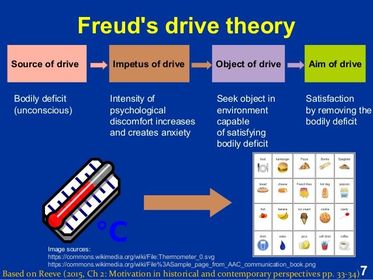
pg. 36 - 13Drive" a psychological or mental representation of an inner bodily source of excitement, a form of energy that combines elements of both mind and body"
pg. 36 - 14Eros vs. Thanatos" two basic groups of impulsive drives, Eros refers to life impulses or drives, those forces that maintain life processes and ensure reproduction of the species. Thanatos (encompassing death impulses or drives), is a biological reality and the source of aggressiveness, and reflects the ultimate resolution of all of live's tension in death."
pgs. 36-37 - 15autoeroticterm used to describe the sexual activity in children, " they seek pleasure from their own bodies rather than from the body of another person. ex. sucking their thumb, exploring their genitals.
pg. 37 - 16Psychosexual Stages" stages in which different erogenous zones are important, children move from autoeroticisim to reproductive sexuality and develop their adult personalities"
pg. 37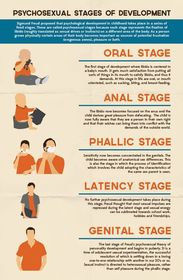
- 17Oedipus complex"a child has incestuous wishes towards the opposite sex parent and murderous impulses toward the opposite sex parent"
pg. 39 - 18castration anxiety" a male child fears physical retaliation from his father, in particular that he will lose his penis, due to Oedipus complex"
pg. 40 - 19Fixation"If the Libido is prevented from obtaining optimal satisfaction during one or more of the stages it has been unduly frustrated or overindulged, it may become fixated or arrested at that particular stage
ex. an orally fixated person is likely to be dependent on and easily influenced by others, oral personalities are also optimistic and trusting to the point of being gullible. Anal personalities tend to be orderly, miserly, and obstinate.
pgs. 41-42 - 20id" the core of our being, the oldest and original function of the personality and the basis of the ego and superego. Id includes instincts and drives that motivates us as well as our genetic inheritance and out reflexes and capacities to respond. Represents our basic drives, needs, and wishes, and is the reservoir of psychic energy that provides the power for all psychological functioning"
pg. 43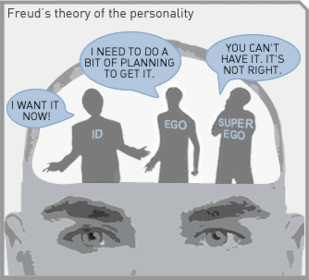
- 21Primary processes"part of the id, which seeks to reduce tension through primary processes, hallucinating or forming an image of the object that would satisfy its needs"
pg. 44 - 22Pleasure Principle"seeking immediate tension reduction"
pg.43 - 23Ego" emerges in order to realistically meet the wishes and demands of the id in accordance with the outside world, it draws on the id's energy, acquires its structures and functions from the id, and endeavors to serve the id by realistically meeting its demands. The ego is the executor of the personality, curbing the id an maintaining transactions with the external world in the interests of the fuller personality"
pg. 44 - 24Reality Principle"relating to ego, satisfying the id's impulses in an appropriate manner in the external world, redirects the id's wishes in accordance with the demands of reality"
pg. 44 - 25secondary process" the cognitive and perceptional skills that help an individual distinguish between fact and fantasy, including the higher intellectual functions or problem solving, which let the ego establish suitable courses of action and test them for their effectiveness"
pg. 44 - 26Superego" represents internalized values, ideals, and moral standards, strives for perfection, seeks moralistic rather than realistic solutions"
pg. 44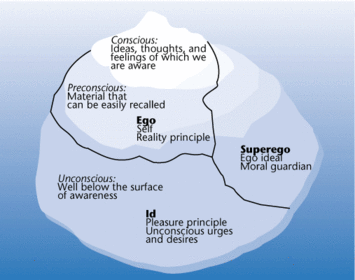
- 27conscience vs. ego-idealtwo subsystems of superego: "conscience is the capacity of self-evaluation, criticism, and reproach, scold the ego and creates feelings of guilt when moral codes are violated. Ego-ideal is an ideal self-image consisting of approved and rewarded behaviors, the source of pride and a concept of who we think we should be."
pg. 44 - 28Reality Anxiety"fear of a real danger in the external world"
pg. 46 - 29Neurotic anxiety" fear that one's inner impulses cannot be controlled"
pg. 46 - 30Moral Anxiety" Fear of the retributions of one's own conscience"
pg. 46 - 31Defense Mechanisms" procedures that ward off anxiety and prevent our conscious perception of it, occur unconsciously so that we are not aware of what we are doing & they deny or distort reality so as to make it less threatening."
pg. 46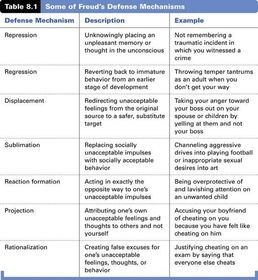
- 32Repression" blocking a wish or desire so that it cannot be experienced consciously or expressed directly in behavior"
pg. 46
ex. being unaware of deep-seated hostilities toward one's parent - 33Denial" refusing to acknowledge an unpleasant reality or fact of life"
pg. 47
ex. refusing to believe one has aids - 34Projection" unconscious attribution of an impulse, attitude, or behavior onto someone or something else in the environment"
pg. 47
ex. blaming another for your act or thinking that someone is out to get you - 35Reaction Formation" expressing an impulse by its opposite"
pg. 47
ex. treating someone whom you intensely dislike in a friendly manner - 36Regression"returning to an earlier form of expression an impulse"
pg. 47
ex. resuming bed wetting after one has long since stopped - 37Rationalization" Dealing with an emotion intellectually to avoid emotional concern"
pg. 47
ex. arguing that "everybody else does it, so I don't have to feel guilty" - 38identification" modeling one's own behavior after the behavior of somebody else"
pg. 48
ex. imitating one's mother or father - 39displacement" satisfying an impulse with a substitute object"
pg. 48
ex. scapegoating - 40Sublimation"re channeling an impulse into a more socially desirable outlet"
pg. 48
ex. satisfying sexual curiosity by researching sexual behaviors - 41Transference" a process whereby the patient transfers to the analyst emotional attitudes felt as child toward important persons"
pg. 49 - 42Positive transference vs. negative transference" Positive transference: friendly, affectionate feelings toward physician. Negative transference: characterized by the expression of hostile, angry feelings."
pg. 49 - 43Neuropsychoanalytic research" combination of neurological objective study of the brain with psychoanalytical introspective study of the mind"
pg. 53-54 - 44the brain stem" regulates basic life activities such as breathing, heart rate, and alertness"
pg. 54 - 45the lymbic system"includes part of the amygdala & hippocampus, involves much of our emotional processing"
pg. 54 - 46the neocortex & prefrontal cortex" entailed in higher thought and executive functioning"
pg. 54
Informações
- Descrição
- FlashCards sobre Chapter 2 Psychoanalysis , criado por Selena Munguia em 16-01-2017.
- Criado por
- Selena Munguia
- Visualizações
- 2
- Avaliação