
Flashcards
PC Components
Flashcards do conjunto (21)
- 1Desktop ComputerPC that is not designed to be used on the move
- 2System caseaka chassis
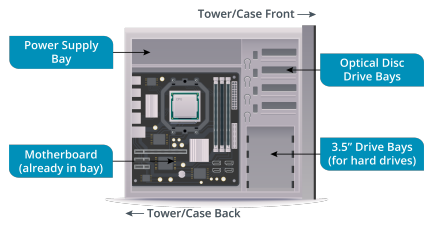
- plastic and metal box that houses this second class of components such as the motherboard, CPU, memory, adapter cards, disk drives, and power supply unit. - 3Tower caseDesigned to sit vertically on a surface, so that it is taller than it is wide.
- 4SFFSmall Form Factor (SFF) case
- semi-portable, space-saving designs typically used for domestic entertainment or Media Center systems that will not look out of place in a living room. SFF cases can hold only a limited number of components. - 5all-in-one unitsall the computer components, except the keyboard and mouse, are contained within the monitor case.
- 6Parts of the System Case- Cover: removed by either undoing the screws at the back or pressing together clips that release it
- Front panel: provides access to the removable media drives, a power on/off switch, a reset switch, and LEDs to indicate drive operation
- rear panel: has cut-out slots aligned with the position of adapter card slots. These slots should either be covered by an adapter card or a metal strip known as a blanking plate. provides access to the Power Supply Unit sockets.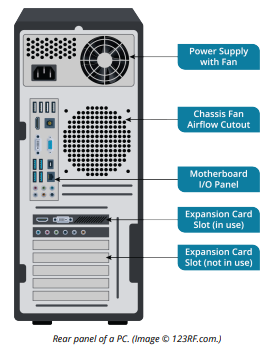
- 7FRUsField Replaceable Units (FRUs)
- PC components that are easily user-replaceable (or upgradeable) are referred to as FRUs. - 8Motherboardsaka mobo, system board or main board
- houses the processor, chipset, memory, and expansion slots. The mother board is attached to the case by using standoffs. - 9Motherboard Form FactorsThe form factor of the motherboard describes its shape, layout, and the type of case and power supply that can be used.
- ATX: 12 in wide by 9.6 in deep, contain up to seven expansion slots
- Micro-ATX: mATC 9.6 in square board, up to 4 expansion slots
- Mini-ITX: Small Form Factor (SFF) PCs use this, 6.7 in square with one expansion slot
- Other: nano, pico-, mobile-ITX form factors are used for embedded systems and portables, rather than PCs - 10Motherboard Connector Types
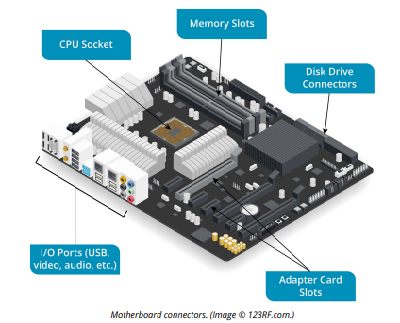
- 11CPU SocketsCPU models are closely tied to the chipset and memory subsystem. The CPU is typically inserted into a sqaurish socket, located close to the memory sockets, and then covered by a heatsink and fan.
- 12Memory SlotsSystem memory uses a type of memory technology called Random Access Memory (RAM). System RAM is volatile; it loses its contents when power is removed. System RAM is normally packaged as Dual Inline Memory Modules (DIMM) fitted to motherboard slots.
- 13Chipset and Memory ArchitectureThe chipset consists of several controllers that handle the transfer of data between the CPU and various devices. Examples: system memory control, IO controller to handle disk drives and expansion buses, controllers for any integrated video, sound, and network interfaces/
The chipset is soldered onto the motherboard and cannot be upgraded.
The main function of the Northbridge is the system memory controller, connecting the processor to RAM. The south bridge is designed to control all of the IO functions not handled by the northbridge. - 14CMOS and RTC BatteriesCMOS devices require very little power to operate and use a small battery to maintain their settings. The CMOS battery is a coin cell lithium battery. These batteries last for 5-10 years. On current motherboards, configuration data is stored in a Non-Volatile RAM (NVRAM) chip such as flash memory, rather than in CMOS RAM. CMOS battery is still used to power the Real Time Clock (RTC).
- 15Bus ArchitectureAn electrical pathway on the motherboard or through cabling that carries the signals is referred to as a bus. Physically, a bus is implemented on the motherboard as tiny wires (called traces) running between components. Bus architecture usually means an expansion bus, used to connect peripheral devices.
- 16Internal and External BusesInternal bus, or local bus, connects core components, such as the CPU, memory, an the system controllers.
External bus, or expansion bus, allows additional components to be connected to the computer. These components could be peripheral devices or adapter cards. - 17Expansion SlotsExpansion slots enable you to install plug-in adapter cards in a computer to extend the range of functions it can perform. Computers can support more than one expansion bus.
- Riser Cards: enables you to connect additional adapters to the system in an orientation that is parallel to the motherboard - 18Daughter boarda general computing and electronics term for any circuit board that plugs into another circuit board.
- 19System Clock and Bus SpeedSystem clock synchronizes the operation of all parts of the PC and provides the basic timing signal for the CPU.
- 20PCI BusPeripheral Component Interconnect (PCI) bus
The different capabilities:
- Bus width and clock speed: PCI supports up to 5 devices and allocates system resources by using Plug-and-Play. Bandwidth on the PCI bus is shared between all devices and only one component can make use of the bus at any one time. PCI supports bus mastering, meaning that the device can control the bus to transfer data to and from memory, without requiring the CPU
- Adapter card and slot form factors: - 21PCI Express Bus
Informações
- Descrição
- FlashCards sobre PC Components, criado por Darika Batbayar em 09-09-2019.
- Criado por
- Darika Batbayar
- Visualizações
- 0
- Avaliação