
Flashcards
NMR 1
Flashcards do conjunto (43)
- 1how are the majority of the structures in the PDB solveNMR
- 2what is the size limit for NMR10kDa
- 3what technique would you use when looking at large crystals and why- Larger the protein the better the crystal that they can form and hence crystallography would be preferable
- X Ray crystallography is by far the most power technique to determine the protein structure —> NMR is comparatively minor technique but there is areas in which this technique is useful - 4what does NMR allow that is not possible with crystallisationNMR can be used to determine the structure of a protein in the context of a cell
- Not possible using X-ray crystallography (can be done with cryoEM but not using small/ medium sized proteins) - 5how can we be certain that the structure of a protein that is obtained after it has been expressed recombinantly and purified resembles that of the native structure- Structure above in red had been determine using recombinant production and purification
- The same structure was solved for this protein while it was still in the E.coli cell before isolation and purification—>while the definition of the structure is not exact the overall fold that was determined was the same
- This can therefore be used as a confirmation that the structures that are determined in vitro are typically very similar to that found in the cell - 6what does NMR stand forNuclear magnetic resonance spectroscopy
- 7why does NMR not damage the cells the it is used to study- No damage to any living system due to the wavelength that is at the lower end of the spectrum —> compared to X-ray crystallography
The wavelength used in NMR is on the other end of the spectrum to these other techniques
- The radio frequencies are those that correspond to those used for TV and radio (gigahertz)
- The wavelength of these is very long (cm-m) - 8what is the wavelength that is used in crystallographyuses a wavelength of around 1 angstrom
- 9what is solution state NMRThis is the only technique that provides experimental high resolution structures of protein in solution
Extremely versatile - 10in solution state NMR what is the limiting factor of the resolutionHigh resolution is however limited to proteins that are <30-50kDa
- 11why might the solution state NMR be favoured over cryoEM or crystallography- completely unrivalled by Cryo- EM or crystallography as these only gather screenshots of information
- 12what kind of proteins can solution state NMR examine that it is not possible for another structural technique- Not all protein adopt a secondary, tertiary or quaternary structure some are active in an unfolded state
- it is thought that a third of proteins are natively unstructured and hence cannot be visualised by other techniques (X-ray crystallography or cryoEM) as they do not crystallise or have enough electron density to visualise
- Makes NMR useful in studying highly dynamic proteins - 13what can the pharamecutical industry use NMR forcan be used to look at the interactions between drugs and other molecules
- 14how does NMR determine structureSpin state transitions of nuclei are induced with radio frequency radiation
- The excited spin state relaxed and emits radiation
- The convoluted signal contains information about the chemical environment (I.e. the spatial context) of all the nuclei - 15what are the 4 steps to NMR1. Resonance frequencies for all spins are recorded
2. Resonances are assigned to atoms
3. Neighbouring atoms are identified
Structural restraints (distances, bond angles and H bonds) are collect - 16what is required for NMR- Large magnetic field is required
—>this is generated using a super oiled solenoid
—>superconducting - means that at a low temperature (4Kelvin) there is no resistance to electric currents
—>no resistance means the wire doesn’t need to be recharged - 17how is the data collected- Sample placed in a small tube ~0.5 ml
- In general the sample restraints are flexible but the sample should be 0.1-0.5 mM with a pH of around 7 and a low salt concentration
- And placed into the centre of the magnet
- Sample surrounded by a radio frequency transmitter - often referred to as the probe - 18what are the disadvantages of NMR- Sensitivity: Requires high protein concentrations
- Resolution—> need to resolve all resonances (>1000)
- Need to assign each resonance to an atom in a protein - 19what are the technical solutions that are used to aid in the structural determination- Multidimensional NMR (spread out resonances)
- Isotopic labelling, heteronuclear NMR
- High magnetic fields (currently the highest available corresponds to 1H resonance frequency of 1GHz) - 20what is the bottleneck of the NMR precesssample prep
- Can take weeks or months
- If you cant produce a good sample, that is soluble and at a high enough concentration NMR will not work - 21after sample prep and before the NMR is undergone what can be determine about the protein (after isolation)- Immediately after the isolation of the protein you can obtain useful information such as if it is folded, monomer or has quaternary structure and even if the protein can undergo NMR or crystallography
- 22what is backbone assigning in NMR- Amine (H, N, C)
- Determine the dynamics of the protein
—>possible at this stage without the structure to determine areas of the protein that are rigid and those that are mobile
—>domain scouting- sometime when solving the structure it is not possible to work with the full length of the protein and it requires being chopped down into individual domains or removal of flexible regions that interfere with crystallisation
—>NMR can tell you which residues you can engineer or get rid of to have the best chance of crystallisation
- Interactions of the protein with ligands or other proteins - 23what is isotope labelling NMRBecause there is many thousands of atoms in a protein that need to be distinguished for structure determination we need to look at more than one type of atom
- Requires you to look at the 3 main atoms that are found in proteins (C, H and N)
- Hydrogen (1H) is the main isotope that is found in proteins
1H is active in NMR - 24why do the isotopes of carbon and nitrogen need to be be replaced- The isotopes that are used in NMR for these molecules are not the isotopes that are most commonly abundant in proteins
—>13C is only 1.07% if the carbons that are found within protein (12C is silent within NMR despite being the most abundant in the cell)
—>15N is only around 0.368% of the nitrogen abundance within the protein
- These isotopes contain an uneven number or proteins and neutrons in the nucleus and this is required for NMR
- The small quantity of the carbon and nitrogen is not sufficient in proteins to measure the spectra and so these atoms need to be enriched - 25how do you produce protein samples that contain the isotopes that you are looking for- Make the recombinant proteins in media where there is carbon and nitrogen sources replaced with small molecules that contain the isotope of interest
—>feed bacteria glucose that is composed of carbon 13
—>ammonium chloride used that is 15N labelled - 26what are the isotopes that are required for NMRH1- 99.9% natural abundance
13C-1.07% natural abundance
15N- 0.3% natural abundance - 27what might you do when working with large proteins the you want to simplify a complex spectrumreplacing the NMR proton (1H) with a deuteron (2H) that is NMR silent and cannot be observed
- Simplifies the spectra
- These are produced using heavy water - 28how are H1 isotopes removed from a protein sample to simplify the spectralheavy water
- 29what are triple resonance experiment sTriple resonance experiments take advantage of the C and N atom replacement
- 30what does NMR rely onexcited states
- 31which nuclei have spin- Isotopes that have uneven numbers of protons and/ or neutrons have nuclei with spin (I- nuclear angular momentum quantum number)
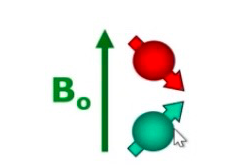
- 32what can be said of the nuclei oreientation when a magnetic field is appliedIf Bo is the applied magnetic field, the nuclei can orientate itself in two possible orientations
- Up or down
These 2 states are slightly different in energy - 33what is the magnetic momentum- Nuclei rotate at a high momentum called the magnetic momentum
- 34what is the spin (l) on a nuclei in NMRthis is the nuclear angular momentum quantum number
- They interact with the applied field to form 2I+1 energy levels - 35when is resonance generated in NMRgenerated by supplying the sample with energy that is exactly of the right frequency to match the splitting of the ground and the excited state
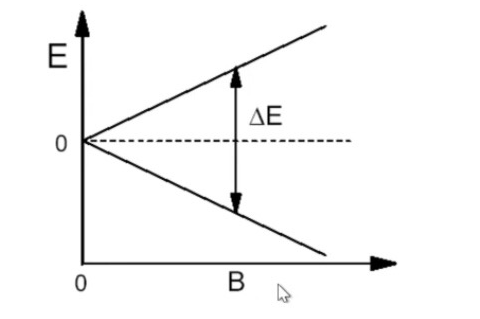
- 36what can be said of the relationship between the energy different and the magnetic fieldThe higher the magnetic field is the larger the energy difference is
- Different isotopes have different resonant frequencies
To characterise the strength of a magnetic in NMR the energy difference that is used to excite protons is used - 37why is NMR limited to the study of small proteins—> i if you have a short lived excited state the spectrum that you obtain is broad
—> if you have an excited state that is long in lifetime the signal produced is very narrow - 38what determines the lifetime fo the excited stateLife time of excited states is long for small molecules but decreases with slower tumbling in solution
Larger molecules tumble more slowly
The excited state for large protein decays in milliseconds - giving rise to very broad spectral lines — this limiting the application of solution state NMR - 39describe the lifetime of large proteinslong
slow tumble
borad spetra - 40why is NMR limited to salt proteins in respect to their tumblingIt is hard to distinguish individual signals in the case of the slow tumbling 50kDa protein
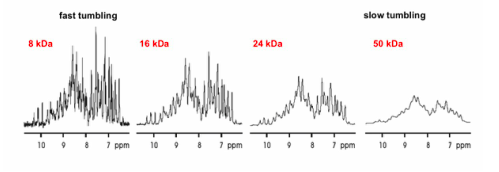
- 41at what speed do differently sized molecules tumblelarge= slow
small= fast - 42why do you want to have sharp lines on the NMR spectra- Broad lines cover wide energy ranges
want to have sharp signals as then we can't distinguish them individually - 43what can be used to counteract slow tumbling of larger proteinsstronger magnetic fields
-
Can resolve spectral lines better because the relaxation properties are different at a higher field
-
higher fields give better sensitivity and resolution
Informações
- Descrição
- Protein structure and function FlashCards sobre NMR 1 , criado por Samantha bruce em 06-12-2019.
- Criado por
- Samantha bruce
- Visualizações
- 1
- Avaliação