
Flashcards
OCR AS Chemistry A Organic Chemistry Revision
Flashcards do conjunto (39)
- 1What are hydrocarbons?Organic compounds that contain carbon and hydrogen only.
- 2Explain what is meant by the term, 'unsaturated hydrocarbon'.A hydrocarbon containing carbon-carbon multiple bonds.
- 3What is a functional group?The part of an organic molecule responsible for its chemical reactions.
- 4Define the term 'homologous series'.A series of organic compounds with the same functional group but with each successive member differing by CH2
- 5What is the general formula for: (i) alkanes (ii) alkenes(i) CnH2n+2
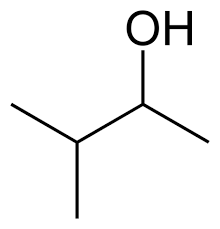
(ii) CnH2n - 6Name this organic molecule.2-methyl-propan-2-ol
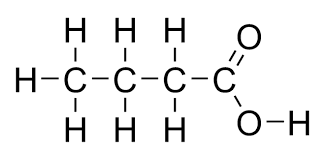
- 7Give the displayed formula for butanoic acid.
- 8Define: (i) structural isomer (ii) stereoisomer(i) Same molecular formula, different structural formula.
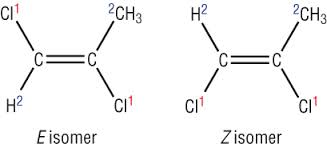
(ii) Same structural formula, different spatial arrangement of atoms. - 9Draw and label the E/Z isomers of 1,2-dichloropropene.
- 10Define: (i) homolytic fission (ii) heterolytic fission(i) The breaking of a covalent bond, with one of the bonded electrons going to each atom, forming 2 radicals.
(ii) The breaking of a covalent bond with both of the bonded electrons going to one atom, forming a cation and an anion. - 11What is an electrophile?An atom/group of atoms that is attracted to an electron-rich centre/atom, where it accepts a pair of electrons to form a new covalent bond.
- 12What is a nucleophile?An atom/group of atoms that is attracted to an electron-deficient centre/atom, where it donates a pair of electrons to form a covalent bond.
- 13What is fractional distillation?The separation of components in a mixture into fractions which differ in boiling point by means of distillation.
- 14Why do branched alkanes have lower boiling points than straight chain alkanes?There are fewer points of contact between branched molecules, leading to fewer Van der Waals' forces. Therefore, less energy is required to separate the molecules.
- 15Write an equation for the incomplete combustion of octane.2C8H18(l) + 16O2(g) --> 16CO(g) + 18H2O(l)
- 16What is the name of this process?Isomerisation (of pentane)
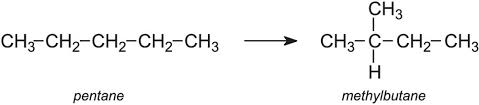
- 17Show how pentane can be reformed.

- 18Why are branched and cyclic alkanes used as petrol additives?They promote more efficient combustion than straight-chain alkanes.
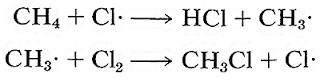
- 19Show the (mechanism) propagation equations for the reaction of methane with chlorine.
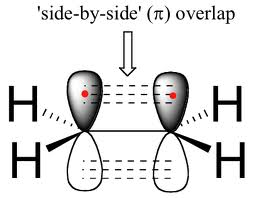
- 20Represent the pi bond in alkenes in a labeled diagram.A pi bond is the sideways overlap of p-orbitals above and below the plane
- 21What type of reactions do alkenes always undergo?Addition reactions
- 22What reagent and conditions are required for the formation of ethane from ethene?H2 (g), heated Ni catalyst
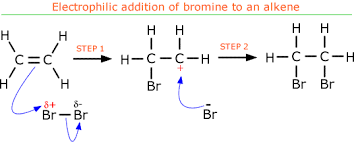
- 23Show the electrophilic addition mechanism for the bromination of ethene.
- 24What reagent and conditions are required for the formation of ethanol from ethene?H2O(g) steam, high temperatures and pressure, acid catalyst.
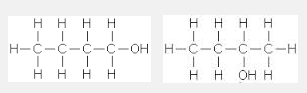
- 25Draw the two products formed in the hydration of but-1-ene and explain why there are two products.But-1-ene is an asymmetrical alkene and therefore, produces 2 structural isomers - butan-1-ol and butan-2-ol.
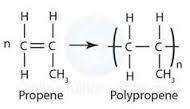
- 26Give an equation for the polymerization of propene.
- 27Draw the monomer that was used to make the polymer above.
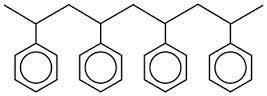
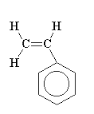
- 28How can polymer waste be minimized?Sorting and recycling; using them as a fuel source; breaking them down into feedstock (feedstock recycling); using biodegradable or photodegradable polymers
- 29Write an equation showing the formation of ethanol via fermentation. Give the reagents and conditions required.Yeast (zymase enzyme); 37 degrees Celcius; aqueous glucose

- 30Draw the hydrogen bonding between 2 ethanol molecules and use it to explain why alcohols have higher boiling points than alkanes of similar mass.Hydrogen bonds are the strongest type of intermolecular forces. The presence of hydrogen bonds between alcohol molecules means more energy is required to separate them.
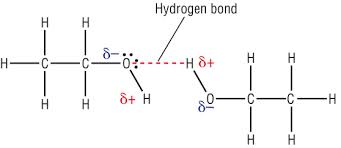
- 31Classify the above alcohols as primary, secondary and/or tertiary.From left to right:
1. tertiary
2. primary
3. secondary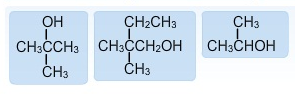
- 32Give equations for the 2 step reaction of ethanol with acidified potassium dichromate.
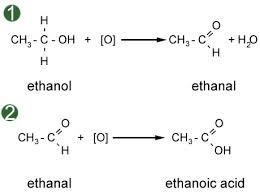
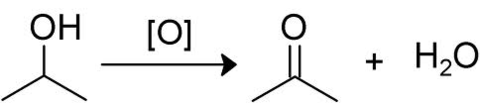
- 33What is this reaction showing? What would you observe?The oxidation of a secondary alcohol (propan-2-ol). Using acidified potassium dichromate as the oxidizing agent, you would observe a colour change from orange to green.
- 34Define the term 'reflux'.The continual boiling and condensing of a reaction mixture to ensure that the reaction takes place without losing volatile reagents or products.
- 35Show the esterification reaction that would form ethyl propanoate.
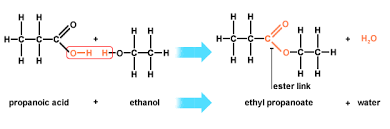
- 36What conditions are required for esterification?concentrated sulfuric acid catalyst; heat by reflux
- 37What are esters used for?Perfumes, flavourings, adhesives, solvents
- 38Show the mechanism for the nucleophilic substitution of 1-iodopropane by hydroxide ions.
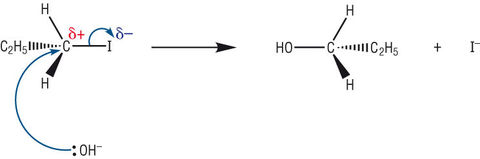
- 39Why does the hydrolysis of 1-iodobutane occur faster than for 1-chlorobutane?The carbon-iodine bond is weaker than the carbon-chlorine bond, so it will be broken most easily, and therefore react the fastest.
Informações
- Descrição
- FlashCards sobre OCR AS Chemistry A Organic Chemistry Revision, criado por Miss K Hammond em 16-03-2015.
- Criado por
- Miss K Hammond · mar 2015
- Atualizado
- 27 nov 2016
- Visualizações
- 64
- Avaliação