
Flashcards
Sem título
Flashcards do conjunto (27)
- 1Energy-Anything that supplies electricity, supplies energy too.
-Cells, Batteries, generators... all transfer energy to the charge in wires then it is transferred to components or devices in the circuit
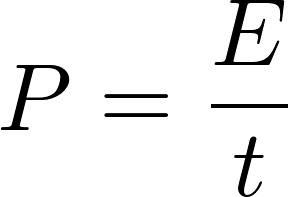
-Components can transfer energy in different forms to the environment - 2Power-tells you how fast it transfers energy from the charge passing through it
Power(W)=Time(s)/Energy transferred(joules) - 3To calculate how much your electrical cost-Energy Transferred (kWh)= Power(kilowatt) x Time (hour)
-Cost= no. of kWh x Cost per kWh - 4Power Ratings of Appliances-the higher the power rating, the higher the energy that can be transfer in a short time
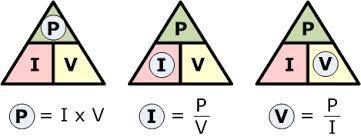
-This energy comes from the current flowed from it - 5Equation of the power of a component-Power (W) = Voltage (V) x Current (A)
- 6Efficiency- Some energy is wasted as heat/sound
-show the percentage of how much the total energy is usefully used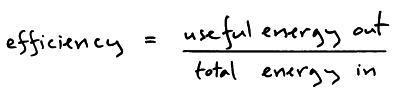
- 7—-No energy is ever lost but it is converted to other forms
-Sankey diagram-energy transformation diagrams
-The thicker the arrow=the more energy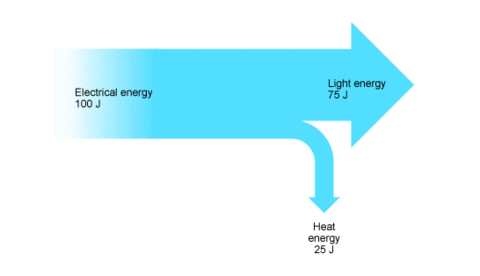
- 8Saving Energy at homeLess energy escape=Less wasted+needed
-Install cavity wall, loft-insulation,double glazing and draught proofing reduces heat lost, Thick curtains also reduce heat loss
-buying efficient appliances , energy saving light bulbs, switch off things if not used - 9Workplace and Energy saving-not printing/photocopy unnecessary things
-Offer employees energy efficient ways to travel to work (cycling, car sharing...)
-methods at home
(switch off computer/light when not use) - 10Government and Saving Energy-Encourage people by offering grants for better home insulation,improving public transport
-Control energy used in a national scale
e.g. invest in alternative energy sources, improve recycling service, make laws to ensure new housing+ businesses are energy efficient - 11Primary energy sources Non-Renewable energy-Electricity is Secondary energy sources
-Fossil Fuels: Coal, Oil, Natural Gas
-Nuclear Fuels: uranium, Plutonium
>They will run out
>do damage to environment
>currently provide most of our energy - 12Primary Energy Sources Renewable-Wind, Waves, Tides, Hydro electronics, Solar, Bio-fuels, Geothermal
>Never run out
>Do damage but less than non-renewable
>Don't provide much energy and unreliable if they depends on weather - 13Process in Thermal power stations1. Energy is released from the fuel (usually by burning in a boiler) and used to generate steam
2. The steams turns a turbine
3. A generator converts the movement of the turbine (kinetic energy) into electricity - 14Environmental Problem linked to fossil-All three fossil fuels (oil, natural gas,coal) release CO₂ to the atmosphere when burnt
-CO₂ contribute to global warming and climate change
-sulfur dioxide cause acid rain-> harm trees and soil->can have far reaching effects in ecosystem - 15Environmental Problem linked to fossil fuels-Coal mining mess up landscape especially open cast mining
-Oil spillages: affect mammals and birds that live in and around the sea. Even it is tried to be avoid, it always happen - 16Benefits of Fossil Fuels-produce lot of energy
-relatively cheaper
-Doesn't rely on weather - 17Nuclear power station-Nuclear Fission produce heat to make steam to drive turbine
-Nuclear Fission: atoms in the nuclear fuel split into two which release lots of heat
-Water is used as a coolant to take away the heat produced by the process. The heat is used to produce steam to drive a turbine and generator - 18Nuclear Power Plant1. Energy is released from the nuclear fuel by nuclear fission
2. Heat Energy heat water to make steam
3. The steam turns a turbine
4. A generator converts the movement of the turbine (kinetic energy) into electricity - 19Advantages of Nuclear Power-The reaction release a lot more energy than chemical reaction e.g burning
-Doesn't produce CO₂, when making electricity
-Nuclear fuel is relatively cheap - 20Disadvantages of Nuclear Power Radioactive waste-Produce radioactive waste: dangerous and difficult to dispose as it emits ionising radiation+stays radioactive for a long time
-Increase exposure=increase cell damage
-high doses kill cells ->(radiation sickness)
-Lower doses damage cell-> cancer - 21Irradiation (Disadvantages of Nuclear Power)-Being exposed without coming in contact with source.
Damage stops as long you leave radioactive area
-Expose short period of time=Receive lower doses - 22Contamination (Disadvantages of Nuclear Power)-Pick up some radioactive waste
e.g. breathe in, drink contaminated water
-Still exposed to the radiation once left area
-Leaves people exposed to ionising damage for a long time-> more damage - 23Disadvantages of Nuclear Powe-Needs extra safety precautions on disposition and need to test soil and water also the workers
-Supported by some, but people live nearby are scared of the risk
-Take long time to set up, overall cost is high due to cost of power plant and final decommisioning - 24Wind Power-put lots of wind turbines up in exposed places like on moors or round coasts
-Electricity is generated directly from the wind turning the blade that turn generator
-No pollution is caused - 25Disadvantages of Wind Power-1500 wind turbines=one coal power station, cover lots of ground(big effect on scenery)
-Very noisy
-No power when wind stop, couldn't increase supply
-Initial cost are quite high but no fuel and minimal running costs - 26Solar Cells-Generate electric currents directly from the sunlight
-often used in remote places, power electric road signs and satellites
- on a relatively small scale e.g. home
-Very reliable source in sunny countries - 27Disadvantages of Solar Power-lot of energy is used to manufacture, but no pollution
-Initial cost are very high, after that the energy is free and low running cost
-Not practical or too expansive to connect to the National Grid
Cost of connecting>value of electricity made
Informações
- Descrição
- FlashCards sobre Sem título, criado por charmaine1999 em 19-04-2015.
- Criado por
- charmaine1999
- Visualizações
- 1
- Avaliação