
Flashcards
Basic tissues-slideshow 2
Flashcards do conjunto (45)
- 1All body parts are composed of four basic tissues- name and describe1. Epithelium (= epithelial tissue)
Covers body surfaces, lines body cavities and forms glands
2. Connective tissue
Underlies or supports the other three basic tissues, both structurally and functionally
3. Muscle tissue
Made up of contractile cells and is responsible for movement
4. Nervous tissue
Receives, transmits, and integrates information from outside and
inside the body to control its (the body’s) activities - 2Connective tissuesProvides general structure, mechanical
strength, space filling (body shape), and physical and
metabolic support - 3Benefits of connective tissue1.It supports and connects other tissues and organs
2. Protection
3. Transport of fluid, nutrients, waste, and chemical messengers
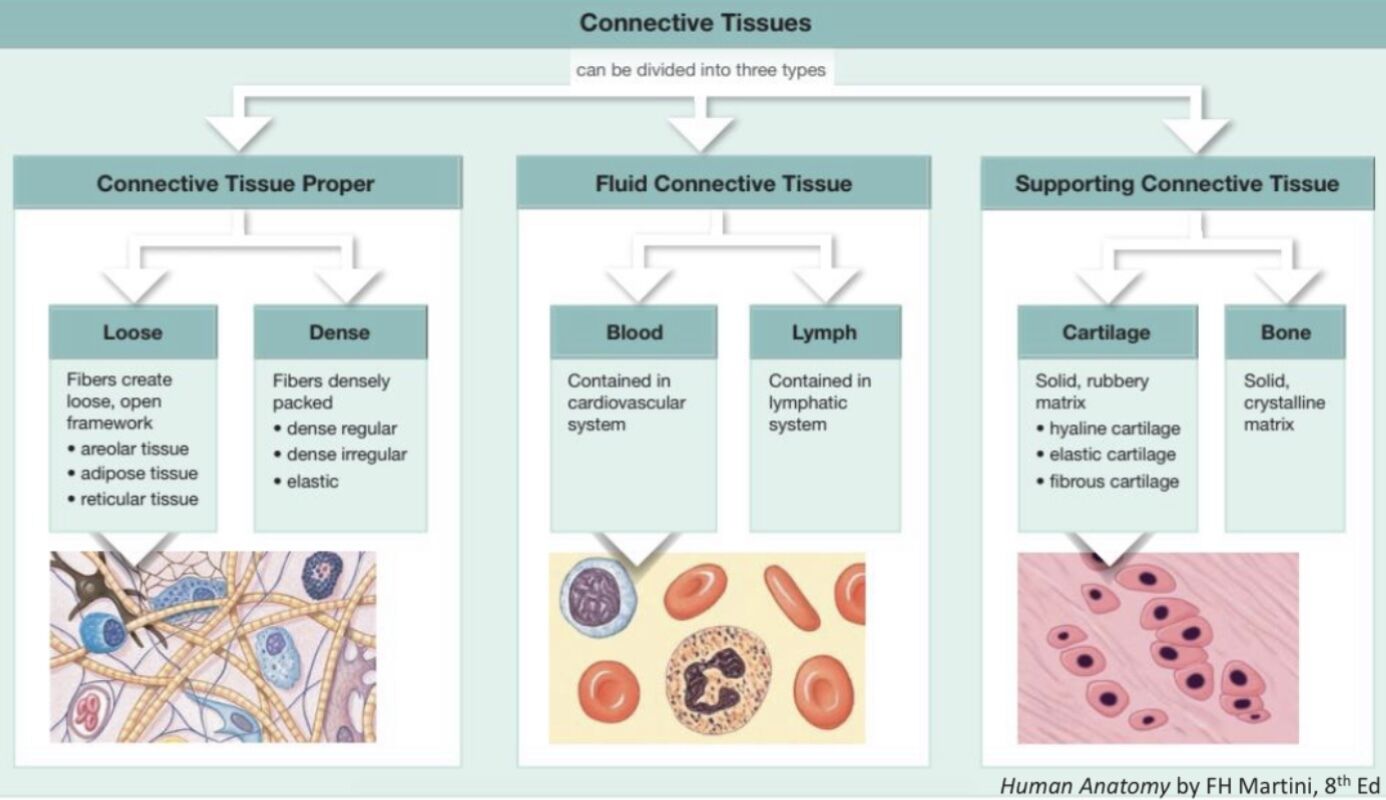
4. Storage of energy in the form of fat and thermal insulation of the body - 4Types of connective tissue1. Loose connective tissue e.g under the skin
2. Fibrous connective tissue E.g forming a tendon
3. Adipose tissue
4. Cartilage e.g at the end of the bone
5. Bone
6. Blood - 53 types of connective tissue
- 6What are tissues composed of?Cell and extra cellular matrix (fibers + ground substance)
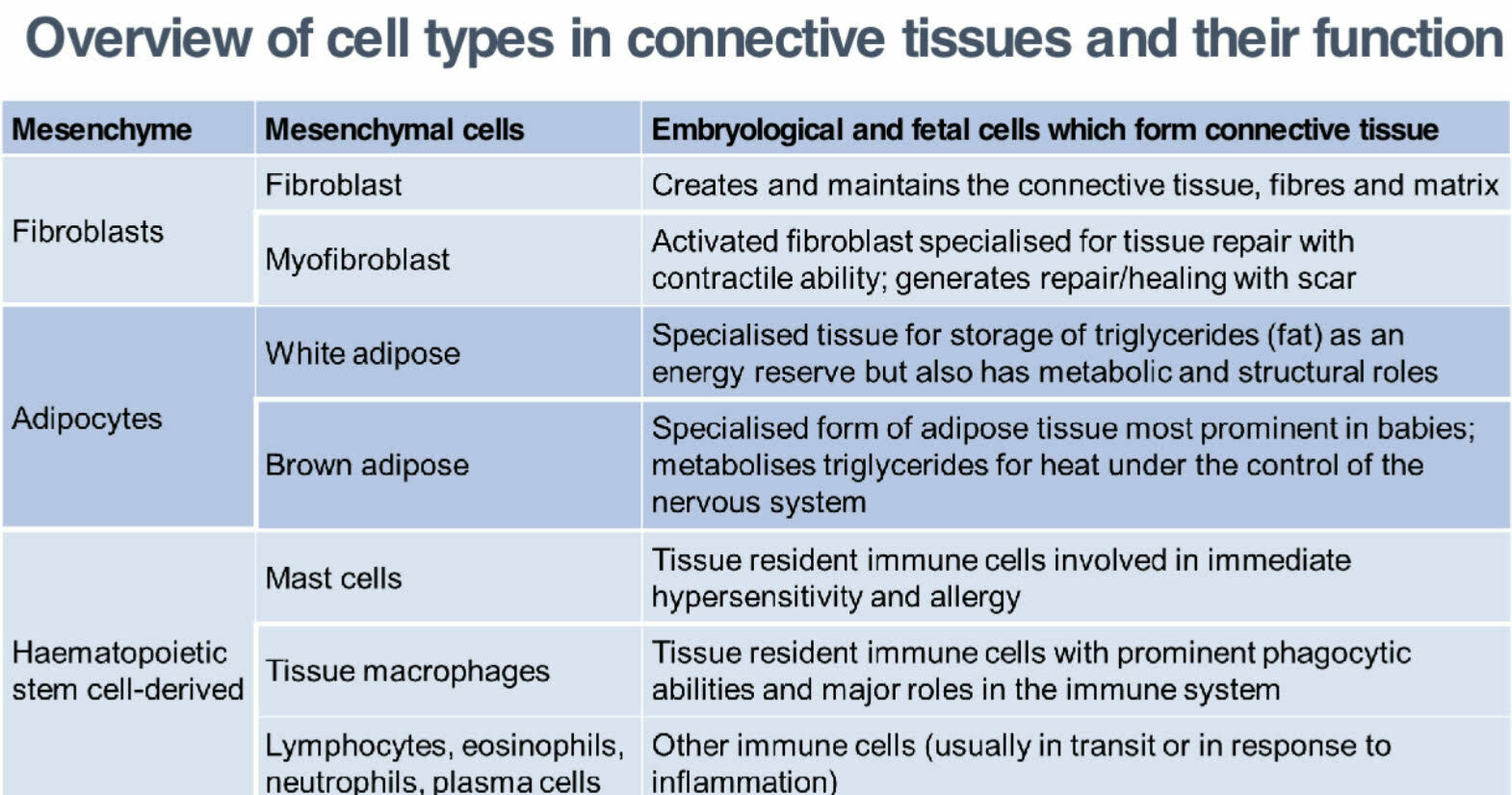
- 7Overview of cell types in connective tissues and their function
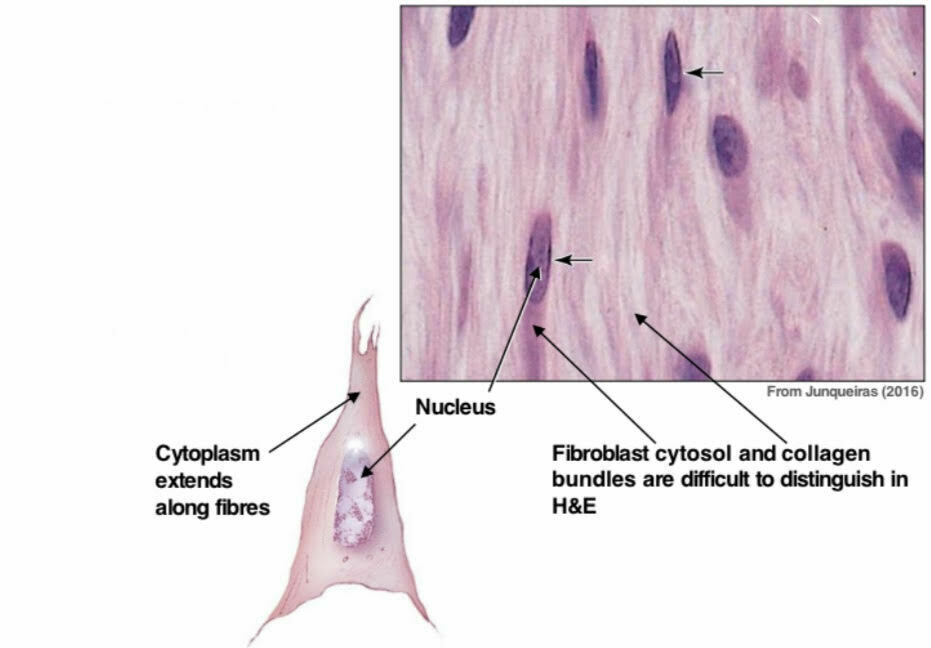
- 8What are FibroblastsThe fibroblast is the principal cell of connective
tissue - 9What are fibroblasts responsible for?Fibroblasts are responsible for the synthesis of
• Collagen
• Elastic and reticular fibres
• complex carbohydrates of the ground
substance - 10Research suggests that a single fibroblast is capable of producing all of the ECM components
- 11What are Adipocytes1. The adipocyte is a connective tissue
cell specialized to store neutral fat and
produce a variety of hormones
2. Adipocytes differentiate from
mesenchymal stem cells and
accumulate fat in their cytoplasm - 12White adipose tissue:Fat storage, structural fill, thermal
insulator, shock absorption - 13Brown adipose tissue:Generates heat
- 14Location of Adipocytes- loose connective tissue (as individual
cells, groups of cells)
- adipose tissue (predominant cell type) - 15What are macrophages and what do they specialise in?Macrophages are phagocytic cells that contain an abundant number of lysosomes.
• They specialise in...
- turnover of protein fibres
- removal of dead cells, tissue debris, or other particulate material
• They are derived from monocytes
(Monocytes migrate from the bloodstream into the
connective tissue, where they
differentiate into macrophages) - 16What are mast cellsMast cells are ovoid cells with a spherical nucleus and
cytoplasm filled with large, intensely basophilic granules - 17What do mast cells store?They store secretory products (mediators of inflammation) in granules and release them upon activation, e.g...
• Heparin: a sulfated GAG, local anticoagulant
• Histamine: promotes increased vascular permeability and smooth muscle contraction
• Serine proteases: activate mediators of inflammation
• Eosinophil and neutrophil chemotactic factors: attract those leukocytes
• Cytokines: polypeptides directing activities of leukocytes and other immune cells
• Phospholipid precursors: are converted to lipid mediators of the inflammatory response - 18Where do mast cells develop?Mast cells develop in bone marrow and
differentiate in connective tissue
Mast cells are especially numerous in the
connective tissues of skin and mucous
membranes, but are not present in the brain and spinal cord - 19Plasma cellsPlasma cells are relatively large,
ovoid cells which have basophilic
cytoplasm rich in RER and a large
Golgi apparatus near the nucleus - 20Plasma cells factsThey are antibody producing cells
• They are derived from B lymphocytes
• The cytoplasm displays strong basophilia because of the extensive rER. The Golgi apparatus is usually prominent because of its relatively large size and lack of staining in light microscope
preparations - 21What are fibers of connective tissues?Fibers of connective tissue are elongated structures formed from proteins that polymerize after secretion from fibroblasts
- 22Three main types of fibres are...• Collagen fibres
• Reticular fibres
• Elastic fibres
Collagen and reticular fibres are both formed from collagen proteins
Elastic fibres are composed of the protein elastin
Connective tissue fibres are present in varying amounts, depending on the structural needs or function of the
connective tissue. - 23Collagen FibresMost abundant protein in the
human body (representing 30%
of its dry weight)
Extremely strong and resistant
to normal shearing and tearing
forces - 24Type I Collagen Fibres• Collagen fibers (Type I) densely fill the
connective tissue
• They are resistant to tension and extremely strong
• They form structures such as tendons, organ capsules, and dermis
• Fibres are composed of type I fibrils bundled together
• Type I is the most abundant of
collagen molecules - 25Type II Collagen fibresType II: resistance to pressure
Location: Cartilage - 26Tendons 1• Dense regular connective tissue
• Features bundles of essentially parallel type I collagen
• Provides great strength (but little stretch) in binding together components of the musculoskeletal system - 27Tendons 2• Attach skeletal muscle to bone
• Densely packed collagen bundles,
sparse ground substance
• Fibroblast (tendinocytes) oriented, elongated nuclei
• Provides great strength, little stretch
• Poor vascularization
• Heal slowly when damaged
• Thin external sheet of dense CT: epitendineum - 28Tendon – Clinical detailRuptured tendo calcaneus (Achilles tendon)
• Partial (strain) or complete
• Healing slow
Tendonitis
• Overuse of tendons → microtears
• Weakened tendon → increased
chance of rupture - 29Reticular Fibres (Collagen Type III)Reticulin fibres form a delicate supporting framework for many cellular organs such as endocrine glands, lymph nodes, bone marrow and liver
• Composed of Collagen type III
• Reticulin fibres stain poorly in H&E
preparations but are able to absorb
metallic silver, staining them black
• Abundant in lymphoid tissue - 30Collagen synthesis defects- Osteogenesis imperfecta(Brittle bone disease)
Congenital deficiency of Type I Collagen
(→ blue sclera, dwarfism) - 31Collagen synthesis defects-Danlos SyndromeCongenital deficiency of Types III and V Collagen
(→ hyperflexible skin and joints) - 32Elastic Fibres (Fibrillin and Elastin)• Elastic fibres allow tissues to respond to stretch and distension
• They form sparse rubberlike networks and fenestrated sheets
• They allow tissue (e.g. lungs, blood vessels), to be stretched and return to their original shape.
• They stain poorly with H&E, more darkly than collagen with stains such as orcein and aldehyde fuchsin
• Composed of Fibrillin (350 kDa) embedded in cross-linked Elastin (60 kDa) - 33LigamentsConnect bone to bone or cartilage
• They are robust but flexible bands of
collagenous tissue
• They limit joint motion to appropriate
ranges and directions
• They have a similar structure to tendons, but...
- are less dens, have more elastic fibres - 34Ground substanceGround substance fills the space
between cells and fibres, and is highly
hydrated, viscous and transparen - 35What is ground substance made up of?It is a complex mixture of three
macromolecules:
• glycosaminoglycans (GAGs),
• Proteoglycans (PGs),
• multiadhesive glycoproteins
→ cell adhesion and movement
and water (interstitial fluid) - 36Ground substance factsIt allows diffusion of molecules and
exchange of metabolites (nutrients,
waste)
• It acts as lubricant and a barrier to the
penetration of invaders
• Ground substance is barely visible in
H&E (white or pale blue) - 37Loose connective tissueAlso called areolar tissue
• Contains cells, fibres, and
ground substance in roughly
equal parts
• Forms a layer beneath the
epithelial lining of many organs
• Fills the spaces between fibres
of muscle and nerve - 38Reticular tissue• characterized by type III collagen fibers
• secreted by modified fibroblasts (reticular cells) which remain associated
with and partially cover the fibres
• forms a delicate network for cells in haemopoietic tissue and lymphoid organs
• bone marrow, liver, lymph nodes, spleen
• only visible using silver stain - 39Dense Irregular Connective Tissue (DICT)• Dense connective tissue (irregular and regular) features few cells and little ground substance
• It is composed primarily of randomly distributed bundles of type I collagen
• ...with some elastic fibers, providing resistance to tearing from all directions and some elasticity
• Found in dermis of the skin, organ capsules - 40Dense Regular Connective Tissue (DRCT)...is prominent in tendons and ligaments
• It features bundles of essentially parallel type I collagen
• It provides great strength (but little stretch) in binding together components of the musculoskeletal system - 41Elastic connective tissue• Location: ligaments of spinal column, ligaments supporting transitional epithelia, blood vessel walls
• Composition: bundles with a central core of elastin associated with a network of fibrillin microfibrils
• Function: To stabilise positions of vertebrae and penis; cushions shocks; permits expansion and contraction of organs - 42Embryonic connective tissueMesenchyme is primarily found in the embryo
• It gives rise to various connective tissues of the body
• It contains a loose network of spindle-shaped cells, viscous ground substance, fine collagen and reticular fibres
• Sparsity of collagen fibres is consistent with the limited physical stress on the growing fetus - 43Adipose tissueAdipose tissue is located deep to the
skin, especially in the flanks, buttocks,
breasts; padding around the eyes and
kidneys.
It functions to provide padding
and cushions shocks, insulates
and stores energy
Adipose tissue is a loose connective tissue dominated by adipocytes.
In standard histological views the cells look empty because their lipid inclusions dissolve during slide
preparation. - 44White adipose tissue (unilocular)Fat storage, structural fill, thermal
insulator, shock absorption - 45Brown adipose tissue (multilocular):Generate heat, mainly in fetus,
brown colour, numerous mitochondria
Informações
- Descrição
- Medicine FlashCards sobre Basic tissues-slideshow 2, criado por i i em 14-12-2022.
- Criado por
- i i
- Visualizações
- 0
- Avaliação