
Connective Tissue
23 resources created by 21 users
This Connective Tissue page on GoConqr gathers community-made flashcards, mind maps, quizzes and notes, from connective tissue proper and adipose tissue to cartilage, bone and the extracellular matrix. It's built for university students revising histology and teachers after ready-made material. There are over 160 resources here, including more than 20 quizzes, over 50 mind maps and over 70 flashcard decks, all at university level. Pick a topic, try a quiz to find your gaps, then make your own maps and cards.
Top Connective Tissue resources
-
32 cardsHistology Connective Tissue Histology (Alb) Lecture 3 (Exam One)
-
6 cardsConnective: Bone -Identification of bone tissues -Understanding the systems for Bone formation -Practicing for exams
-
23 questionsBio 275 lab 3 mmm
-
79 cardsExtracellular matrix and cell adhesion molecules What is the ECM? What is the main role of the ECM?
-
67 cardsCell tissue and structure - lecture II Define connective/supportive tissue
-
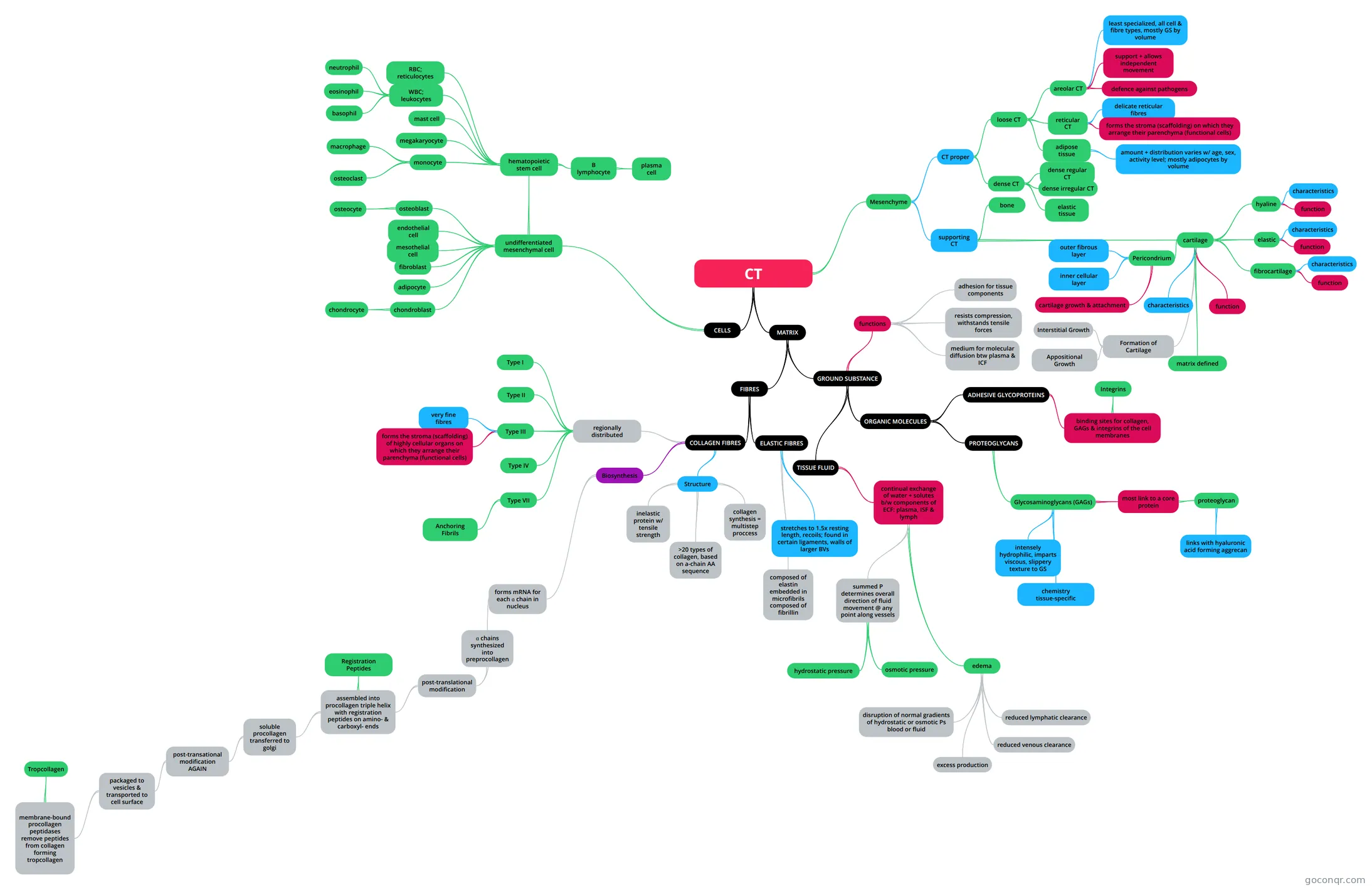 Mind map CT Flow Chart for CT Lectures
-
62 questionsConnective Tissue The connective tissue lines the body cavities
-
58 cardsConnective tissue: cartilage, tendons, ligaments
Quizzes
-
23 questionsBio 275 lab 3 mmm
-
62 questionsConnective Tissue The connective tissue lines the body cavities
-
55 questionsHistology- Connective Tissue PMU 1st Year The connective tissue lines the body cavities
-
20 questionsCHE - Blood Tissue The increase in number of erythrocytes is called erythropenia
-
45 questionsCHE - Connective Tissue The connective tissue lines the body cavities
-
10 questionsConnective Tissue Long Ans. Questions Histology MCQ 1st Year PMU Based on the specific features of their intercellular substance there are the following main types of conne...
Mind maps
Flashcards
See all 15 flashcards-
32 cardsHistology Connective Tissue Histology (Alb) Lecture 3 (Exam One)
-
6 cardsConnective: Bone -Identification of bone tissues -Understanding the systems for Bone formation -Practicing for exams
-
79 cardsExtracellular matrix and cell adhesion molecules What is the ECM? What is the main role of the ECM?
-
67 cardsCell tissue and structure - lecture II Define connective/supportive tissue
-
58 cardsConnective tissue: cartilage, tendons, ligaments
-
70 cards1 What is the function of connective tissue?
-
21 cardsBMS08-1006 -Histology of Soft Connective Tissue What is soft connective tissue?
-
26 cardsConnective tissue What are the functions of connective tissue?
More Histology and embryology topics
About Connective Tissue
GoConqr OriginalWhat the page covers
The resources on this page follow the main branches of connective tissue. Some look at connective tissue proper: loose, dense, reticular and adipose. Others cover cartilage and bone, blood and lymph, and the extracellular matrix with its fibres, ground substance and cell adhesion molecules. Smaller mind maps zoom in on single topics such as fibroblasts, mast cells, mesenchyme and types of collagen.
Where to start
Begin with an overview. The flashcard deck Histology Connective Tissue walks through the forms of connective tissue proper, special connective tissues and supporting tissues. Then open the mind map Connective tissue, which sets out general features, functions, cells, matrix and fibres.
- Read an overview deck or map to see the big picture.
- Move to the types: the deck L3 histo- CT proper asks what loose, dense, reticular and adipose tissue are.
- Look at the matrix with the ECM mind map and the deck Extracellular matrix and cell adhesion molecules.
- Finish with bone and cartilage, using the deck Connective: Bone for compact and spongy bone, canaliculi and Sharpey fibres.
Using quizzes and maps together
Study a mind map first, then test yourself. The quiz Bio 275 lab 3 asks you to match function and location for areolar, adipose, reticular, dense regular, dense irregular and elastic tissue. If an answer slips, go back to the matching map, such as Dense Connective Tissue or Adipose tissue, and read that branch again. Repeat the quiz later and see what has stuck.
Where it fits
This unit sits in the Basic Tissues strand of Histology and embryology. Everything here is made for university-level study, so it suits lab revision, lecture follow-up and quick checks before a class.
Make it your own
Browse the list, open whatever looks useful, and then build your own flashcards or a map of the tissue types you find hardest. Teachers can pick out a ready-made quiz or deck to share with a class.
Frequently asked questions
Which resource should I open first?
Start with the flashcard deck Histology Connective Tissue, which outlines connective tissue proper, special connective tissues and supporting tissues. Then read the mind map Connective tissue for general features, cells, matrix and fibres. Once you have the overview, move on to the deck on connective tissue proper and a quiz.
What do the mind maps cover?
The mind maps range from broad overviews of connective tissue to narrow topics. You will find maps on the extracellular matrix, dense connective tissue, adipose tissue, cartilage, bone, fibroblasts, mast cells, ground substance, reticular tissue, mesenchyme and types of collagen.
Are the resources free to use?
Yes. Every resource listed here is free to open, study and take, with no account needed. They were made by GoConqr users, not by GoConqr itself, so styles and depth vary. Try a few and keep the ones that suit the way you revise.
Which level are these resources for?
All the resources on this page are at university level. They suit university students studying histology, and teachers looking for ready-made decks, maps and quizzes. None are tied to a named exam, so use them as general practice on connective tissue.
Is there a quiz on tissue types and where they are found?
Yes. The quiz Bio 275 lab 3 covers the function and location of areolar, adipose, reticular, dense regular, dense irregular and elastic tissue. There are also quizzes on cartilage, bone and cartilage, blood tissue and the extracellular matrix.
Can I save my scores or make my own material?
A free account saves your quiz scores and lets you make your own quizzes, mind maps, flashcards and notes. That is handy if you want to adapt a resource from the list or build a set on the tissues you find hardest.