
4043712


| Questão | Responda |
| This provides a structure for collecting and interpreting observations | The Scientific Method |
| ___________ on the natural world prompt scientists to question the __________ behind the observed phenomena | Observations ; Explanations |
| This refers to an educated guess on the explanation of a phenomenon | Hypothesis |
| A hypothesis must be _______, ________, and inclusive of a _____________ statement | Specific ; Testable ; Cause and Effect |
| Experiments must either ______ or ________ the original hypothesis | Support ; Refute |
| These explain the results of a large number of experimental observations | Scientific Theories |
| Theories constantly evolve as scientists _______ and _______ more ecological data | Collect ; Interpret |
| This constitutes a broad field, analyzing interactions across many spatial and temporal scales | Ecology |
| Ecology can study ______ or ______ periods of time | Long ; Short |
| Ecology can study ______ or ______ geographic areas | Large ; Small |
| Ecology studies the interactions between _______ ________ and the _________ | Living Organisms ; Environment |
| This examines human impacts on the environment, rather than biologic interactions | Environmental Studies |
| This refers to a social movement that seeks to minimize human impacts on the environment | Environmentalism |
| Interactions among species and the environment control the ___________ __________ and ___________ of species | Geographic Distribution ; Abundance |
| These interactions take place between two organisms | Biotic Interactions |
| These interactions take place between organisms and their physical environment | Abiotic Interactions |
| The term "ecology" was coined in this year | 1866 |
| This German ecologist coined the term Ecology | Ernst Haeckel |
| "Ecology" is derived from the word "oekologie" which takes the greek roots "oikos" and "logos", which mean | House ; Science |
| Haeckel connected ecology with this man's theory of _______ _______ | Charles Darwin ; Natural Selection |
| This explains how favorable heritable characteristics pass down through generations | Natural Selection |
| Organisms with _________ _________ survive to reproduce and pass them on | Useful Characteristics |
| __________ and __________ change as a result of Natural Selection | Species Distribution ; Abundance |
| This graphic describes the levels of ecology. The smallest level is at the top, and the largest level is at the bottom | The Ecological Pyramid |
| The order of the Ecological Pryamid | Individual Organism Population of Organisms Community of Populations Ecosystem includes Abiotic Factors Landcape includes Multiple Ecosystems Biome includes Similar Ecosystems Biosphere is all of the inhabited Earth |
| The weather is made up of | Temperature ; Humidity ; Precipitation ; Wind |
| The wind _______ surfaces and _______ particles | Erodes ; Transports |
| Plants in windy environments have evolved to have ______ stems, ______ statures, and _______ leaves to withstand the wind | Flexible ; Small ; Narrow |
| The long term weather patterns in an area refer to that area's _______ | Climate |
| Variations in climate are caused by | Varying amounts of sunlight hitting different parts of the planet |
| High humidity and minimal seasonal temperature fluctuations indicate a __________ climate | Maritime |
| Large seasonal temperature fluctuations indicate a _________ climate | Continental |
| This type of tree is well adapted to hurricane force winds | The Palm Tree |
| The arrangement of geographical features refers to __________ | Topography |
| Varying topography can cause changes in __________ _______ | Regional Climate |
| This explains climate differences across mountain ranges | The Orographic Effect |
| The Orographic Effect is also called | The Rain Shadow Effect |
| Explain the Orographic Effect | 1. Cool air from the ocean drops its water as precipitation as it moves up a mountain 2. The windward side of mountains usually feature tall forests 3. Dry air moves down the other side, creating harsh, arid climates |
| The Orographic Effect explains the climate differences between the ________ ______________, and the _______ _______ | Pacific Northwest ; Great Basin |
| The Mountain range that separates the Pacific Northwest and the Great Basin is the _______ ________ | Cascade Range |
| The Western side of the Cascade Range is ______ and ______, while the Eastern side is _______ and _______ | Wet, Rainy ; Hot, Dry |
| Climate varies over _______ and _______ | Time ; Space |
| Earth's rotation on it's axis controls _______ weather patterns | Daily |
| The Earth's revolution around the Sun controls ________ weather patterns | Seasonal |
| As Earth orbits and revolves, the intensity of _______ _______ striking a certain area _____ | Solar Radiation ; Varies |
| The _________ and __________ regions have the greatest variation in radiation amounts. This means they also have the greatest ________ fluctuation | Polar, Temperate ; Seasonal |
| Large-scale cycles in _______ ______ and the ________ drive global climate shifts | Ocean Currents ; Atmosphere |
| Variations in atmospheric pressure create the ___ ______ _________ _________, also abbreviated as ________ | El Niño Southern Oscillation ; ENSO |
| El Niño warms the ocean near the _______, causing warmer and ______ winters in the American ________ and ________ | Equator ; Drier ; Northwest, Midwest |
| Winters along the _________ pacific coast become cooler and ________ | Southwest ; Wetter |
| The ENSO cycle occurs irregularly every _____ to _____ years | 3 ; 7 |
| __ ______ usually follows El Niño and produces the _______ climate shifts | La Niña ; Opposite |
| Long-term climate shifts over millions of years drive _______ | Evolution |
| Earth has experienced many phases of _______ and _______ over the past _____ million years | Warming, Cooing ; 500 |
| Earth's warming and cooling cycles likely arise from changes in _________ ________ | Greenhouse Gases |
| _________ used to be covered with plant and animal life | Antarctica |
| Soil contains a mixture of _______ and ________ that support plant life | Minerals ; Nutrients |
| Soil surrounds the ______ of plants and provides _______ and _______ | Roots ; Support, Nutrients |
| In respiration, plant roots absorb _______ and release _______ ________ | Oxygen ; Carbon Dioxide |
| ______ in the soil allow for the flow of ______ through the soil | Pores ; Gases |
| Soil stores ______ for the plant’s use | Water |
| Plants use water to transport ________, repair _______, regulate _________, and _____________ | Nutrients ; Tissue ; Temperature ; Photosynthesize |
| Plants consume _______ _______ in the soil, which animals then ______ | Mineral Nutrients ; Absorb |
| Nutrient ___________ vary considerably across different ___________ | Concentrations ; Ecosystems |
| An increase in aluminum, hydrogen, and ____________ concentration increases the soil’s ______, creating a ______ environment | Manganese ; Acidity ; Toxic |
| Environmental shortages of certain nutrients restrict the ___________ of specific _______ | Establishment ; Species |
| Soil forms through the __________ of parent material | Weathering |
| ____________ weathering refers to the physical breakdown of rock through _________ and _________ induced by temperature changes | Mechanical ; Expansions, Contractions |
| Water, oxygen, and acids ________ weather the material | Chemically |
| The __________ of organic material adds nutrients to the soil | Decompositions |
| Soil formation can take _______ of years | Thousands |
| Different types of soil have significantly different _______ and ________ properties | Physical ; Chemical |
| Soil ____ indicates the composition of the soil | Color |
| Dark soil contains _______ materials, red and brown soil contains _______ _______, purple soil contains ________ _______, and white soil contains ______, ______, ______, and ________ ________ | Organic ; Iron Oxide ; Manganese Oxide ; Quarts, Gypsum, Calcium, Magnesium Carbonate |
| Soil particles vary in size Gravel is larger than ___ mm Sand is between _____ and ___ mm Silt is between _______ and _____ mm Clay is smaller than ______ mm | 2 ; 0.05, 2 ; 0.002, 0.05 ; 0.002 |
| Soil _______ measures the proportions of the different particles in soil | Texture |
| Fine soils contain _______ pores, which _______ root growth | Smaller ; Inhibit |
| The presence of _____ increases the amount of water soil can hold | Clay |
| The _______ material, ______, and _________ type control the soil depth | Parent ; Slope ; Vegetation |
| Mountains feature ________ soil, while level ground usually generates ______, _______ soil | Shallow ; Thick, Dense |
| Soil contains _____ distinct orders | 12 |
| The ______ ______ shows how soil changes as organic material seeps _____ | Soil Profile ; Down |
| Each layer in the profile constitutes a separate _________ | Horizon |
| The soil horizons are labeled in _______ order | Alphabetical |
| The first horizon is called the ___ horizon, which is followed by the ___, ___, ___, and ___ horizons | O ; A ; B ; C ; R |
| The O Horizon is the surface layer composed of decomposing ______ and ______ | Leaves ; Twigs |
| The A Horizon is topsoil that consists of the _______ _______ as well as ________ materials from the O Horizon | Parent Material ; Organic |
| The B Horizon has _____ organic material, as well as accumulated ______ ______. It is very dense | Little ; Mineral Particles |
| The C Horizon is ____________ material with very little ________ activity | Unconsolidated ; Biologic |
| The R Horizon is called the _______ and consists of solid _______ material | Bedrock ; Parent |
| The _______ of water in an environment determines what plants and animals live there | Quantity |
| _______ and _______ currents control precipitation patterns | Ocean ; Atmospheric |
| Soil ___________ controls how much water remains locked into the ecosystem | Absorbency |
| _______ _______ refers to the flow of excess water over the ground | Surface Runoff |
| Water percolates ___________ through the soil | Downwards |
| ____________________ refers to the loss of water through evaporation and transpiration | Evapotranspiration |
| Transpiration is the evaporation of water ______ a plant, through the _______ of the plant | Inside ; Surface |
| The _______ of water affects an organism’s ability to use that water | Salinity |
| Saltwater comprises _______ of all of Earth's water | 97% |
| The ocean’s salinity of around ________ parts per million is _______ at the equator | 33-37 ; Highest |
| Organisms have adapted to soil that is _____ in salt due to it's ______ to salty water | High ; Proximity |
| Plants have adapted to salt by | Filtering it out through their roots |
| Animals have adapted to salt by | moving with the tides to remain in environments of equal salinity |
| Fish have adapted to salt by | Filtering it out through their gills |
| Seabirds have adapted to salt by | Excreting it through glands in their nasal cavity |
| Marine mammals have adapted to salt by | Getting hydration from their food, rather than from water |
| Plants convert sunlight to energy-laden _______ compounds in the process of ___________ | Carbon ; Photosynthesis |
| Photosynthesis involves harnessing sunlight’s _______ to fix carbon into ____________ | Energy ; Carbohydrates |
| The amount of ______ determines an environment’s energy productivity | Light |
| In _________ environments, sunlight penetrates less and less at deeper depths | Aquatic |
| The pattern of light penetration in the ocean is called a ________ ________ of light availability | Vertical ; Gradient |
| Dense forests feature a thick layer of leaves called a _______, that blocks out ______ during the day | Canopy ; Light |
| Deciduous trees in ________ forests lose their leaves in the ________, letting more _______ penetrate through to the forest floor | Temperate ; Winter ; Light |
| There is less ________ during the winter months | Daylight |
| ______ ______ form the most common type of environment | Water Biomes |
| Water biomes cover ____ of the earth’s surface | 75% |
| Aquatic biomes come in two categories: _____ ____ and _____ _____ | Saltwater ; Freshwater |
| The ______ ______, also called the water cycle connects the two environments | Hydrologic Cycle |
| It describes the motion of water from the ______ to the ____________ and back | Earth ; Atmosphere |
| Oceans cover ______ of Earth’s surface | 71% |
| Variations in __________, __________, __________, and _________ _________ create multiple marine ecosystems | Temperature ; Sunlight ; Substrate ; Water Pressure |
| The _______ zone refers to the open ocean | Pelagic |
| This is the order of the ocean's layers | Sandy Beaches Rocky Intertidal Zones Coral Reefs Pelagic Zone or the Open Ocean Benthic Zone or the Sea Floor |
| Variations in ______ create separate aquatic habitats based on ______ | Light ; Depth |
| Microscopic _____________ dominate the pelagic zone and concentrate near ____ ________ | Phytoplankton ; The Surface |
| Phytoplankton absorb ________ from the water and feed the rest of the oceanic _______ _______ | Nutrients ; Food Chain |
| Sinking carcasses feed deeper marine __________ | Crustaceans |
| ______, ______ ___________, __________, and _______ prey on these decomposers | Fish ; Large Crustaceans ; Octopuses ; Squid |
| The bottom of a body of water forms the _______ _______, which stretches from the rocky intertidal zone to the deep ocean trenches | Benthic Zone |
| Organisms in the Benthic Zone are _________ to study | Difficult |
| ________ from upper layers form the base of the benthic food chain | Detritus |
| __________ ________, ________, _____ _________, and _____ ______ feed on detritus or filter nutrients from the water | Polychaete Worms ; Crustaceans ; Sea Cucumbers ; Sea Stars |
| ____________ predators emit light to lure prey | Bioluminescent |
| This is where a river meets the ocean ; The salinity depends on the tides ; Organisms that live here include ________ ______, ________, _______, and ________ | Estuary ; Juvenile Fish ; Shellfish ; Crabs ; Seagrass |
| This is an area near the shore that is high in river sediment ; Organisms that live here include ______, ______, ______, and ______ | Marsh ; Fish ; Crabs ; Birds ; Mammals |
| This is where salt-tolerant trees and shrubs anchor sediment on the shore ; Organisms that live here include _______ _______, ______, _______, _______, and _______ | Mangroves ; Monitor Lizards ; Monkeys ; Manatees ; Fish ; Birds |
| No plants live here ; Organisms here such as _____, _________, and __________ ______ feed on tidal plankton and detritus | Sandy Beach ; Clams ; Crustaceans ; Polychaete Worms |
| _______ _______ _______ mark the boundary between the ocean and the beach | Rocky Intertidal Zones |
| ________ organisms, like mussels, stay in place as the tides change | Sessile, meaning immobile, or fixed in one place |
| Mobile organisms like crabs and starfish move to _____ _____ during low tide | Tide Pools |
| Warm shallow coastal areas frequently contain ______ ______ at depths of less than ___ meters | Coral Reefs ; 50 |
| Coral reefs form from collections of tiny microorganisms called _____ _____ | Coral Polyps |
| Coral polyps build hard outer skeletons by extracting _______ _______ from the ocean | Calcium Carbonate |
| The solid skeletons of coral polyps __________ as the polyps ____, building the solid structure of the reef | Accumulate ; Die |
| Algae inside coral polyps ____________ energy | Photosynthesizes |
| Coral polyps shelter algae from _______ | Predators |
| ___________ environments link terrestrial and marine environments | Freshwater |
| Rivers and streams carry nutrients __________ to the sea | Downhill |
| _______ _______ streams constitute the smallest streams | First Order |
| The merging of two first order streams forms a ______ ______ stream | Second Order |
| The largest classification a river can have is _____ _____. The largest river in the world, the Amazon River, is a ______ ______ stream | Twelfth Order ; Twelfth Order |
| These freshwater bodies are cold and shaded, with limited productivity ; Insects break down organic matter | Headwaters |
| These freshwater bodies have Higher water temperatures, slower current at low elevations, vegetative growth, algae, larvae nesting in plant roots and bottom feeding predators e.g. catfish, suckers | Medium Creeks ; Small Rivers |
| These freshwater bodies have wide channels with high flow volumes ; Sediment deposition on stream floor feeds bottom-dwellers | Streams and Rivers |
| In _______, the fast-moving stream flows over a coarse stream bed | Riffles |
| Swimming organisms occupy the ______ ______ portions of the stream | Faster Moving |
| Invertebrates feed on ______ ______ on the stream bed | Dead Matter |
| Deep, slow moving stretches of a river form _______ | Pools |
| _________ ecosystems exist at the shores of streams and rivers | Riparian |
| Greater _______ _______ leads to profuse and varied vegetation | Water Availability |
| ___________ ___________ are covered by shallow water at least seasonally | Freshwater Wetlands |
| _________ ______ encourages submerged water plants, floating vegetation, and cattails | Saturated Soil |
| _____, ________, _________, and ___________ reside in wetlands | Fish ; Reptiles ; Mammals ; Invertebrates |
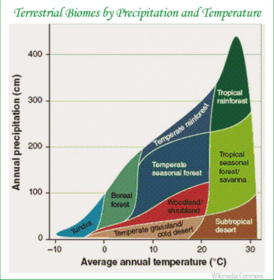
| Tropical Rainforests have the ________ and ________ climates Tundras have the _________ and ________ climates Deserts have the _______ and _______ climates | |
| Terrestrial biomes are classified according to _______ ______ and the primary form of _____ life | Climate Patterns ; Plant |
| Tropical rainforests near the equator receive over _____ mm of rainfall every year | 2000 |
| Because these areas are near the equator, they experience little variation in _________ and _________ | Temperature ; Precipitation |
| Tropical climates allow plants to grow __________ | continuously |
| Tropical rainforests contain a ______________ amount of the planet’s biodiversity | diproportionate |
| __________ and _________ trees grow here ; Deciduous trees shed their leaves _______ | Evergreen, Deciduous ; Annually |
| Plants compete for the _______ sunlight under the forest _______ or adapt to require ______ ______ | Limited ; Canopy ; Less Light |
| ________ _______ ______ and _______ experience seasonal cycles and a warm climate | Seasonal Tropical Forests ; Savannas |
| Seasonal tropic forests and savannas exist in the Tropics of ________ and _______, the latitudes _____ degrees south and north of the equator | Capricorn, Cancer ; 23.5 |
| Rainfall follows ____ and ____ cycles | Wet ; Dry |
| Vegetation adapts to the seasonality with lower _____ _______, shorter ________, seasonal ________, and an abundance of ______ and ______ | Tree Densities ; Stature ; Foliage ; Shrubs, Grasses |
| Fires during the ____ _______ and floods during the ____ _______ create woodlands and savannas | Dry Season ; Wet Season |
| Areas with ____ _________ and long periods without ___________ become hot deserts | High Temperatures ; Precipitation |
| Succulent plants evolved ______, _______ ______ and _______ to store water | Thick, Heavy ; Leaves ; Stems |
| Some desert animals compress their entire ____ ______ to fit short periods of ____________ | Life Cycles ; Precipitation |
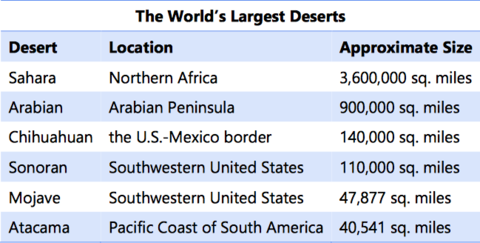
| The world's six largest deserts, in order from largest to smallest | |
| Temperate grasslands experience great __________ in temperature, with freezing _______ and warm, moist _______ | Fluctuations ; Winters, Summers |
| Frequent _____ and ______ by herbivores limits the growth of trees and shrubs | Fires ; Grazing |
| Temperate areas with _______ winters form shrublands and woodlands | Rainy |
| In temperate areas with rainy winters, since precipitation does not fall during the summer growing season, _______ _______ cannot develop | Large Plants |
| In temperate areas with rainy winters, short evergreens grow _______ due to the dryness of this environment | Slowly |
| The _________ of South Africa and the __________ of North America are coastal shrub lands | Fynbos ; Chaparrals |
| Inland shrub lands lie behind _________ ________ which suck moisture from the air | Mountain Ranges |
| The ________, ________ ________, and ________ ________ ring North America’s Great Basin | Cascades ; Sierra Nevada ; Rocky Mountains |
| _________ _________ forests exist in areas with prolonged winters | Temperate Deciduous |
| Trees cannot _________ efficiently in long periods of cold and therefore shed their leaves | Photosynthesize |
| A long growing season in spring and summer allows ________ regrowth | Foliage |
| Deciduous forests occur in _________ _________ and __________ | North America ; Eurasia |
| In a temperate deciduous forests, a sub canopy of _______, _______, and _______ _______ lies below the upper canopy | Shrubs ; Ferns ; Smaller Trees |
| These forests grow in a variety of climates | Temperate Evergreen |
| In dry areas of evergreen forests, forest fires every ____ to ____ years prevent the development of ______ ________ | 10 ; 20 ; New Species |
| The _______ _______ of evergreen trees prevent other plants from growing near them | Acidic Leaves |
| Evergreen trees include ______, ______, _______, and ________ | Pines ; Firs ; Hemlocks ; Junipers |
| ________ ________ grow in temperatures which remain below freezing for most of the year | Boreal Forest |
| These forests grow above 50° N | Boreal Forests |
| The cold climate above 50° N can lower the ____ ___________ to -50° C and freeze the _____ | Air Temperature ; Soil |
Quer criar seus próprios Flashcards gratuitos com GoConqr? Saiba mais.