
Flashcards
Bio 2nd Midterm
Flashcards do conjunto (187)
- 1What is EnergyIt is the capacity to cause change in a system or to do work. It comes in three forms, potential, kinetic,
- 2Potential EnergyIs the category of stored energy that an object has because of location, structure (also chemical energy arranged in molecules)
- 3Kinetic EnergyThe energy of motion
- 4What are the 3 differences between Kinetic and Potential EnergyPotential has it's energy on location and structure while kinetic is motion
- 5What are the principles of Conservation of Energy1. Energy can't be destroyed
2. Energy can be converted from one form to another - 6In every energy conversion what does some energy get converted intoHeat. Heat is kinetic and caused by the random motion of atoms. Heat decreases useful energy and causes entropy or disorder in the system
- 7Describe the general ways in which breakdown of gasoline in an automobile’s engine is similar to the process of cellular respirationBoth start with two molecules and they have to go through chemical reactions to get energy and they both have two byproducts at the end of the process. THEY BREAK COVALENT CHEMICAL BONDS and rearrange the atoms into lower energy molecules.
- 8What does ATP consist ofAdenosine and a triphosphate tail (Three phosphate groups) It's a nucleic acid
- 9Why is ATP essential to living organismsOrganisms can't break down high energy molecules directly and need ATP to provide energy. All cells need energy to move, grow and build chemicals that keep us alive. ATP gives us direct energy we need
- 10What type of things can ATP be used for1. Muscle Movement,
2. Movement in and out of cell (Transport), 3. Drive chemical reactions that require energy, and processes that require energy - 11What happens when ATP is broken down into ADPATP is a high energy molecule that has three phosphates. Energy is released from the Phosphate bond and it becomes Adenosine with two phosphates. This is ADP and it is a lower energy molecule
- 12How can ADP be converted back into ATP?ADP is a low energy molecule and needs to gain back it's energy. It also needs a phosphate to gain back and revert back to a ATP.
- 13MetabolismIs the sum total of all chemical reactions that occur in an organism.
- 14Hows do Metabolism workEach metabolic reaction requires the assistance of a specific enzyme. The enzyme lowers activation energy making everything more efficient and are able to produce more
- 15EnzymeAre proteins that act as catalysts that increase the rate of chemical reactions by lowering activation energy. ( Input of energy required for reaction to occur)
- 16Explain how enzymes are important in regulating metabolismAlmost always enzymes are needed to have metabolic reactions
- 17What type of organic molecules are enzymesThey are proteins that act as catalysts
- 18What effect does an enzyme have on the rate of a chemical reactions in a cell?The enzyme lowers the activation energy so it allows for more production and more efficient production. This makes enzymes vital and affects metabolism even in small amounts. An enzyme will catalyze thousand of molecules per second
- 19How do enzymes accomplish chemical reactions with less energyThey lower the activation energy of a reaction allowing for a decreased use of energy. The enzyme binds with molecule causing chemical or physical stress allowing for lower activation.
- 20Does a particular enzyme affect many different types of chemical reactions, or just one typeOnly one enzyme can affect one chemical reaction. They have to work together in order to produce the products it needs.
- 21Explain the relationship between an enzyme’s active site and the substrate it works onThe active site is on the enzyme where the substrate (molecule) will attach to the enzyme and break down. The active site is where the bind and breakdown happen. An active site must fit the substrate
- 22Is the enzyme used up in the chemical reaction it is involved in, or can it be reusedThe enzyme is not destroyed after the catalysis (separation of molecule) so the substrate is reused for the same chemical reaction and a new same molecule
- 23What sorts of things can inactivate an enzymeEnzyme inhibitors make enzymes inactive. It includes substrate imposters or substrates that don't fit. Also an inhibitor that attachs to enzyme so that they enzyme shape changes and can't function.
- 24Diffusion involves a net movement of molecules from where to whereMolecules from an area where they are in high concentration to an area where they are in lower concentration
- 25DiffusionIs the random movement of molecules so that they spread out evenly into the available space.
- 26Why does diffusion occurThe random movement of molecules from heat energy, Molecules tend to spread into the available space until equally distributed.
- 27Explain how facilitated diffusion is different from simple diffusion across a membraneFacilitated Diffusion, which requires specific transport proteins that act as selective corridors through which diffusion can occur. Like ordinary diffusion, no energy is required. This has to go through a membrane while Reg. Diffsion doesent
- 28Does Reg. Diffusion or Facilitaited diffusion either of these processes require an input of ATP energy from a cellNo. Like ordinary diffusion, no energy is required
- 29Osmosisis the diffusion of water across a membrane.
- 30which way water will move across a membrane by osmosisis the diffusion of water from a higher
water concentration (less dissolved particles) to a lower water concentration (more dissolved particles). water moves across a membrane by osmosis in a direction toward the higher concentration of dissolved particles. - 31predict which way water will move across a membrane by osmosis when a cell is placed into a solution of pure water (a hypotonic solution).Animal cells placed in pure water or other solutions with lower concentrations of dissolved particles (hypotonic solutions) than themselves will swell and burst due to osmosis of water into the cells
- 32Osmoregulationis the control of water balance within a cell or organism. It's hard for animals but the cell wall of plants regulate water a lot better and prevents burst
- 33Which way will water move across the membrane if a cell is placed into a concentrated (hypertonic) solution of salt or sugar water?Water will be moved into the solution out of the cell shriveling them up and draining the cell of water dying
- 34Why is it harmful for an animal cell to be surrounded by pure water, but beneficial for a plant cell?Animal cells don't have a cell wall from the osmosis and the concentration of water. They have to have the same isotonic (particle) water. It's good for plants because they can soak up more water in the cell to survive and creates a pressure on the cell wall making it firm
- 35Active transportRequires that a cell expend energy (by breaking down a molecule of ATP) to move molecules across a membrane.
Cells must use active transport to move substances across a membrane from lower to higher concentration - 36What type of protein does Active Transport needrequires a special carrier protein in the membrane
- 37What two things are required for Active Transport that are not required for simple diffusionActive Transport needs energy from a ATP and a special carrier protein
- 38Exocytosisis the secretion of large molecules within membrane-bound transport vesicles. (“exo” means to exit). The vesicle membrane just fuses with the cell’s plasma membrane to expel its contents
- 39EndocytosisTakes material in by means of vesicles that bud inward from the plasma membrane. (“endo” means inside)
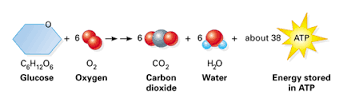
- 40Cellular respirationis a chemical process that harvests energy from organic molecules like glucose, and uses that energy to produce the ATP that all cells need.
- 41The process of photosythesisin green plants converts sunlight energy into a type of chemical energy, which is stored within the high-energy bonds in a molecule of glucose (or other sorts of high energy “food” molecules made by plants). They also make o2
- 42Where does cellular respiration occurMitochondria
- 43What is the equation for cellular respiration.(it can go either way)
- 44What is the eqaution for cellular respirationCan go either way
- 45Where does photsynthesis occurChloroplasts
- 46What processes does the chloroplasts doThey do cellular respiration and photosynthesis. They transform light into chemical energy and glucose as well as oxygen
- 47What processes does the mitochondria doThey only do cellular respiration. This turns oxygen and glucose into water and carbon dioxide
- 48Autotrophs(self-feeders) or producers
make their own high-energy organic molecules from inorganic nutrients (carbon dioxide and water), using sunlight as energy. - 49Heterotrophs(other-feeders) are consumers
include humans and other animals that cannot make their own high energy organic molecules: must consume them. - 50What types of cells carry out aerobic cellular respiration (animal cells, plant cells or both)?Both do but plant cells are the only ones who can do photosynthesis. Aerobic Respiration REQUIRES O2
- 51Are cellular respiration and breathing the same thing?No. Breathing allows fo the exchange of gases (O2 and CO2) so that the cells can perform cellular respiration.
- 52When a molecule of glucose is broken down by cellular respiration, what role do the high energy electrons in the glucose play?The electrons are passed from a higher energy state to a lower energy state, and potential energy is released in the process. The release of this energy must be done in a step-wise fashion in order for it to be “harnessed” in a useful way and used to generate ATP.
- 53metabolic pathwaywhich is a series of chemical reactions in cells. Each step in the pathway requires a specific enzyme.
- 54list the three main stages of cellular respiration in orderGlycolysis, Citric Acid cycle, electron transport chain
- 55Each chemical reaction or step in a metabolic pathway requires what in order for it ot occurIt requires a specific enzyme
- 56glycolysisa molecule of glucose is split into two molecules of a compound called pyruvic acid. Glycolysis occurs in the cytoplasm
- 57citric acid cycle (also called the Krebs cycle)uses enzymes that are dissolved in the fluid within mitochondria and
completes the breakdown of glucose all the way to CO2, which is then released as a waste product. - 58Electron Transport.Electrons captured by NADH are stripped of their energy, until they are finally combined with oxygen to form water. The electron transport chains are embedded within the inner membrane of the mitochondria. Electron transport from NADH, down theElectron Transport Chain to Oxygen releases the energy your cells use to make ATP
- 59When NAD+ accepts high energy electrons, it forms a high energy substance called___.NADH
- 60Explain glycolysis processGlucose is broken down. It begins with a input of ATP to begin and makes two 3 carbon molecules. An electron attaches to the NAD which becomes a NADH. This high energy molecule is broken down into 4 ATP and 2 Pyruvic acids
- 61What role does the NADH you named play in cellular respirationIt provided the molecules needed to create ATP and begin the cellular respiration cycle. It is used in nearly all the cycles of Cellular Respiration.
- 62The first stage of cellular respiration is called _________.Glycolysis
- 63Where does glycolysis occurs in what part of the cellCytoplasm
- 64What is the net gain of ATP molecules in Glycolysis4 ATP and a net gain of two after you subtract the two you put into the system to begin with
- 65What chemical is the end product of glycolysisPyruvic Acid, Co2, and 4 atp (2 net ATp)
- 66What happens to pyruvic acid before it enters the Citric Acid CycleIt loses a carbon that exits as a CO2 and becomes acetic acid. The acetic acid attaches to an enzyme to make acetyl Coa and produces NADH.
- 67What type of cells can carry out this cellular respiration plant, animal bacterial, or all threeall of them can
- 68This process ( before citrus acid cycle) starts with ___________and results in the production of a two carbon compound called _____________.1. Pyruvic Acid
2. Acetic Acid - 69The third carbon (before citric acid cycle) is released in the form of ________.CO2
- 70(Befor citric acid cycle)More high energy electrons and Hydrogen are transferred to ________ to form a high energy substance called ___________.1. Acetyl COa
2. NADH - 71WHat role does coenzyme a play in the process before the citic acid cyclecoenzyme a joins with acetic acid to create acetyl coa that makes the nadh
- 72The carbons that enter the citric acid cycle in the form of acetate (or acetyl co A) are eventually released as ________co2
- 73(Citric Acid Cycle) A small amount of _______ is produced which provides readily usable energy to the cell, but most of the energy from the original glucose molecule is captured by electron carriers called ____________1. ATP
2. Nadh and fadh2 - 74What does FADH2 and NAdh from the citric acid cycle do to the Electron transport systemIt donates it's high-energy electrons to the electron transport system
- 75Where does the Citric Acid Cycle occurMitochondria in the presence of oxygen
- 76What other types of molecule must be present in order for it to occur? (Citric Acid Cycle)oxygen
- 77What are the inputs of Citric Acid cycleAcetic acid, adp+p, 3 NAD+, and FAD
- 78Describe where the electron carriers of the Electron Transport Chain are locatedThe molecules of ETS are built into the inner membranes of mitochondria
- 79What role does NADH play in the ETSThe electrons from the NADH are taken and processed in the system.
- 80and in which stages of cellular respiration was NADH producedGlycolysis and after citric acid cycle
- 81What is the end product of the etsWater and ATP
- 82How are Hydrogen ions (H+) important to the functioning of the ETS?They flow through the membrane and release energy. They flow through the ATP synthase and takes the energy and then synthesizes ATP
- 83What does ATP synthase doThey synthesize ATP (create)
- 84(ETS) What chemical is the final electron acceptor, and what final product is producedThe final acceptor is oxygen and it bonds with hydrogen to make a final product of H2O
- 85How much ATP can be produced from a molecule of glucose by cellular respiration32
- 86Comparre Cellular Respiration to the amount of ATP produced by fermentationCR makes 32 while fermentation makes 2 ATP
- 87FermentationIt is a Anaerobic proccess (without oxygen) and makes 2 atp in glycolysis
- 88In which stage of stage respiration is most of the ATP producedETS
- 89Explain where each of the chemicals shown below enters into or is produced by the process of cellular respiration: C6H12O6 + 6O2 → 6CO2 + 6H2O1. Glucose
2. Oxygen
3. Co2 - Citirc Acid Cycle
4. ETS (water) - 90Explain in general terms how other high energy food molecules besides glucose (such as polysaccharides, fats and proteins) can be broken down to produce ATP energy.They are broken down into monomers and they will enter the different stages of respiration
- 91Describe the process of fermentation in muscle cells.It's glycolysis but hte end products are lactic acid instead of pyruciv
- 92Which part of cellular respiration does it involve (Fermentatoion)Glycolysis
- 93Why do muscle cells sometimes carry out fermentationWhen not enough oxygen is reaching the muscle. The lactic acid builds (soreness)
- 94What are the end products of fermentation2 atp and 2 lactic acid
- 95Describe the same things for anaerobic fementation carried out by yeast cells and other microorganismsThey do alcholic fermentation. It's glycolysis but the end products ethyl alcohol and co2
- 96Explain what energy isis the ability to perform work or cause change
- 97describe several different types of energy.1. Potential based on location and structure as well as chemical energy
2. Kinetic is motion energy includes heta energy - 98What types of organisms carry out photosynthesisChloroplasts
- 99Explain several ways that humans use the products of photosynthesis.Plants are food for organisms we eat. They produce oxygen and they keep the life cycle going and create usable energy from the sun
- 100thylakoid membranesChloroplasts contain stacks of membranes called tm
- 101chlorophyll.the pigment in thylakloid membranes. They capture light and convert light energy into chemical energy
- 102write the overall chemical equation for photosynthesis.
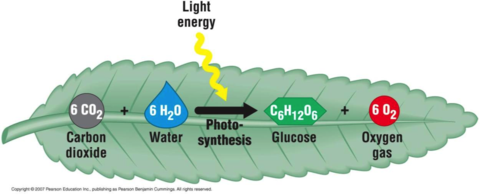
- 103Describe what photosynthesis accomplishes with respect to converting energy from one form to anotherPhotosyht has two processes the light reactions which convert light to chemical enerrgy and the calvin cycle which uses the chemical energy to make glucosse
- 104For the Light Reactions: where does this process occurChloroplasts
- 105For the Calvin Cycle: where does this process occurchloroplasts
- 106What “input” is required in order for the light reactions to occurYou need light and water for light reactions
- 107What products are formed in the light reactionso2 and ATP and NADH are formed
- 108How is the O2 produced in a light reactionA H20 molecuule is broken down by the sun and releasses s hydrogen
- 109Describe the characteristics of visible lightIt's in a small spectrum and all the colors combined makes white and different wavelengths of visible light is seen as different colors
- 110difference between different colors of light.they have different wavelengths
- 111pigmentis a materials selectively absorb certain wavelengths of light and do not absorb other wavelengths
- 112what wavelengths (colors) of light are absorbed and which are reflected by a pigment that appears green, or one that appears black, or whiteA pigment that appears green is one that doesn't absorb green but absorbs the rest of the spectrum. If it's white it doesn't absorb the entire spectrum
- 113Which wavelengths of visible light are absorbed and used for photosynthesis?chlorophyll a/b and carotonoids. It doesn't absorb green light
- 114Which pigment molecule in the water-splitting photosystem is involved directly in the light reactionsChlorophyll absorbs the photons of light energy and the electrons in the pigment gain energy and get to an excited state
- 115What happens when chlorophyll absorbs a photon of lightIt excites the electrons in the pigment getting it to an excited state
- 116What role do electrons play in the chlorophyllWhen the electrons get excited they are harnessed and turn into ATP and NADH (chemical energy)
- 117How does it replace these electrons in hte chlorophylla water molecule is broken up and it loses electrons and is used in the chlorophyll. Oxygen is produced from the replacement
- 118How does the electron transport system within the thylakoid membrane create ATP? (It involves H+ ions, and ATP synthaseETS is used between light reaction and calvin cycle. As electrons lose energy through ETS the hydrogen ions are released and they are pumped to the thylakoid membrane. Inhte membrane they go through atp synthase and synthesize atp
- 119How does this compare to the electron transport system for cellular respirationIt's close to the same but it doesn't produce as much atp and the atp is produced from the atp synthase in the thylokoid membrane instead of the mitochondria
- 120What things are produced in the light reactions that are necessary to fuel the Calvin Cycle?ATp, and nadph
- 121For the Calvin Cycle (CO2 Fixation): where does this process occurthey are in the liquid stroma of the chloroplasts
- 122What “input” is required in order for the Calvin cycle to occurCo2, Atp and NADPH
- 123What happens to the carbon that enters the Calvin Cycle as CO2It's broken down into a a G3P sugar that can be used to make a glucose or another form of high energy
- 124Explain how destruction of large areas of forest contributes to global warming (the greenhouse effect).We put more carbon dioxide increasing heat and less tress mean less carbon sinks and less oxygen
- 125What type of organisms first developed photosynthesisCyanobacteria (prokaryotes
- 126How did the development of photosynthesis significantly change the atmosphere on earthIt added oxygen into the air and allowed for other organisms to grow and created atmosphere that protected the earth which made conditions more favorable
- 127How and where is O2 gas produced by photosynthesisLight reactions
- 128stomataor pores for the exchange of carbon dioxide (in) and oxygen (out) between plant cells and the air. Stomata can close at night or when water is in short supply
- 129vascular tissuea system of tube-shaped cells that branch throughout the plant, for the transport of water and minerals from the roots up into the plant
- 130cuticlewaxy layer coating the leaves have to minimize evaporation of water.
- 131Two types of vascular tissue exist in plants1. Xylem transports water and minerals from roots UP to leaves and
2. phloem distributes sugars - 132Flowering plants (angiosperms) are characterized by having pollen, flowers, seeds, and fruits. Explain how each of these structures is an adaptation for reproducing in a terrestrial (land) environment.They are important for sexual reproduction because it can be carried in hte wind and is very easy to move. They don't need sperm to swim at all and fertilize an egg. They are very efficient
Seeds are good too because htye are protected and have food so they are durable - 133How do fungi obtain energy and nutrientsdigests food outside its body by secreting powerful digestive enzymes to break down the food andabsorbing the simpler food compounds
- 134What important functions do fungi perform for us, and for an ecosystem?They release nitrogen, carbon and other elements that recycle and are able to be used by us. This is the stock of inorganic nutrients needed for plants to grow
- 135symbiosisis a close and long-term interaction between members of two different species
- 136mycorrhizaeare an example of a mutually beneficial symbiotic relationship between fungi and plant roots
- 137how does each type of organism involved in this symbiosis benefit from the interaction mycorrhizaPlants bemefit because the fungus helps absorb water and minerals.
Fungi benefits by transfer of sugars and other organic materials - 138At what point in the cell cycle of mitosis do chromosomes replicateInterphase (No signs of cell division)
- 139After replication, each chromosome is made up of two ___________________ held together at a point called the _________________1. sister chromatids
2. Centromeres - 140chromosomemade of chromatin, fibers composed of roughly equal amounts of DNA and protein molecules and
not visible in a cell until just before cell division occurs. They also hold genes that are the blueprints for all of the cell - 141chromatinis fibers composed of roughly equal amounts of DNA and protein molecules an
- 142At what point in the cell cycle do chromosomes replicateinterphase in the s phase
- 143At which point in the cell cycle does chromatin condense and become visible as chromosomesProphase
- 144ProphaseThe nuclear envelope is disintegrated and chromatin condenses and single strands of chromosome. SPindle forms and attach to centromeres seperating chromatids. The centrosomes move to opposite poles
- 145MetaphaseChromosomes line up in Middle of the cell (at the equator), pulled there by spindle fibers attached to centromeres.
- 146AnaphaseSister chromatids are pulled Apart from each other at the centromere, and are pulled apart to opposite poles. Each sister chromatid is now considered to be a separate chromosome.
- 147TelophaseChromosomes uncoil, become less visible
Nuclear membranes reform around each new identical nucleus
Spindle disappears - 148function of the spindle in mitosis and meiosispull apart the chromatids
- 149cytokinesis(division of the cytoplasm) occurs in Telophase. Animal cells do cleavage and sucks in so much it splits. The animal cells build a new cell wall and it builds up until it becomes a new cell. It called a cell plate
- 150During which stage of mitosis does cytokinesis occurtelophase
- 151Describe the main difference between cytokinesis in plant cells and cytokinesis in animal cells.Animal cells doo cleavage furrow which snaps the cell into two. The animal cell creates a cell plate that becomes a cell walll that divides the two cells and they become two
- 152Compare how the number of chromosomes in the “parent” cell compares with the number of chromosomes in the two “daughter” cells that are formed.They both have the same amount of chromosomes. There are 46 chromosomes and in the daughter cells the chromosomes are exactly the same
- 153Describe the key characteristics of cancer cells, in terms of genetic changes and regulation of mitosisThere are cell cycle control systems that regulate division. Cancer is a disease that don't respond to the cell control system. They will divide out of control and spread. They form tumors
- 154metastasisThe spread of cancer cells beyond their original site of origin
- 155What is the difference between a benign tumor and a malignant one?A beignin tumor is abnormal cells remain in the same site. Malignant tumors or cancerous tumors spread across the body and interrupt normal body functions. They can travel through lymphatics or bloodstream
- 156Sexual reproduction always involves two processes1. Meiosis
2. Fertilization - 157a special type of cell division called _______ which reduces the number of chromosomes in the cell by half,meiosis
- 158a process called __________ which results in formation of a new cell with two sets of chromosomesfertilization
- 159Explain why sexual reproduction always requires both meiosis and fertilizationSexual reproduction produces offspring that contain a unique combination of genes from two parents
- 160Meiosis in humans results in the formation of ________________.Haploid cells
- 161Explain the difference between haploid and diploid cellsHaploids are for sexual reproduction cells and have only one set of chromosomes. Diploids have two sets of chromosomes and are mostly for the bodies cells
- 162Which cells in the human life cycle are haploidDuring egg and sperm and inbetween meiosis and fertilization
- 163How many chromosomes does a diploid human body cell contain?46
- 164How many chromosomes does a haploid human body cell contain?23
- 165What is a karyotypeA picture of a complete set of chromosomes
- 166autosomesTwenty-two pairs of chromosomes . two members of each pair look similar to each other. (44) Sex chromosomes dont count
- 167What determines whether a person is male or femaleSex chromosomes. XX is girl XY is male
- 168In what ways are homologous chromosomes similar to each otherThey are two members of a pair of chromosomes. Similar in the size, shape, and staining pattern. Homologous chromosomes carry genes for the same traits
- 169Are the homologous chromosomes both from one parentNo. one chromosome comes from the mother and the other from the father
- 170What are gametes, and are they haploid or diploidhaploid (egg and sperm)
- 171What is a zygote, and is a zygote haploid or diploidA zygote is a fertilized egg and it's a diploid
- 172What happens in Interphase before meiosisThe homologous chromosomes are duplicate they form two sister chromatids and the sister chromatids are split
- 173What does meiosis I accomplishSeperate the homologous chromosomes
- 174What does meiosis II accomplishSeperat the sister chromatids
- 175homologous chromosomes ever pair up in mitosis? In meiosis?Homologous chromosomes never even pair up with each other in mitosis but they do in meiosis
- 176What is being pulled apart from each other in Anaphase I of meiosisThere pulling apart the homolougous chromosomes but the sister chromatids remained attached
- 177what things are being pulled apart from each other in Anaphase II of meiosis?The sister chromatids are being pulled apart from both of the haploid cells
- 178Which Anaphase of meiosis is most similar to what happens in Anaphase of mitosis? ExplainProbably Anaphase two becuase the sister chromatids are being pulled apart.
- 179What happens during Crossing Over,exchanges genes between maternal and paternal chromosomes, creating new combinations of genes
- 180what point in meiosis does crossing over occur?anaphase 1
- 181What does “independent assortment” of chromosomes meanchromosomes during Metaphase I occurs: the pairs line up and head to opposite poles randomly
- 182Explain how Independent Assortment, Crossing Over, and Random Fertilization each contribute to genetic variation in offspringThere is sharing of genes and the genes chosen are randomly chosen so there could be a huge variation in the genes chosen. And a sperm can fertilizee with any random egg
- 183Explain how nondisjunction during meiosis can result in chromosomal problems such as Down Syndromenon disjunction the members of a chromosome pair fail to separate at anaphase, producing gametes with an incorrect number of chromosomes
- 184What happens when there is disjunctionAbnormal amount oof chromosomes is triomy and babies could die form this and many will have strange karyotype and many syndromes could occur
- 185What is the main risk factor (thing that increases risk) for Down Syndrome?The increasing age of the mother
- 186What does a karyotype show?the 46 chromosomes which are then shown as pairs called autosomes and then called homologous chromosomes
- 187Meiosis begins with cells that are _______ (haploid or diploid) and produces cells that are _____(haploid or diploid) .1. Diploid
2. Haploid