
Flashcards
Material removal processes
Flashcards do conjunto (21)
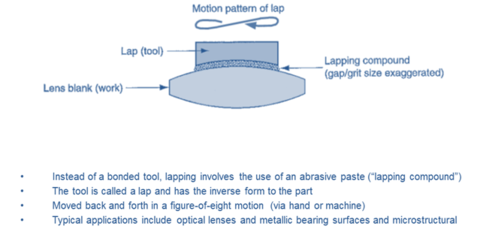
- 1Lapping
- 2Laser Cutting (Light Amplification by Stimulated Emission of Radiation)-Converts electrical energy into light, can be focused onto a small area with high power density.
- Produces a combination of evaporation and melting
- Uses include precision cutting of metals with high hardness, soft metals, ceramics, glass, rubber, wood.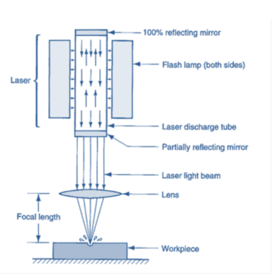
- 3Water Jet Cutting- Use of a fine, high-pressure and velocity water stream directed at work
- cutting fluid is usually polymer-based, gives a more coherent stream than water alone
- CNC controlled
- Can be used to precisely cut narrow slits in flat stock at high rates - 4Pros and cons- minimum distortion at the cut and low material loss
- Not suitable for cutting brittle materials due to their tendency to crack under high impact - 5Abrasive Jet Machining-Involves bombarding the surface of the work with small gas-borne particles at high pressures
- The gases used are dry and inert (dry air, nitrogen or CO2)
- The process is normally performed by manually directing the jet and therefore sufficient ventilation is required
- Normally used as a finishing process (deburring, deflashing, cleaning, polishing)
- Grains cannot be re-used as they fracture or deform during the process.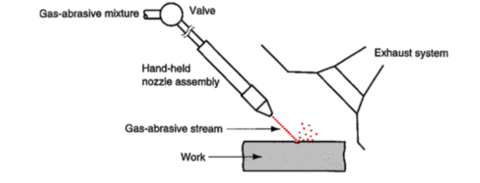
- 6Ultrasonic Machining- Abrasives carried in a slurry are driven at high speed against the work by a tool vibrating at low amplitude and high frequency
- Tool is slowly fed into the work and the shape is formed by the abrasive particles.
- The slurry is a mix of water and abrasive particles
- Circulation brings in fresh grains and washes away worn particles and chips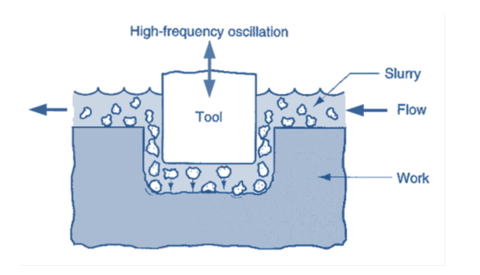
- 7Advantages and disdvantages- Can be used for the machining of very hard brittle materials (ceramics and glass)
- But the cutting action also acts against the tool - 8Electric Discharge (Spark Erosion) Machining- One of the most widely used non traditional processes
- pulsating current passes from the tool to the work through a dielectric fluid (which ionises and creates a path for the discharge)
- discharge occurs where the two surfaces are closest
- High local temperatures result in local melting and removal of the metal work (carried away in the fluid)
- Used to produce high precision parts such as tooling, molds, extrusion & forging dies & sheet metal stamping dies - 9Disadvantage- Tool becomes a disposible ittem
- But graphite can be used: doesn’t melt but vaporises at higher temps – leading to less wear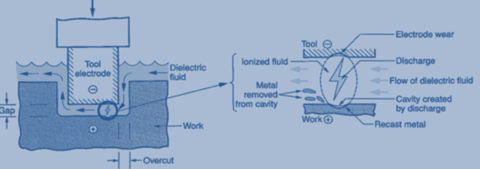
- 10Electro Chemical Machining (Characterized as “reverse electroplating)- cathode is in the shape of the desired feature
- material is selectively dissolved from the gap (80-800 μm) between the cathode and anode
- Electrolyte used to bridge gap between cathode and anode
- Very high current but low voltage used - 11Advantages- Exceptional accuracy
- Low material removal rate (Almost no damage to the underlying material structure (residual stresses) - 12Temperature damage- Temperature: A measure of the average kinetic energy of a material’s particles
- Energy drives structural changes
- Energy allows transformations of structure
- Changes to properties
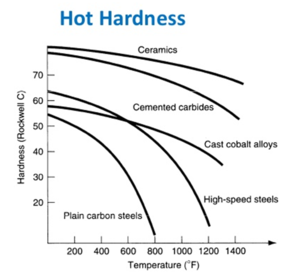
- Changes to the material itself - 13Hard Machining- The tool rubs the workpiece and causes an extreme increase in temperature.
- Workpieceis heat treatable steel- extreme heating hardens the material
- eliminating the need for the secondary process – A hybrid process - 14Heating & deformation
- 15Deformation twins- Crystals of material which although they share a common plane have a completely separate orientation to the host crystal.
- high strain energy produces twins of the twins - 16Material degradation- Well processed materials have low energy
states.
- Reverting back to mineral states involves oxidisation leading to rusting and film development.
- Corrosion is generally a chemical reaction
- - 17Minimum potential energy- Reactants and products want to achieve a minimum energy state.
- Free energy: energy stored and energy that can potential be used by the substance
- Enthalpy: numeric representation of the potential eergy of the product compared to the PE of the reactants. - 18Residual stress- Caused by deformation during machining
- Can be either tensile or compressive.
- Can occur at the surface but more commonly acts throughout the material.
- The more abusive the cutting parameters the larger the magnitude of these stresses. - 19Removing residual stress- Simple annealing process
- Heating to a certain temperature can allow dislocation within the lattice
- can be reverted, but will remove work hardening etc, intentional or not
- This process can soften the metal - 20Braggs lawCalculation of the angles for coherent and incoherent scattering from a crystal lattice
- 21Analysis of materials- In a perfect lattice the X-Rays will penetrate and bounce back out of the material at a known angle.
- Stress and strain will make the angle deviate from the known angle
- Following this procedure we can:
-identify what material we are looking at
- can measure the amount of stress and strain within the material structure.
Informações
- Descrição
- Bachelors Materials & manufacturing FlashCards sobre Material removal processes, criado por Natalia Rehakova em 14-05-2016.
- Criado por
- Natalia Rehakova
- Visualizações
- 0
- Avaliação