
5786771
Descrição

FlashCards por pavanishukla9569, atualizado more than 1 year ago

|
Criado por pavanishukla9569
mais de 10 anos atrás
|
|
| Questão | Responda |
| 1. What is the order of the organisational hierarchy? | Atoms, molecules, cells, tissues, organs, system, organism, population, community, ecosystem & biosphere |
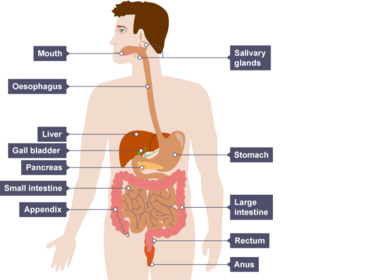
| 2. What do the parts of the digestive system do? | Mouth - food enters the alimentary canal and digestion begins |
| Salivary glands | Produce saliva containing amylase |
| Oesophagus | Muscular tube which moves ingested food to the stomach |
| Stomach | Muscular organ where digestion continues |
| Pancreas | Produce digestive enzymes |
| Liver | Produce Bile |
| Gall bladder | Stores bile before releasing it into the duodenum |
| Both small intestines | Duodenum - Where food is mixed with digestive enzymes and bile Ileum -Where digested food is absorbed into the blood and lymph |
| Large intestine (colon) | Where water is reabsorbed |
| Rectrum | Faeces are stored |
| Anus | Faeces leave the body |
| 3. What is peristalsis? | Muscular contractions in the smooth wall of the gut which move food through the alimentary canal |
| Muscles in the gut wall | Circular muscles - which reduce the diameter of the gut when they contract Longitudinal muscles - which reduce the length of the gut when they contract |
| 4. Plasma functions | Transporting carbon dioxide, digested food, urea, hormones and heat |
| Red blood cells | Transport oxygen |
| White blood cells | Produce antibodies and ingest pathogens |
| Platelets | Involved in blood clotting and scab forming |
| Adaptions of red blood cells | Haemoglobin - a red protein that combines with oxygen No nucleus - for more haemoglobin Biconcave shape - maximise surface area space small and flexible so that they can fit through narrow blood vessels |
Quer criar seus próprios Flashcards gratuitos com GoConqr? Saiba mais.