
Flashcards
Learning
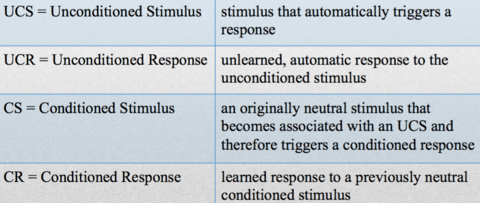
Flashcards do conjunto (43)
- 1What are the acquisition and performance phrase of a learnt response?The acquisition of a learnt response is the period during which learning is occurring. Performance occurs after learning.
Acquisition: neutral stimulus repeatedly presented before the unconditioned stimulus to form an association.
Performance: the conditioned stimulus produces a conditioned response
If the acquisition phrase is successful, it will be displayed in the performance phrase. - 2What is Observational Learning?Observational learning is learning through observation of others performing the desired behaviour.
The components of observational learning are:
*Attention
*Retention
*Motivation
*Reproduction - 3What are the components of Observational Learning? Define them.
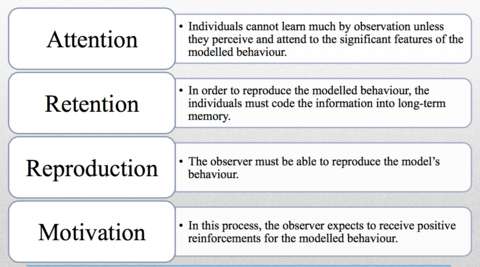
- 4Using examples, explain the 4 Components of Observational Learning.
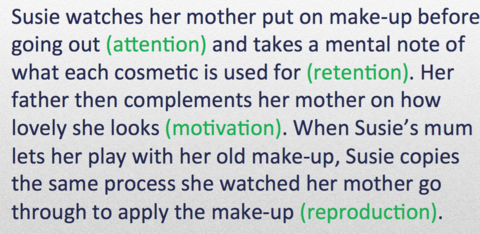
- 5What are the Components of Classical Conditioning?The components of classical conditioning are:
*Neutral Stimulus
*Unconditioned Stimulus
*Unconditioned Response
*Conditioned Stimulus
*Conditioned Response - 6Using an example, explain how the Components of Classical Conditioning work.
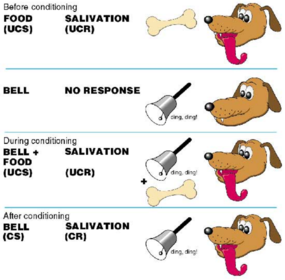
- 7What are the Components of Operant Conditioning?The components of operant conditioning are:
*Positive Reinforcement
*Negative Reinforcement
*Punishment - 8What is the different between reinforcement (positive and negative) and punishment?
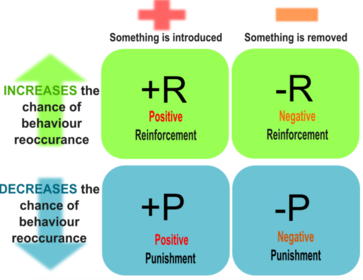
- 9Identify what type of Operant Conditioning is being used in the following scenario: Cass really wants to do well on her spelling test, so she studies really hard. She spells all the words correctly on the test and feels really proud of herself. This motivates her to study even harder in the future.Positive Reinforcement
- 10Identify what type of Operant Conditioning is being used in the following scenario: A marketing firm starts awarding their top salesperson each month a reserved parking space in order to increase sales.Positive Reinforcement
- 11Identify what type of Operant Conditioning is being used in the following scenario: Charlie is sent to the sin bin for abusing the referee during an ice hockey match. The next time she thinks she made a bad call, she bites her tongue.Punishment
- 12Identify what type of Operant Conditioning is being used in the following scenario: Attendance at Sydney Primary School increases after a policy is introduced where students who have perfect attendance during a term get to go to bowling on the last day of school.Positive Reinforcement
- 13Identify what type of Operant Conditioning is being used in the following scenario: Mataya cleans her room so that her parents will stop nagging her.Negative Reinforcement
- 14Identify what type of Operant Conditioning is being used in the following scenario: Ling did not go to the dentist every 6 months for a check-up. Instead, he waited until a tooth really hurt, then went to the dentist. After 2 painful emergency dental procedures, John now goes to the dentist every 6 months like he should.Negative Reinforcement
- 15Identify what type of Operant Conditioning is being used in the following scenario: Santa wasn’t doing well in her 6th grade math class. Her teacher told her parents that Santa handed in less than 50% of her assignments. Her parents told Santa that any day on which she did not hand in her homework she would be sent to bed right after dinner. As a result of this threat, Santa has handed in her assignment 97% of the time.Negative Reinforcement
- 16Identify what type of Operant Conditioning is being used in the following scenario: Every time Tim calls his girlfriend, she sounds really happy to hear from him. This encourages him to call her more often.Positive Reinforcement
- 17Identify what type of Operant Conditioning is being used in the following scenario: You take the time to tell your boss that you have some ideas for how the business could run better. She doesn’t seem interested in your ideas, so you don’t bother to approach her again.Punishment
- 18Identify what type of Operant Conditioning is being used in the following scenario: You tell a joke to a group of people at a party and everybody laughs, so you tell the same joke to the next group of people you speak to.Positive Reinforcement
- 19Identify what type of Operant Conditioning is being used in the following scenario: Carl wants to stop his cat from jumping up on the kitchen counter, so he squirts her with water every time he sees her on the counter.Since it doesn't say whether the behaviour increases or decreases, it could be:
Punishment- because the cat is squirted with water every time it jumps on the counter
Negative reinforcement- because the cat is squirted with water every time it jumps on the counter, which could encourage the cat to keep doing the action - 20What Factors impact the effectiveness of punishment?*Contingency
*Contiguity
*Resentment between the punisher and recipient
*Causes the recipient to be sneaky or rebellious
*Intensity- how likely the punishment will affect the recipient - 21Why is Punishment not used for Behaviour Modification? Explain using an example.Punishment is not used for behaviour modification because it is only useful for short-term behaviour change. It only works when contingency and contiguity are both high. Punishment cannot always be continuous. It also makes it incredibly predictable when and what kind of punishment the recipient will receive, which may cause them to be sneaky.
For example, if a child is punished every time they go out without finishing their work, they may sneak out of the house, which would not change the behaviour in the right direction. - 22What are the Schedules of Reinforcement?The schedules of reinforcement are:
*Fixed interval
*Variable interval
*Fixed ratio
*Variable ratio
*Continuous
*Intermittent Schedule of Reinforcement includes everything but Continuous (behaviour reinforced every time) - 23Using examples, explain the Schedules of Reinforcement.
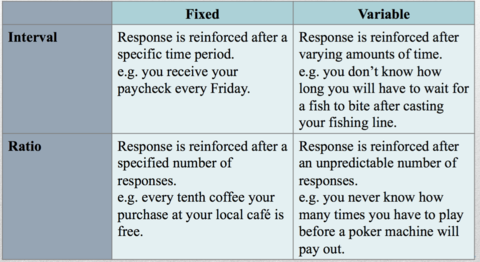
- 24What is Behaviour Modification? What is the process?Behaviour modification is a therapeutic technique. It only uses positive reinforcement.
The steps of behaviour modification are:
*Establish desired behaviour goal
*Establish the reinforcement (reward)
*Start program
*After behaviour is established, move to the intermittent schedule
*Gradually decrease the reinforcement
*Eventually the behaviour becomes self-rewarding - 25Using an example, explain how Behaviour Modification can be used to increase the Time Spent on Homework by a child.
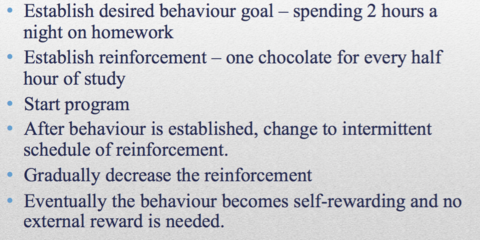
- 26What is Contiguity? *For Classical Conditioning and Operant ConditioningClassical Conditioning:
Contiguity in classical conditioning is how closely together in time the UCS and NS are presented
Operant Conditioning:
In operant conditioning, contiguity is the time interval between the behaviour and the consequences - 27What is Contingency? *For Classical Conditioning and Operant ConditioningClassical Conditioning:
In Classical Conditioning, contingency is the strength of the association between the NS and UCS
(Are they always presented together?)
Operant Conditioning:
In Operant Conditioning, contingency is the connection between the behaviour and consequences/reinforcement
(Does the same consequence follow behaviour?) - 28Identify the NS, UCS, UCR, CS and CR from the following scenario: The smell of freshly baking bread makes my mouth water
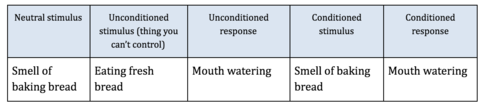
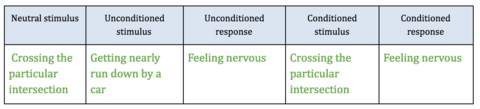
- 29Identify the NS, UCS, UCR, CS and CR from the following scenario: While crossing an intersection, you are nearly run down by a car. The next time you approach that intersection, you find yourself feeling nervous (palms sweating, heart racing, etc.)
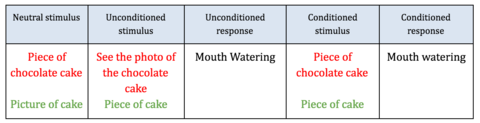
- 30Identify the NS, UCS, UCR, CS and CR from the following scenario: You see a photo in a magazine showing a big piece of chocolate cake and you discover that your mouth is watering
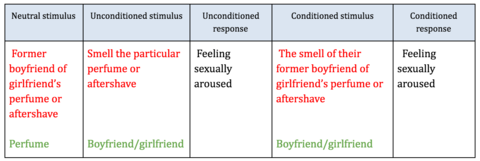
- 31Identify the NS, UCS, UCR, CS and CR from the following scenario: You smell someone’s perfume or aftershave, the same one that a former girlfriend or boyfriend used to use, and you find yourself feeling sexually aroused
- 32Identify the NS, UCS, UCR, CS and CR from the following scenario: You eat a large bowl of chilli for supper, and then wake up in the night terribly sick from the flu. The next time you are served chilli, you pass, saying that it makes you sick just to look at it

- 33Identify the NS, UCS, UCR, CS and CR from the following scenario: In order to be able to punish my cat, even when I’m not near enough to reach him, I have paired the sound of a clicker with getting squirted with water. Now the sound of the clicker causes him to startle

- 34Identify the NS, UCS, UCR, CS and CR from the following scenario: After the bad car accident we had last year, I cringe and break into a sweat at the sound of squealing brakes

- 35Identify the NS, UCS, UCR, CS and CR from the following scenario: To treat alcoholics, doctors sometimes put chemicals in their drinks that make them sick. Eventually, the taste of alcohol makes them sick

- 36Explain how Extinction applies to this situation: Joan, an animal trainer, has been phobic about monkeys since an earlier attack. However, because of the money, she has agreed to work with monkeys for a movie studio. At first, just going anywhere near the monkey cages makes Joan tense, sweaty, and apprehensive. Lately, though, things have changed. Working with such cuddly, affectionate, human-like creatures is causing Joan to wonder why she ever felt such extreme distress.Extinction is when the CR decreases, and eventually disappears. It occurs when the UCS is repeatedly presented without the CS, therefore the association between the two becomes weaker, until they are no longer related.
In this case, Joan... - 37How can Classical Conditioning be used for Advertisements?Commercial for a Perfume with an attractive male model
NS: Perfume
UCS: Attractive male model
UCR: Interest
CS: Perfume
CR: Interest in the perfume - 38What is preparedness? Explain using an example.Some behaviours are easier to evoke than others- it is easier to strengthen an already existing behaviour than to generate a new one.
For example, it is much easier to condition food with poison than poison with food. - 39What is extinction? Explain using an example.Extinction is when the CR decreases, and eventually disappears. It occurs when the UCS is repeatedly presented without the CS, therefore the association between the two becomes weaker, until they are no longer related.
For example, a person may have been scared of dogs because of past experiences (being chased by a dog). If the person does not react negatively after being exposed to a dog (a cute, small and fluffy dog), extinction would occur. - 40What is Stimulus Generalisation? Explain using an example.Stimulus generalisation is the tendency to evoke the CR to stimuli that are similar to the CS.
For example, fearing a spider and responding the same way to all spiders disregarding the size or shape is stimulus generalisation - 41What is Stimulus Discrimination?Stimulus discrimination is the ability to distinguish between a CS and other similar stimulus
For example, a person might be scared of large, black dogs, but not small, white dogs. - 42What is Systematic Desensitisation? What steps are involved?Systematic desensitisation is a therapy to treat phobias, which uses the principals of classical conditioning.
The steps involved are:
*The person chooses and learns a deep relaxation technique (listening to music, meditating)
*The person constructs an anxiety hierarchy starting from the least anxiety evoking stimuli to the most anxiety evoking stimuli
*The relaxation technique and the anxiety hierarchy would be paired together and each level would be conditioned before moving on to the next one - 43What Ethical Issues needs to be considered for Animal Research in Learning?Ensure:
*The animal is in a comfortable surrounding
*They have an appropriate diet
*They do no undergo any distress or harm
*Their natural behaviour is not changed (dog barking or licking things)
Informações
- Descrição
- 12 Psychology Stage 2 (Learning) FlashCards sobre Learning, criado por Roosi P em 24-06-2016.
- Criado por
- Roosi P
- Visualizações
- 1
- Avaliação