
Flashcards
Week 1
Flashcards do conjunto (86)
- 1Chemically correct ratio?1:15
- 2Best economy ratio?1:16
- 3Best Power ratio?1:12
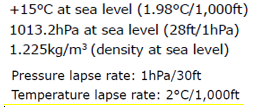
- 4Standard Atmosphere details:
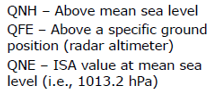
- 5Altimeter subscale setting?
- 6Composition of atmosphere?78% nitrogen
21% oxygen - 7EW?Empty Weight:
Aircraft + Fixed equipment + unusable fuel + undrainable oil - 8BEW?Basic Empty Weight:
EW + full oil and other items necessary for all flights - 9ZFW?Zero Fuel Weight:
BEW + Crew + Pax + all baggage & Cargo, but not including fuel - 10GW?Gross Weight:
a.k.a All Up Weight (AUW)
ZFW + fuel for a flight - 11Weight of Male crew?85kg
- 12Weight of female crew?65kg
- 13TORATake-off run available
(runway length) - 14TODA?Take off distance available:
Physical length of runway (TORA) + any clearway - 15TOSS?Toke-off safey speed
No less than 1.2Vs at 50ft AGL - 16TODR?Take-off distance required:
Distance required to reach 50ft AGL at TOSS
15% added to planes with MCTOW 2000kg or less (Maximum Certified Take-off Weight) - 17Finding Pressure Altitude?1. Standard pressure – stated pressure
2. Difference convert to ft using (1hPa/30ft)
3. Add to altitude given - 18How to find Density altitude?1. Actual pressure – expected altitude using PA (15 deg – 2deg/1000ft)
2. Difference convert to ft using (120ft/deg)
3. Add to pressure altitude - 19Performance-Limited Landing Weight (LW-P)Maximum gross weight (usually less than MCLW) due to external
influence such as atmospheric conditions and runway limitation - 20Maximum (Certified) Landing Weight (MCLW)Maximum gross weight permitted prior to landing
MCLW may not be the same as the MCTOW - 21Performance-Limited Take-Off Weight (TOW-P)Maximum gross weight (less than MCTOW) due to external
influence such as atmospheric conditions and runway limitation - 22Maximum (Certified) Take-Off Weight (MCTOW)Maximum gross weight permitted prior to take-off
- 23Maximum ramp weightMaximum gross weight permitted prior to taxiing
• May exceed the MCTOW by the start-up and taxi fuel allowance - 24List of all the weight terms(EW) Empty Weight
(BEW) Basic Empty Weight
(ZFW) Zero Fuel Weight
(GW) Gross Weight
(MRW) Max Ramp Weight
(MCTOW) Max certified Take-off Weight
(TOW-P) Performance-Limited Take-off Weight
(MCLW) Maximum Certified Landing Weight
(LW-P) Performance Limited Landing Weight - 25Relationship between seating capacity and standard passenger weightAs capacity increases
Male and Female weight Decreases - 26Meaning of Pax?Passengers
- 27Loading CategoriesNormal Category: Load factor = 3.8 - 1.5g
Utility Category: Load Factor = 4.5 - 1.8g - 28LDRLanding Distance Required:
The distance from 50ft over the runway at the correct speed
(1.3Vs) with full flaps and power off, to the point where the aircraft
reaches a full stop - 29LDALanding Distance Available:
Actual runway length, less any threshold displacement. - 30Economy Expectations for actual vs calculated altitudeCPL: +/- 50ft
PPL: +/- 100ft - 31What is aircraft operations?- The ground and airborne movement of aircraft
- Either in controlled or uncontrolled airspace - 32CAR vs CASRs vs CAA?Talk to Paul Lee
- 33Why are CARs being phased out? What is replacing them?Talk to Paul Lee
- 34Purpose of a CAO - relevence to pilots - future uses?1. They amplify,
explain and/or expand the CARs where necessary, and contain
material of a less permanent nature.
2. Parts 20-95 Pilots
3. CAOs are incorperated into CASR and CAAP (why?) - 35AIPAeronautical Information Publication:
AIP strengthens relevant pre-flight information and inflight
procedures of a lasting nature into a primary publication - 36CAAPCivil Aviation Advisory Publication:
The CAAP contains advice on operational matters relating to civil
aviation and there is no legal requirement to observe the details - 37ERSAEn Route Supplement Australia:
The ERSA is an aerodrome and facility directory with information on
air traffic services and frequencies - 38NOTAMNotices to Airmen:
NOTAMs provide information that is of direct operational significance,
but a temporary nature, which may immediately affect aircraft
operations - 39AICAeronautical Information Circular:
The AIC is used to disseminate aeronautical information, an
administrative nature, to aircrew - 40Airworthiness classesClass A: Transport or commercial
Class B: Aeroplane that is not Class A - 41List of Airworthiness Documents1. (COA) Certificate of Airworthiness
2. (CoR) Certificate of Registration
3. (AFM) Flight Manual
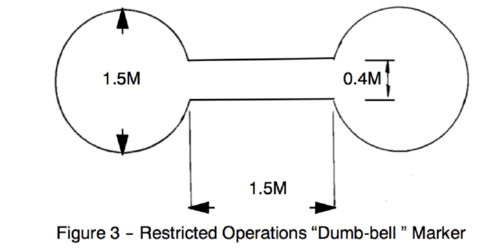
4. (MR) Maintenance Release - 42Purpose of a CoA and who issued byCertificate of Airworthiness:
1. Issued by the CASA if it meets:
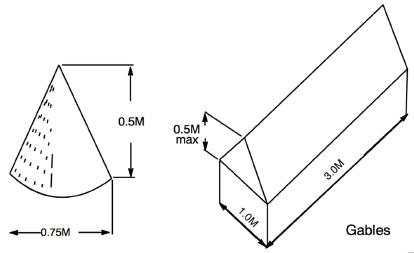
2. Approved manufacturing standards;
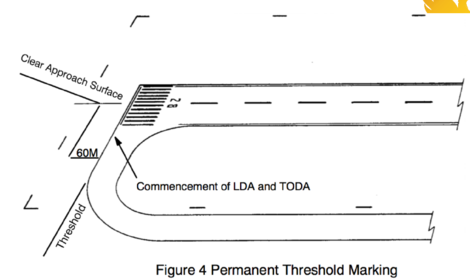
3. Conforms to approved design standards; and,
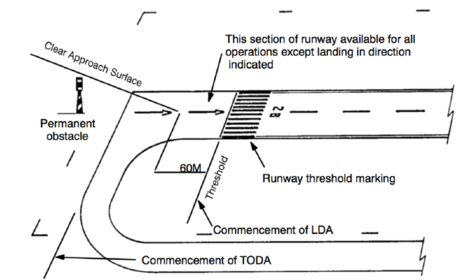
4. All the appropriate airworthiness standards - 43Purpose of a CoRCertificate of Registration:
1. Issued by CASA
2. Keeps a register of Australian aeroplanes
3. VH(xxx) Aus registered aircraft
4. Amateur-built aircraft can be registered with CASA as VH aircraft or registered with RA-Aus - 44Runway conditions and protocol1. Damp: Assumed no effect.
2. Wet: Puddles. Refer to table, manual or regulator.
3. Contaminated: 25% covered by ice, water, slush. Refer to table, manual or regulator. - 45AFMFlight Manual:
1. An airworthiness document approved by the CASA
2. Must remain in the aeroplane when operating
3. Contains the final reference in relation to operating limitations
and techniques - 46MRMaintenance Release:
1. App by CASA
2. Records the current legal airworthiness status of the aircraft
3. Consists of three parts
4. MR to be re-issued after one year or clocked up the specific TIS
whichever comes first - 473 Parts of an MR1. Maintenance release
2. recording of all aircraft defects (done by Licensed Pilot) and
corrective action taken to return the aircraft to airworthy state (cleared by LAME: Licensed Aircraft Maintenance Engineer)
3. Certification of the daily inspection + recording of the
total time-in-service (TTIS) and time-in-service for each day’s flying - 48Types of Maintenance Inspections1. Periodic or general maintenance inspections: These can be annual and/or 100-hourly inspections by a suitably qualified LAME.
2. Daily (Maintenance) inspection. These are carried out by an LAME or by a licenced pilot prior to the
first flight of each day to ensure the aeroplane is in a suitable
condition for flight
3. Pre-flight inspection - 49Aircraft log book1. A logbook for each of a particular part of the aeroplane
2. An engine log book, a propeller log book and a radio log book for aeroplanes operating under IFR
3. TTIS: Total-Time-In-Service
4. TIS: Time-In-Service. Airborne time - 50What is a Transponder?A transponder is an electronic device that produces a response when it receives a radio-frequency interogation
- 51What is an SSR?Secondary Survellience Radar Transponder:
Used by ATC to detect:
Position, Range and Bearing,
And requests information such as identity + altitude - 52SSR Transponder Modes + requirementsNeed Mode A + C or Mode S
A: no alt, C: alt mode
Mode S: alt mode + registration of AC + flight plan + etc
When:
1. Within controled airspace
2. Class E airspace -10,000ft AMSL
3. Any class of airspace +10,000ft AMSL - 53SquawkingThe term "squawk" is used when they are assigning an aircraft a transponder code.
"select transponder code" - 54SSR Emergency Codes7700 Emergency
7600 Emergency + Losing 2 way comm
7500 Unlawful interference
(need to confirm) - 55Distress vs UrgencyDistress: Immediate help. Engine failure etc (call MAYDAY 3 times)
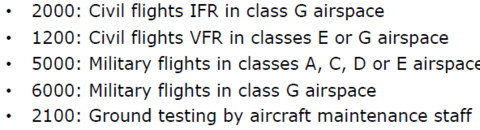
Urgency: Non-immediate help. Sick Passenger etc (call PAN PAN 3 times) - 56Examples of non-discrete transponder codes
- 57Classes of aerodromesCertified aerodrome
Registered aerodromes
Military aerodromes
Designated aerodromes
Controlled Aerodromes - 58Certified aerodromeHas a runway suitable for use by aircraft having a max pax seating
capacity of more than 30 seats or a max carrying capacity of more
than 3,400kgs - 59Registered aerodromesMeeting basic operating standards (facilities and inspections)
- 60Military aerodromesAn aerodrome under the control of any part of the Defence Force
- 61Designated aerodromesAerodromes where CASA requires aircraft to have serviceable VHF radio before they are allowed to use the aerodrome
- 62Controlled aerodromes- Aerodromes that are within CTR where Class C or D procedures and services apply
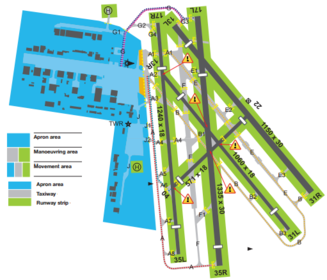
- Capital city aerodromes - 63List of Sections of an AerodromeMovement area
Manoeuvring area
Apron - 64Movement areaPart of an aerodrome to be used for the surface movement of aircraft, including manoeuvring areas and apron
- 65Manoeuvring areaMovement area excluding apron
- 66Apron

- 67Sections of Aerodrome in diagram
- 68Restricted OperationsWhen operations at an aerodrome which
does not have 24 hour ATC coverage are confined to hard surface runways, taxiways and aprons, a dumb-bell marker is displayed in the signal circle. A dumb-bell marker is white - 69Dimensions of a Restricted Runway marker
- 70Dimensions of a cones and gables
- 71Permanent Threshold Marking
- 72Permanently Displaced Threshold Marking
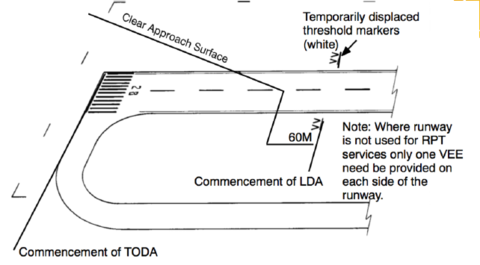
- 73Temporarily Displaced Threshold Markings due to obstacle infringement for a period equal or less than 30 days
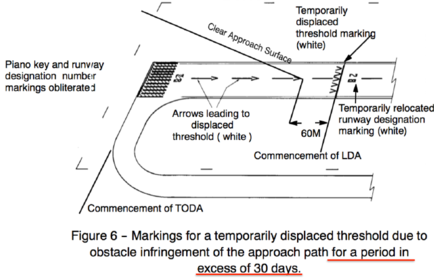
- 74Temporarily Displaced Threshold Markings due to obstacle infringement for a period more than 30 days
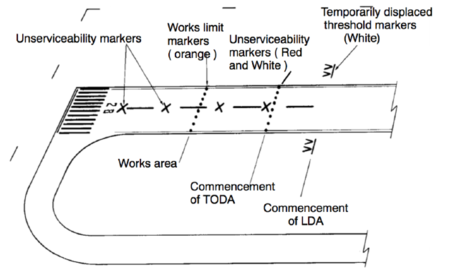
- 75Temporarily Displaced Threshold Markings due to works on the runway for a period equal or less than 30 days
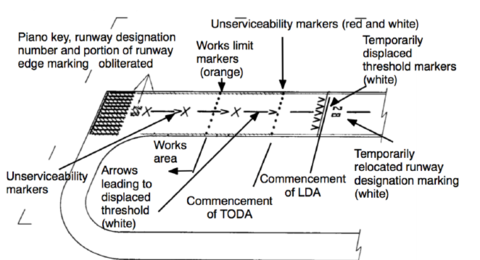
- 76Temporarily Displaced Threshold Markings due to works on the runway for a period more than 30 days
- 77All of the Runway markings
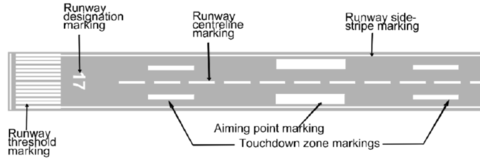
- 78What is VASI?Visual Approach Slope Indicator
It can be a Two-bar system - 79Two bar VASI sayingWhite over White, you're high as a kite. / you'll fly all night
Red over White, you're alright.
Red over Red, you're dead.
White over Red, unsaid / you're under head - 80Standard Two-bar vasi diagram
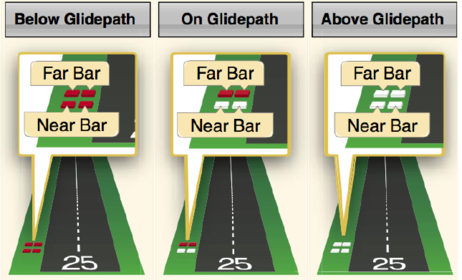
- 81What is PAPIA type of VASI called a Precision approach path indicator.
- 4 lights on left of runway
- same as standard VASI but also show how far off glide slope AC is - 82PAPI diagram
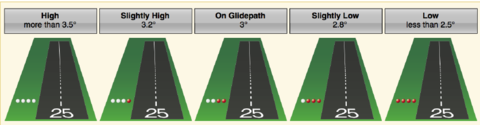
- 83T-VASIS20 white lights, 10 on each side, 4 making cross bar and 6 making longitudinal of T. When below T, when above inverted T.
- 84kts?knots
- 85nm?nautical miles
- 86knots to minutes?3nm/min
3 for nmmn
3 is the most central
Informações
- Descrição
- hardcore 107 FlashCards sobre Week 1, criado por Matt Barnes em 16-07-2016.
- Criado por
- Matt Barnes
- Visualizações
- 2
- Histórico
-
- Criado por Matt Barnes · 20 jun 2016
- Copiado por Matt Barnes · 16 jul 2016
- Avaliação