
693648
Descrição

FlashCards por oliviabaines, atualizado more than 1 year ago

|
Criado por oliviabaines
mais de 12 anos atrás
|
|
| Questão | Responda |
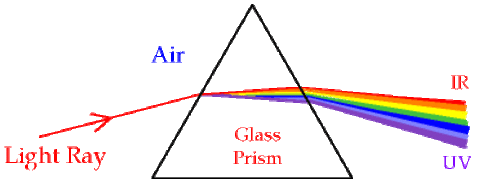
| Infrared Radiation(heat) -Electromagnetic spectrum, beyond visible red light -Emitted by all objects -Can travel through a vacuum -The hotter an object, the more radiation it emits in a given time |
Image:
spectrum.gif (image/gif)
|
| -Dark, matt surfaces are good absorbers and emitters of IR. Transfer energy and cool down quickly -Light, Shiny surfaces are good reflectors of IR | States of matter -Solid, liquid, gas.Change them by heating and cooling |
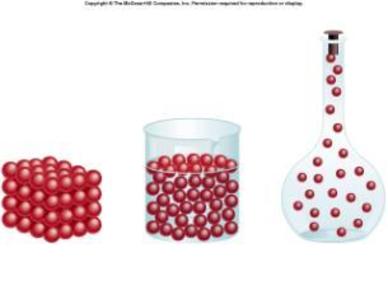
| Solid -Fixed Shape -Transfers energy by vibrating -Good conductors(metals) | Liquid -Can flow -No fixed shape -Particles in contact but can move about at random -Poor conductors |
| Gas -Particles are far apart, move at random, much faster -No fixed shape and can flow -Less dense | |
| Conduction -One end of a solid is heated, the particles at the end gain kinetic energy and vibrate more -Energy is passed to neighbouring particles helped by free electrons colliding amongst the atoms -Occurs in metals | Insulators -Poor conductors -Wool and fibreglass are good insulators as they contain trapped air |
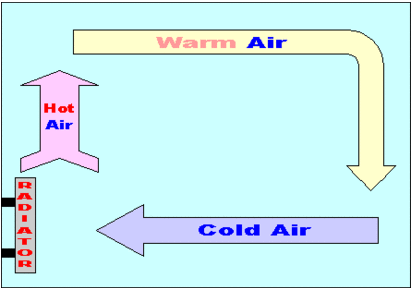
| Convection -occurs in fluids -When a fluid is heated it expands -Becomes less dense and rises -Warm fluid replaced by cooler, denser fluid -The resulting convection current transfers energy throughout the fluid |
Image:
Convection.gif (image/gif)
|
| Evapouration -Liquid turns into a gas -The most energetic liquid moleculesescpae from the surface and enter the air; the average kinetic energy of the remaining molecules is less so the temp. of the liquid decreases -So evapouration causes cooling | Rate of evapouration increased by: -increasing the surface area of the liquid -increasing the temp. of the liquid -creating a draught of air across the liquid's surface |
| Condensation -Gas turns into a liquid -Takes place on cold surfaces(mirrors) | Rate of condensation increased by: -increasing the surface area -Reducing the surface temp. |
| The greater the temp. difference between an object and its surroundings, the greater the rate at which energy is transferred | This depends on: -the materials the object is in contact with -the object's shape -the object's surface area |
| Sometimes we want to maximise the rate of energy transfer to keep things cool -we use things that are good conductors -dull black -the air flow around them maximised | Sometimes we want to minimise the rate of energy transfer of energy by conduction, convection and radiation - we use things that are good insulators -white and shiny -prevent convection currents by trapping air in small pockets |
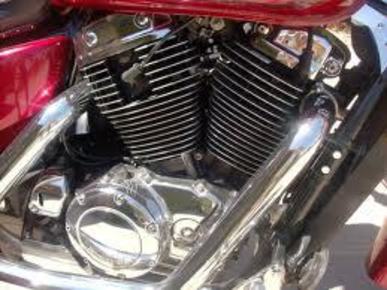
| Motorcycle Engine Fins -Has many small fins to provide a large surface area so it keeps the engine cool and does not overheat - Releases heat quickly | |
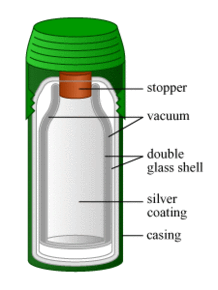
| Vacuum flask -stucture minimises energy transfer by conduction, convection and radiation -reduces the rate of energy transferto keep hot things hot and cold things cold |
Image:
vacuum_flask.gif (image/gif)
|
| Specific Heat Capacity -amount of energy required to raise the temp of 1 kilogram of the substance by 1 degree c -The greater the shc, the more energy required for each degree temp. change | -The greater the mass of substance being heated the more energy required for each degree temp. change |
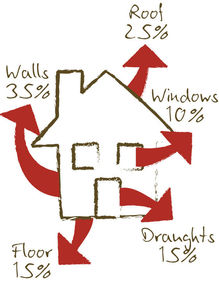
| Energy transferred=Mass x shc x temp. change E=m x c x 0 | Heating and insuating buildings -The rate of energy transfer to or from our homes can be reduced fibreglass loft: stops conduction Cavity wall: traps air in small pockets reduces convection Double glazing: reduces conduction through windows Draught proofing: reduces convection Aluminium foil behind radiators: reflect IR back into the room |
| U-Value -how much energy per second passes through different materials; allows us to compare them -The lower the u-value the better the material is as an insulator | Solar heating panels -contain water heated by radiation from the sun -used to heat buildings/hot water -Cheap to run as they don't use fuel -expensive to buy and install -water not heated at night |
| Forms of energy -Light, sound, kinetic(movement), nuclear, electrical, gravitational potential, elastic potential and chemical -last three are forms of stored energy | -Energy can be transferred from one form to the other -Any object above the ground has gravitational potential energy -A falling object transfers gravitational potential energy to kinetic energy |
| Conservation of energy -law stating it is not possible to create or destroy energy. It is only possible to transfer it from one form to another, or from one place to another -Total amount of energy is always the same. Applies to all energy transfers | E.g. when an object falls, gravitational potential energy is transferred to kinetic energy -stretching an elastic band transfers chemical energy to elastic potential energy -In a solar cell, light energy to electrical energy |
| -A machine is something that transfers energy from one place to the other or from one from to another. The energy produced by the machine consists of: useful energy- energy in the place we want it and the form we need it wasted energy- energy not usefully transferred | Useful energy and wasted energy both end up being transferred to the surroundings, which become warmer -As energy spreads out, it gets more and more difficult to use for further energy transfers -Energy is often wasted because of friction between moving parts of a machine |
| Energy(J) and Efficiency -Energy supplied is the input energy. From the conservation of energy we know: input energy= useful energy transferred+energy wasted | The less energy that is wasted by a machine, the more efficient it is Efficiency=useful energy x 100 total energy |
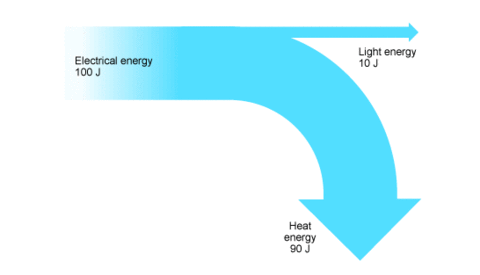
| No appliance can be 100% efficient, except an electric heater, which usefully transfers all of the electrical energy supplied to it by heating its surroundings -Energy transfer through an appliance can be represented with a Sankey diagram | |
| Electrical appliances -transfer electrical energy into whatever form of energy we need at the flick of a switch -lamps(light), speakers(sound),tv(light and sound) | often transfer energy by heating -Appliances should be designed to waste as little energy as possible |
| Electrical Power -the power of an appliance is the rate at which it transfers energy -1 watt transfers 1 joule every second 1kilowatt=1000 watts | Power= energy time taken(s) for energy to be transferred -Power is the energy per second transferred or supplied, so we can write the efficiency equation in terms of power |
| Using electrical energy -A kwh is the amount of energy transferred by a one-kw appliance when used for one hour | Amount of energy transferred E= power x time taken -The electricity meter in a house records the number of kwh of energy used. If previous meter reading is subtracted from the current reading= the electrical energy used between the readings |
| The cost of the electrical energy total cost=number of kWh x cost per kWh -the cost per kWh is given on the electricity bill | Comparing Cost effectiveness of appliances includes: -cost of buying the appliance -the cost of installing the appliance -the running costs -the maintenance costs -environmental costs -the interest charged on a loan to buy the appliance |
| To reduce energy bills many may buy newer, more efficient appliances, or install materials designed to reduce energy wastage -the payback time is the time it takes for an appliance or installation to pay for itself in terms of energy savings |
Quer criar seus próprios Flashcards gratuitos com GoConqr? Saiba mais.