
Flashcards
P1- Topic 4
Flashcards do conjunto (16)
- 1I know what infrasound and ultrasound are.Frequency is the number of complete waves that passes a point in one second. It is measured in hertz (Hz).
Any sound frequencies less than 20 Hz is Infrasound, anything above 20,000 Hz is ultrasound. Humans can only hear sound waves between 20 and 20000 Hz. - 2I can describe the uses of ultrasound.Computers are able to create detailed images by combining many ultrasound reflection readings. This is used in medicine for pre-natal scanning (checking unborn babies).
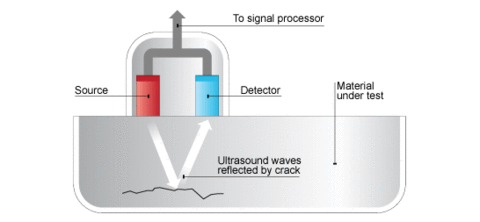
Ultrasound can be used in industry for quality control procedures to check manufactured objects, such as railway tracks and oil pipelines, for damage or defects.
Sonar
Sonar is used on ships and submarines to detect fish or the sea bed. A pulse of ultrasound is sent out from the ship. It bounces off the seabed or shoal of fish and the echo is detected. The time taken for the wave to travel indicates the depth of the seabed or shoal of fish. - 3I understand how how a piece of metal may be tested for cracks or other flaws using ultrasound.
- 4I can describe the uses of infrasound.Infrasound is detected using a microphone.
Elephants and giraffes use infrasound to communicate between herds over long distances. Scientists can now use microphones to track the herds even if they are hidden in dense forests. This helps with the conservation and protection of these animals.
Infrasound can be used to detect volcanic eruptions. As a volcano erupts it produces infrasound, which can be detected even if the volcano is in a remote location a long way away. Scientists also use infrasound to track the passage of meteors through the atmosphere. Meteors are lumps of rock from space. Most burn up in the atmosphere but some hit earth. If a meteor hit a populated area it could cause considerable damage. - 5I know that there are two types of seismic waves produced P Waves and S waves.The Earth is almost a sphere. These are its main layers, starting with the outermost:
crust - relatively thin and rocky
mantle - has the properties of a solid, but can flow very slowly
outer core - made from liquid nickel and iron
inner core - made from solid nickel and iron
Earthquakes happen when large parts of the Earth's crust and upper mantle move suddenly. They could slide over each other or rub against each other causing friction.
Earthquakes produce shockwaves called seismic waves. These waves can be detected using seismographs. Some seismic waves are surface waves, while others can travel through the Earth. The two types of seismic waves are P waves and S waves. - 6I understand the properties of P waves and S waves.

- 7I understand about the reflection and refraction of P and S waves.Seismic waves can be reflected and refracted at boundaries between the crust, mantle and core. This means that they change direction.
- 8I know that the Earth's crust is made up of tectonic plates, which move to the convection currents in the mantle.The Earth's crust and upper part of the mantle are broken into large pieces called tectonic plates. These are constantly moving at a few centimetres each year. Although this doesn't sound like very much, over millions of years the movement allows whole continents to shift thousands of kilometres apart. This process is called continental drift. The plates move because of convection currents in the Earth's mantle. These are driven by the heat produced by the decay of radioactive elements and heat left over from the formation of the Earth. Convection occurs when particles with a lot of heat energy in a liquid or gas move and take the place of particles with less heat energy. Heat energy is transferred from hot places to cooler places by convection.
- 9I understand how P and S waves travel through the Earth.The speed of P-waves and S-waves increases as they travel deeper into the mantle. They travel through the Earth in curved paths, but they change direction suddenly when they pass through the boundary between substances in different states.
- 10I understand how P waves travel through the Earth.

- 11I understand how P waves travel through the Earth. (explanation of diagram).Unlike S-waves, P-waves can pass through the liquid outer core. When P-waves pass from solid to liquid, then from liquid to solid, there are sudden changes in direction. The waves are refracted.
- 12I understand how S waves travel through the Earth.

- 13I understand how S waves travel through the Earth. (explanation of diagram).S-waves travel through solids only. They cannot travel through the liquid outer core, but they can travel through the mantle and crust.
- 14I understand that Earthquakes are caused by the relative motions of the tectonic plates at their boundaries.Where tectonic plates meet, the Earth's crust becomes unstable as the plates push against each other, or ride under or over each other. Earthquakes and volcanic eruptions happen at the boundaries between plates, and the crust may ‘crumple’ to form mountain ranges.
- 15I know that seismometers are used to detect earthquakes but earthquakes are hard to predict.Seismic waves are monitered around the world using a seismometer. The distance from the seismometer to the epicentre of the earthquake can be calculated from the time delay between receiving the P and S waves and their speed. The seismometers will only work out how far the wave has travelled and not the direction. By using information from three seismometers, you can calculate the epicentre, which is where all three distances meet: this process is called triangulation. Scientists make predictions of the risk of the Earthquakes happening in a specific area, based on its earthquake history.
- 16I know the equations for all waves.wave speed= frequency x wavelength
wave speed=distance/ time
Informações
- Descrição
- GCSE Physics (P1) FlashCards sobre P1- Topic 4, criado por isabellaoliver em 07-06-2014.
- Criado por
- isabellaoliver
- Visualizações
- 24
- Avaliação