
Fluxograma
Sem título
Conteúdo do fluxograma
Strategic Management
Rational Strategy
based upon the presumption that the people undertaking the strategic management will always act in a logical, structured and proactive manner.
The presumption is that we are setting out to achieve one or more objectives.
Ansoff - an objective was a means by which success or failure could be identified, and split these objectives into four different categories
1. Economic: the efficient use of available resources to convert inputs into outputs
2. Non-economic: the ability to satisfy the expectations of stakeholders
3. Self-renewal: the building of an organisation through reinvestment
4. Flexibility: sufficient latitude in the prescribed plan to enable an organisation to survive and manage different forces
Ansoff suggests that a strategy is the linking thread that exists within the organisation enabling management to provide guidance. The parameters that exist around this thread are therefore fundamental to the success or otherwise of the organisation.
CORE ATTRIBUTES OF RATIONAL STRATEGY
1. a rational strategy will be created at the top of an organisation, by the leaders and/or those who have accountability for an organisation;
2. a rational strategy starts with the entirety of an organisation, before it can be broken down into smaller constituent parts;
3. a rational strategy will contain conscious choices that have been made concerning the length of the plan, the levels of risk, opportunities and threats offered by the environment, and the realistic availability of resources
Core Aspects of Strategic Management
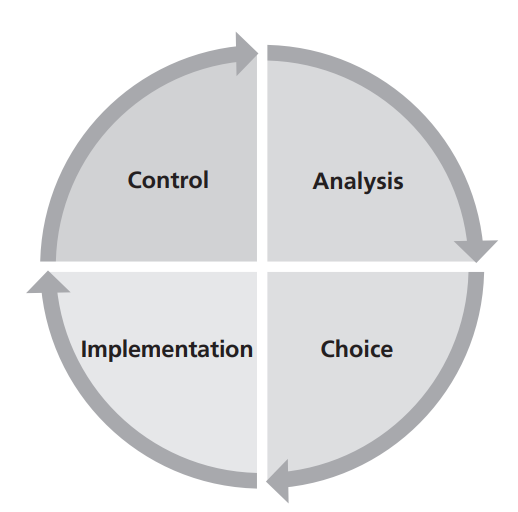
Johnson et al. (2017) report that strategic management needs to include, but also differentiate between, the day-to-day operational (shorter term) decisions made by managers and the process often undertaken by the same managers of making strategic (longer-term) decisions.
ASPECTS OF STRATEGIC MANAGEMENT
1. Analysis: the collection and interpretation of appropriate data to enable the understanding of reality, resource and expectation
2. Choice: the evaluation of the strengths and weaknesses of different potential options arising from the analysis, and the ability therefore to establish a method of how to choose a preferred option
3. Implementation: the ability to put the chosen option into action
4. Control: the establishment of a method of monitoring outcomes of each stage of the process of strategic development
Evolution of the rational view
1. Crafting & Intuition
2. Competition
3. The learning organisation
4. Chaos Theory
Crafting & Intuition
* The Mind of the Strategist, Ohmae - human traits of creativity and obsession were as important as a rational and logical approach in the formation of strategy
*The Age of Unreason, Handy - planning is as much based on intuition as on analysis; our human intuition derives from what he calls the wheel of learning, a constant cycle of theory, test, reflection, question, theory, test
* The human brain allows us at one and the same time to be dealing with what purports to be a logical direct line of thought while at the same time imagining what may lay either side of that line and therefore reshaping and or redirecting that line. This we may describe as intuition, defined as the ability to understand something instinctively, without the need for conscious reasoning
Competition
*Porter (1980) - considered the competitive markets within which organisations operated and suggested that the underlying rationality of their strategic development was often geared to enabling an advantage over the various competitive forces
*Peters and Waterman (1982) - produced a comparison of leading companies with a look at the individual ingredients that enabled the distinction for particular companies – the concept of excellence.
The learning organisation
recognises the significant influence played by different individuals within an organisation. One or more individuals may bring their own individuality to play. When such individuals become aligned in their vision it is possible to describe the organisation itself as a learning organisation.
The organisation is perceived as a group of individuals, bringing together a range of core competencies, and working and learning together.
*Pedler et al. - recognised that that any organisation (at its today point) is a combination of the ideas of the people involved, the stage that the organisation (as a collection of people) has reached in its life-cycle, and the wider economic and cultural contexts in which both the organisation and its people exist.
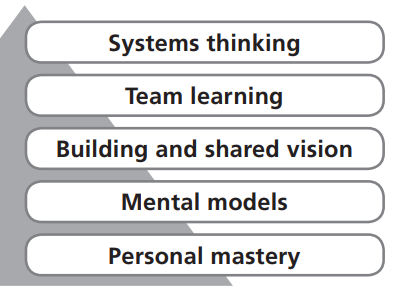
* The Fifth Discipline, Senge- considers the development of an organisation, and the ultimate success or otherwise of its strategic management, from a fivefold perspective, each building upon the previous perspective
Chaos Theory
VUCA - volatility, uncertainty, complexity and ambiguity
Limitations of the Rational Model:
1. Data
2. Routine
3. Inertia
4. Politics
- it is difficult to gather, control and structure the required level of data to enable the formulation of a rational plan
- rational plans very often form a recurrent part of a planning process, often in an annual cycle, but an organisation cannot allow itself to wait 12 months before addressing problems
- once a rational plan is established people are unwilling to question it; this can also lead to an obsession with performance against the plan rather than a readiness to cope with uncertainty
- the rational plan ignores the ‘political’ environment and ‘power struggles’ that exist within most organisations.
Informações
- Descrição
- Fluxograma sobre Sem título, criado por Elena Thorne em 11-01-2020.
- Criado por
- Elena Thorne
- Visualizações
- 0
- Avaliação