
Fluxograma
Sem título
Conteúdo do fluxograma
Strategy and organisational culture
Culture and history
- Many organisations have long histories and their cultural drivers can stem back many years.
- Often these cultural drivers are intrinsically linked with the beliefs of the original founders and have remained as a core part of the organisational ethos and are immediately recognised by a wide group of stakeholders
- Barney (1986) - each organisation has a unique culture which has developed over the life of that organisation and is embedded in the history and heritage of the organisation and its employees
- culture is always difficult to describe, as its idiosyncratic nature is often taken for granted; this therefore makes it difficult to imitate
effective development of strategy requires
a. understanding of how an organisation behaves
b. why it behaves in that way
cultural understanding can be achieved by:
1. considering the historical development of the organisation
2. different forces that have impacted upon its behaviours
3. considering how it aligns with the stereotypical models of culture
Organisational culture
Definition: ‘a complex set of values, beliefs, assumptions and symbols that define the way in which a firm conducts its business
‘the way we do things around here
people behave in a particular manner based around a number of different drivers and stimuli.
Aim - understand these drivers in a structured manner from different perspectives to help us to better analyse
- how the company behaves now, today; and
- how we would like those behaviours to evolve, or
- how those behaviours can underpin and be used to strengthen the strategic direction.
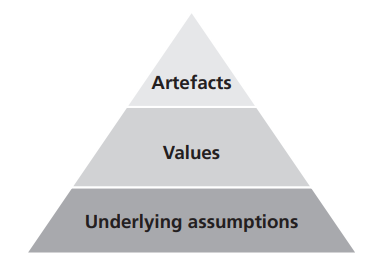
1. Underlying assumptions
held unconsciously by people working within the organisation
guide the behaviour and opinions of employees for the majority of day-to-day operational activities
Schein
2. Values
Values are often promoted within an organisation, to epitomise what that organisation stands for
values allow an individual to decide how to tackle any situation or decision which is not resolved automatically through the underlying assumptions
3. Artefacts
visible and tangible evidence of organisational culture
structure and layout of the workspace, written and spoken language within the organisation.
Strategic drift
Johnson - Strategic drift happens when the strategy of a business is no longer relevant to the external environment facing it.
Stages:
1. Incremental strategic change - In this phase there is little significant change in the external environment. A series of small, incremental changes to strategy enable the business to remain in touch with the external environment.
2. Strategic drift - Now things are starting to drift apart. The rate of change in the external environment is accelerating and small, incremental changes in strategy are not enough on their own to remain in touch. The business will be losing its competitive advantage.
3. Flux - This phase is characterised by management indecision. There is now a significant gap between what the market expects and what a business is delivering. Management may have recognised this gap and begun to alter strategy, however there is no decisive improvement. There may be disagreement between the senior management team about how to address what is now significant strategic drift.
4. Transformation or death - The moment of truth. Either management recognise the need for a transformational change in strategic direction, or the business fails. It often takes new, external leadership for this recognition to be made and the relevant strategic change programme implemented. For some businesses, this phase comes too late.
The influence of the past and the importance of recognising bias
To fully understand the culture of an organisation, it is essential to understand how an organisation has evolved and to be able to identify internal, micro, and macro forces that have resulted in the current structure, personnel and culture.
require:
consideration of the people who have been, and continue to be, involved with the organisation
their particular idiosyncrasies
the way they have chosen to shape and influence the culture of the business, both top-down and bottom-up
‘ladder of inference - the penultimate stage before we take any action or decision will inform the earlier stage of ‘data filtration’.
This process can be described as the basis of prejudice or bias within the brain
Informações
- Descrição
- Fluxograma sobre Sem título, criado por Elena Thorne em 29-01-2020.
- Criado por
- Elena Thorne
- Visualizações
- 0
- Avaliação