
Mapa mental
Torts Outline
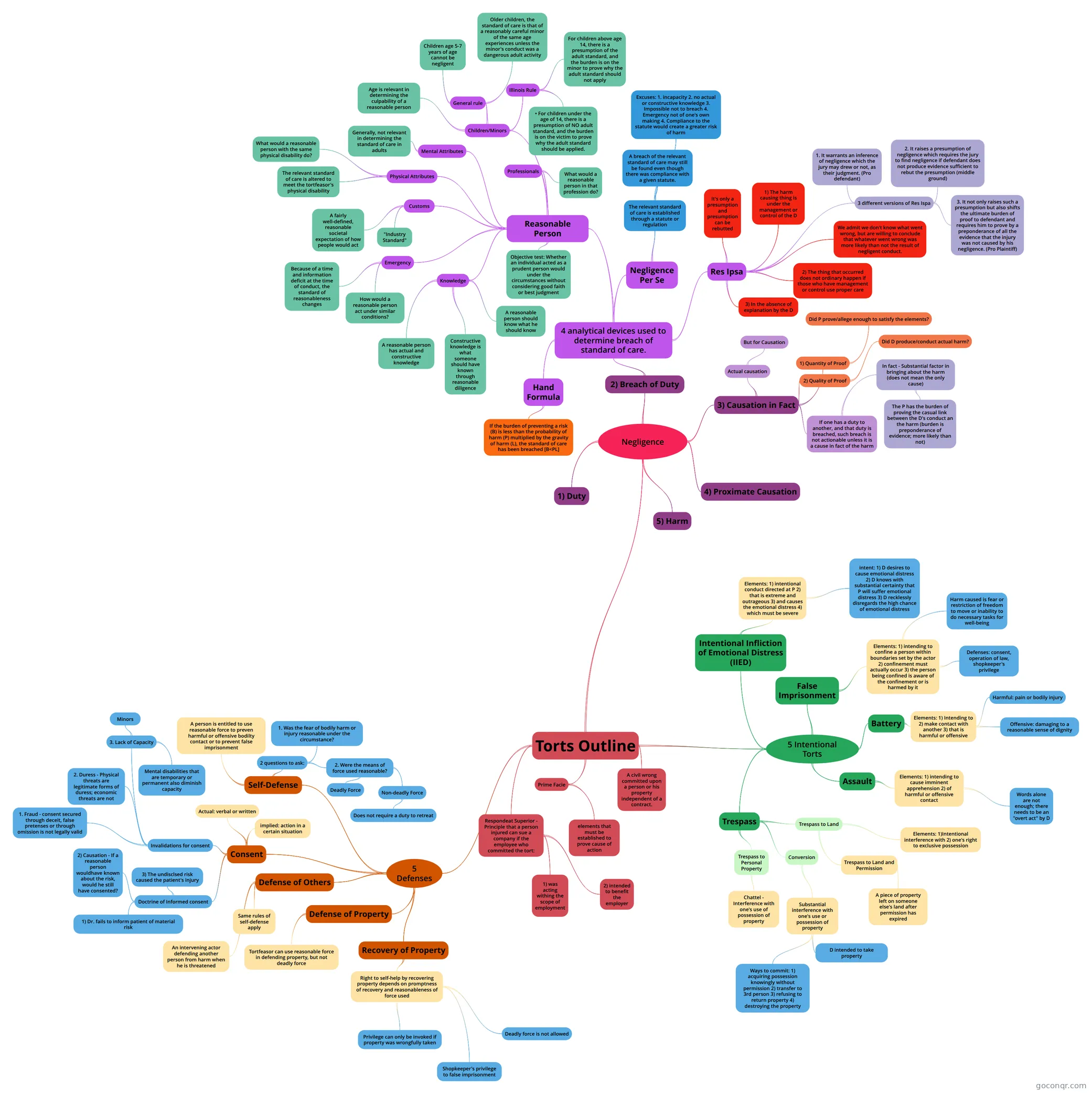
Mind map: Torts outline
Conteúdo do mapa
Torts Outline
5 Intentional Torts
- Battery
- Elements: 1) Intending to 2) make contact with another 3) that is harmful or offensive
- Harmful: pain or bodily injury
- Offensive: damaging to a reasonable sense of dignity
- Elements: 1) Intending to 2) make contact with another 3) that is harmful or offensive
- Assault
- Elements: 1) intending to cause imminent apprehension 2) of harmful or offensive contact
- Words alone are not enough; there needs to be an "overt act" by D
- Elements: 1) intending to cause imminent apprehension 2) of harmful or offensive contact
- False Imprisonment
- Elements: 1) intending to confine a person within boundaries set by the actor 2) confinement must actually occur 3) the person being confined is aware of the confinement or is harmed by it
- Harm caused is fear or restriction of freedom to move or inability to do necessary tasks for well-being
- Defenses: consent, operation of law, shopkeeper's privilege
- Elements: 1) intending to confine a person within boundaries set by the actor 2) confinement must actually occur 3) the person being confined is aware of the confinement or is harmed by it
- Intentional Infliction of Emotional Distress (IIED)
- Elements: 1) intentional conduct directed at P 2) that is extreme and outrageous 3) and causes the emotional distress 4) which must be severe
- intent: 1) D desires to cause emotional distress 2) D knows with substantial certainty that P will suffer emotional distress 3) D recklessly disregards the high chance of emotional distress
- Elements: 1) intentional conduct directed at P 2) that is extreme and outrageous 3) and causes the emotional distress 4) which must be severe
- Trespass
- Conversion
- Substantial interference with one's use or possession of property
- D intended to take property
- Ways to commit: 1) acquiring possession knowingly without permission 2) transfer to 3rd person 3) refusing to return property 4) destroying the property
- Substantial interference with one's use or possession of property
- Trespass to Land
- Elements: 1)Intentional interference with 2) one's right to exclusive possession
- Trespass to Land and Permission
- A piece of property left on someone else's land after permission has expired
- Trespass to Personal Property
- Chattel - Interference with one's use of possession of property
- Conversion
- Battery
5 Defenses
- Consent
- Actual: verbal or written
- implied: action in a certain situation
- Invalidations for consent
- 1. Fraud - consent secured through deceit, false pretenses or through omission is not legally valid
- 2. Duress - Physical threats are legitimate forms of duress; economic threats are not
- 3. Lack of Capacity
- Minors
- Mental disabilities that are temporary or permanent also diminish capacity
- Doctrine of Informed consent
- 1) Dr. fails to inform patient of material risk
- 2) Causation - If a reasonable person wouldhave known about the risk, would he still have consented?
- 3) The undisclsed risk caused the patient's injury
- Self-Defense
- A person is entitled to use reasonable force to preven harmful or offensive bodilty contact or to prevent false imprisonment
- 2 questions to ask:
- 1. Was the fear of bodily harm or injury reasonable under the circumstance?
- 2. Were the means of force used reasonable?
- Deadly Force
- Non-deadly Force
- Does not require a duty to retreat
- Defense of Others
- An intervening actor defending another person from harm when he is threatened
- Same rules of self-defense apply
- Defense of Property
- Tortfeasor can use reasonable force in defending property, but not deadly force
- Recovery of Property
- Right to self-help by recovering property depends on promptness of recovery and reasonableness of force used
- Deadly force is not allowed
- Shopkeeper's privilege to false imprisonment
- Privilege can only be invoked if property was wrongfully taken
- Right to self-help by recovering property depends on promptness of recovery and reasonableness of force used
- Consent
A civil wrong committed upon a person or his property independent of a contract.
Negligence
- 1) Duty
- 2) Breach of Duty
- 4 analytical devices used to determine breach of standard of care.
- Hand Formula
- If the burden of preventing a risk (B) is less than the probability of harm (P) multiplied by the gravity of harm (L), the standard of care has been breached [B<PL]
- Reasonable Person
- Knowledge
- A reasonable person should know what he should know
- A reasonable person has actual and constructive knowledge
- Constructive knowledge is what someone should have known through reasonable diligence
- Emergency
- Because of a time and information deficit at the time of conduct, the standard of reasonableness changes
- How would a reasonable person act under similar conditions?
- Customs
- A fairly well-defined, reasonable societal expectation of how people would act
- "Industry Standard"
- Physical Attributes
- The relevant standard of care is altered to meet the tortfeasor's physical disability
- What would a reasonable person with the same physical disability do?
- Mental Attributes
- Generally, not relevant in determining the standard of care in adults
- Children/Minors
- Age is relevant in determining the culpability of a reasonable person
- General rule
- Children age 5-7 years of age cannot be negligent
- Older children, the standard of care is that of a reasonably careful minor of the same age experiences unless the minor's conduct was a dangerous adult activity
- Illinois Rule
- For children above age 14, there is a presumption of the adult standard, and the burden is on the minor to prove why the adult standard should not apply
- • For children under the age of 14, there is a presumption of NO adult standard, and the burden is on the victim to prove why the adult standard should be applied.
- Professionals
- What would a reasonable person in that profession do?
- Objective test: Whether an individual acted as a prudent person would under the circumstances without considering good faith or best judgment
- Knowledge
- Negligence Per Se
- The relevant standard of care is established through a statute or regulation
- Excuses: 1. incapacity 2. no actual or constructive knowledge 3. Impossible not to breach 4. Emergency not of one's own making 4. Compliance to the statute would create a greater risk of harm
- A breach of the relevant standard of care may still be found even though there was compliance with a given statute.
- The relevant standard of care is established through a statute or regulation
- Res Ipsa
- 1) The harm causing thing is under the management or control of the D
- 2) The thing that occurred does not ordinary happen if those who have management or control use proper care
- 3) In the absence of explanation by the D
- It's only a presumption and presumption can be rebutted
- We admit we don't know what went wrong, but are willing to conclude that whatever went wrong was more likely than not the result of negligent conduct.
- 3 different versions of Res Ispa
- 1. It warrants an inference of negligence which the jury may drew or not, as their judgment. (Pro defendant)
- 2. It raises a presumption of negligence which requires the jury to find negligence if defendant does not produce evidence sufficient to rebut the presumption (middle ground)
- 3. It not only raises such a presumption but also shifts the ultimate burden of proof to defendant and requires him to prove by a preponderance of all the evidence that the injury was not caused by his negligence. (Pro Plaintiff)
- Hand Formula
- 4 analytical devices used to determine breach of standard of care.
- 3) Causation in Fact
- Actual causation
- But for Causation
- 1) Quantity of Proof
- Did P prove/allege enough to satisfy the elements?
- 2) Quality of Proof
- Did D produce/conduct actual harm?
- If one has a duty to another, and that duty is breached, such breach is not actionable unless it is a cause in fact of the harm
- In fact - Substantial factor in bringing about the harm (does not mean the only cause)
- The P has the burden of proving the casual link between the D's conduct an the harm (burden is preponderance of evidence; more likely than not)
- In fact - Substantial factor in bringing about the harm (does not mean the only cause)
- Actual causation
- 4) Proximate Causation
- 5) Harm
Respondeat Superior - Principle that a person injured can sue a company if the employee who committed the tort:
- 1) was acting withing the scope of employment
- 2) intended to benefit the employer
Prime Facie
- elements that must be established to prove cause of action
Informações
- Descrição
- Torts Mapa Mental sobre Torts Outline, criado por Cory Fry em 18-10-2017.
- Criado por
- Cory Fry
- Visualizações
- 0
- Avaliação