
Mapa mental
IR Theories
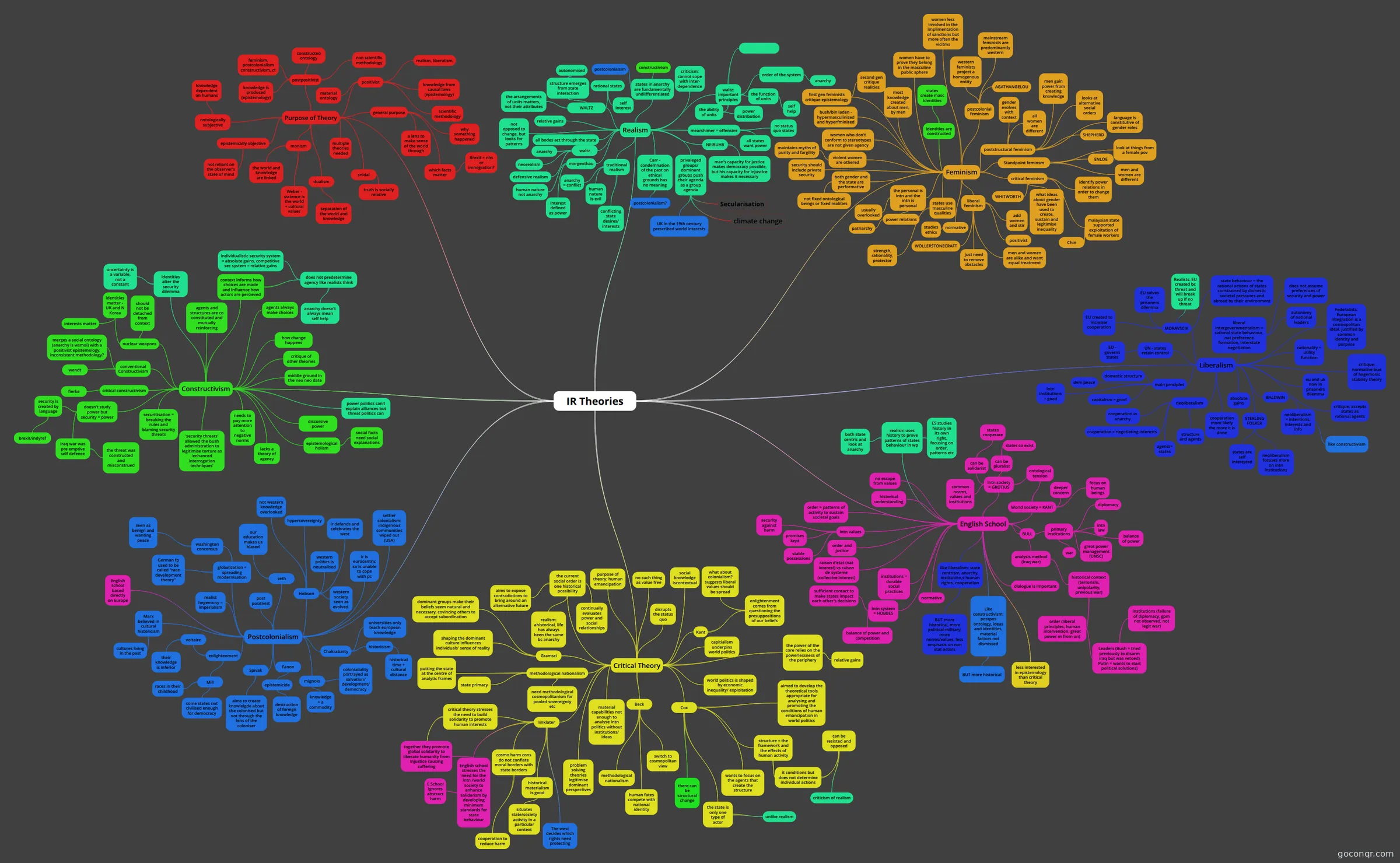
Mind map: IR theories
Conteúdo do mapa
IR Theories
Liberalism
- main prnciples
- domestic structure
- dem peace
- capitalism = good
- intn institutions = good
- neoliberalism
- structure and agents
- cooperation in anarchy
- cooperation = negotiating interests
- agents= states
- absolute gains
- cooperation more likely the more it is done
- STERLING FOLKER
- neoliberalism focuses more on intn institutions
- states are self interested
- UN - states retain control
- EU - governs states
- MORAVSCIK
- EU created to increase cooperation
- EU solves the prisoners dilemma
- Realists: EU created bc threat and will break up if no threat
- state behaviour = the rational actions of states constrained by domestic societal pressures and abroad by their environment
- eu and uk now in prisoners dilemma
- critique: accepts states as rational agents
- critique: normative bias of hegemonic stability theory
- BALDWIN
- neoliberalism = intentions, interests and info
- like constructivism
- neoliberalism = intentions, interests and info
- rationality = utility function
- liberal intergovernmentalism = rational state behaviour, nat preference formation, interstate negotiation
- does not assume preferences of security and power
- autonomy of national leaders
- Federalists: European integration is a cosmopolitan ideal, justified by common identity and purpose
- main prnciples
Critical Theory
- purpose of theory: human emancipation
- no such thing as value free
- social knowledge iscontextual
- disrupts the status quo
- Kant
- enlightenment comes from questioning the presuppositions of our beliefs
- what about colonialism? suggests liberal values should be spread
- enlightenment comes from questioning the presuppositions of our beliefs
- capitialism underpins world politics
- the power of the core relies on the powerlessness of the periphery
- relative gains
- world politics is shaped by economic inequality/ exploitation
- Cox
- aimed to develop the theoretical tools appropriate for analysing and promoting the conditions of human emancipation in world politics
- structure = the framework and the effects of human activity
- it conditions but does not determine individual actions
- can be resisted and opposed
- criticism of realism
- can be resisted and opposed
- it conditions but does not determine individual actions
- wants to focus on the agents that create the structure
- the state is only one type of actor
- unlike realism
- there can be structural change
- Beck
- switch to cosmopolitan view
- human fates compete with national identity
- methodological nationalism
- the current social order is one historical possibility
- continually evaluates power and social relationships
- aims to expose contradictions to bring around an alternative future
- realism: ahistorical, life has always been the same bc anarchy
- Gramsci
- dominant groups make their beliefs seem natural and necessary, covincing others to accept subordination
- shaping the dominant culture influences individuals' sense of reality
- methodological nationalism
- putting the state at the centre of analytic frames
- state primacy
- need methodological cosmopolitanism for pooled sovereignty etc
- linklater
- critical theory stresses the need to build solidarity to promote human interests
- English school stresses the need for the intn /world society to enhance solidarism by developing minimum standards for state behaviour
- together they promote global solidarity to liberate humanity from injustice causing suffering
- E School ignores abstract harm
- cosmo harm cons do not conflate moral borders with state borders
- cooperation to reduce harm
- historical materialism is good
- situates state/society activity in a particular context
- The west decides which rights need protecting
- critical theory stresses the need to build solidarity to promote human interests
- problem solving theories legitimise dominant perspectives
- material capabilities not enough to analyse intn politics without institutions/ ideas
English School
- order = patterns of activity to sustain societal goals
- intn values
- security against harm
- promises kept
- stable possessions
- raison d'etat (nat interest) vs raison de systeme (collective interest)
- order and justice
- intn system = HOBBES
- sufficient contact to make states impact each other's decisions
- balance of power and competition
- Intn society = GROTIUS
- can be pluralist
- states co exist
- can be solidarist
- states cooperate
- common norms, values and institutions
- can be pluralist
- World society = KANT
- deeper concern
- focus on human beings
- ontological tension
- institutions = durable social practices
- BULL
- primary institutions
- intn law
- diplomacy
- war
- great power management (UNSC)
- balance of power
- primary institutions
- historical understanding
- no escape from values
- normative
- realism uses history to prove patterns of states behaviour in wp
- ES studies history in its own right, focusing on order, patterns etc
- both state centric and look at anarchy
- like liberalism: state centrism, anarchy, institution,s human rights, cooperation
- BUT more historical, more political-military, more norms/values, less emphasis on non stat actors
- Like constructivism: postpos ontology, ideas and identities, material factors not dismissed
- BUT more historical
- less interested in epistemology than critical theory
- analysis method (Iraq war)
- historical context (terrorism, unipolarity, previous war)
- order (liberal principles, human intervention, great power m from un)
- Leaders (Bush = tried previously to disarm iraq but was vetoed) Putin = wants to start political solutions)
- institutions (failure of diplomacy, gpm not observed, not legit war)
- Leaders (Bush = tried previously to disarm iraq but was vetoed) Putin = wants to start political solutions)
- order (liberal principles, human intervention, great power m from un)
- historical context (terrorism, unipolarity, previous war)
- dialogue is important
Postcolonialism
- settler colonialism: indigenous communities wiped out (USA)
- ir is eurocentric so is unable to cope with pc
- Hobson
- western society seen as evolved.
- western politics is neutralised
- hypersovereignty
- not western knowledge overlooked
- ir defends and celebrates the west
- seth
- our education makes us biased
- post positivist
- globalization = spreading modernisation
- washington concensus
- seen as benign and wanting peace
- German fp used to be called "race development theory"
- washington concensus
- realist hegemony = imperialism
- English school based directly on Europe
- Marx believed in cultural historicism
- cultures living in the past
- enlightenment
- voltaire
- their knowledge is inferior
- Mill
- races in their childhood
- some states not civilised enough for democracy
- voltaire
- Spivak
- aims to create knowlelgde about the colonised but not through the lens of the coloniser
- Fanon
- epistemicide
- destruction of foreign knowledge
- epistemicide
- mignolo
- knowledge = a commodity
- colonialiality portrayed as salvation/ development/ democracy
- Chakrabarty
- universities only teach european knowledge
- historicism
- historical time + cultural distance
Constructivism
- middle ground in the neo neo date
- critique of other theories
- how change happens
- agents always make choices
- context informs how choices are made and influence how actors are percieved
- does not predetermine agency like realists think
- anarchy doesn't always mean self help
- individualistic security system = absolute gains, competitive sec system = relative gains
- does not predetermine agency like realists think
- agents and structures are co constituted and mutually reinforcing
- nuclear weapons
- should not be detached from context
- identities matter - UK and N Korea
- interests matter
- conventional Constructivism
- wendt
- merges a social ontology (anarchy is wsmoi) with a positivist epistemology. inconsistent methodology?
- critical constructivism
- fierke
- doesn't study power but security = power
- security is created by language
- brexit/indyref
- iraq war was pre emptive self defense
- the threat was constructed and misconstrued
- security is created by language
- securitisation = breaking the rules and blaming security threats
- 'security threats' allowed the bush administration to legitimise torture as 'enhanced interrogation techniques'
- discursive power
- identities alter the security dilemma
- uncertainty is a variable, not a constant
- power politics can't explain alliances but threat politics can
- epistemological holism
- social facts need social explanations
- lacks a theory of agency
- needs to pay more attention to negative norms
Purpose of Theory
- general purpose
- why something happened
- a lens to make sense of the world through
- which facts matter
- Brexit = nhs or immigration?
- positivist
- material ontology
- scientific methodology
- knowledge from causal laws (epistemology)
- realism, liberalism,
- postpositivist
- feminism, postcolonialism constructivism, ct
- constructed ontology
- non scientific methodology
- knowledge is produced (epistemology)
- ontologically subjective
- knowledge dependent on humans
- epistemically objective
- not reliant on the observer's state of mind
- monism
- the world and knowledge are linked
- Weber - sscience is the world + cultural values
- dualism
- separation of the world and knowledge
- snidal
- truth is socially relative
- multiple theories needed
- general purpose
Realism
- states in anarchy are fundamentally undiifferentiated
- postcolonialsim
- constructivism
- WALTZ
- the arrangements of units matters, not their attributes
- structure emerges from state interaction
- autonomised
- rational states
- self interest
- relative gains
- all bodes act through the state
- waltz
- neorealism
- anarchy
- defensive realism
- morgenthau
- human nature not anarchy
- interest defined as power
- traditional realism
- conflicting state desires/ interests
- human nature is evil
- anarchy = conflict
- not opposed to change, but looks for patterns
- criticism: cannot cope with inter- dependence
- Carr - condemnation of the past on ethical grounds has no meaning
- postcolonialism?
- privaleged groups/ dominant groups push their agenda as a group agenda
- UK in the 19th century prescribed world interests
- Secularisation
- climate change
- NEIBUHR
- man's capacity for justice makes democracy possible, but his capacity for injustice makes it necessary
- waltz: important principles
- order of the system
- anarchy
- the function of units
- self help
- the ability of units
- power distribution
- order of the system
- mearshimer = offensive
- no status quo states
- all states want power
- states in anarchy are fundamentally undiifferentiated
Feminism
- the personal is intn and the intn is personal
- power relations
- patriarchy
- usually overlooked
- power relations
- states use masculine qualities
- strength, rationality, protector
- normative
- studies ethics
- liberal feminism
- WOLLERSTONECRAFT
- men and women are alike and want equal treatment
- add women and stir
- positivist
- just need to remove obstacles
- critical feminism
- WHITWORTH
- what ideas about gender have been used to create, sustain and legitimise inequality
- malaysian state supported exploitation of female workers
- Chin
- identify power relations in order to change them
- Standpoint feminsm
- men and women are different
- look at things from a female pov
- ENLOE
- poststructural feminism
- SHEPHERD
- all women are different
- looks at alternative social orders
- gender evolves with context
- men gain power from creating knowledge
- language is constitutive of gender roles
- postcolonial feminism
- AGATHANGELOU
- mainstream feminists are predominantly western
- western feminists project a homogenous entity
- identities are constructed
- states create masc identities
- both gender and the state are performative
- not fixed ontological beings or fixed realities
- security should include private security
- violent women are othered
- maintains myths of purity and fargility
- women who don't conform to stereotypes are not given agency
- bush/bin laden - hypermasculinized and hyperfminized
- first gen feminists critique epistemology
- second gen critique realities
- most knowledge created about men, by men
- women less involved in the implimentation of sanctions but more often the vicitms
- women have to prove they belong in the masculine public sphere
- the personal is intn and the intn is personal
Informações
- Descrição
- Mapa Mental sobre IR Theories, criado por Jessica Leech em 07-12-2017.
- Criado por
- Jessica Leech
- Visualizações
- 2
- Avaliação