
Mapa mental
Chapter 6 Lesson 3
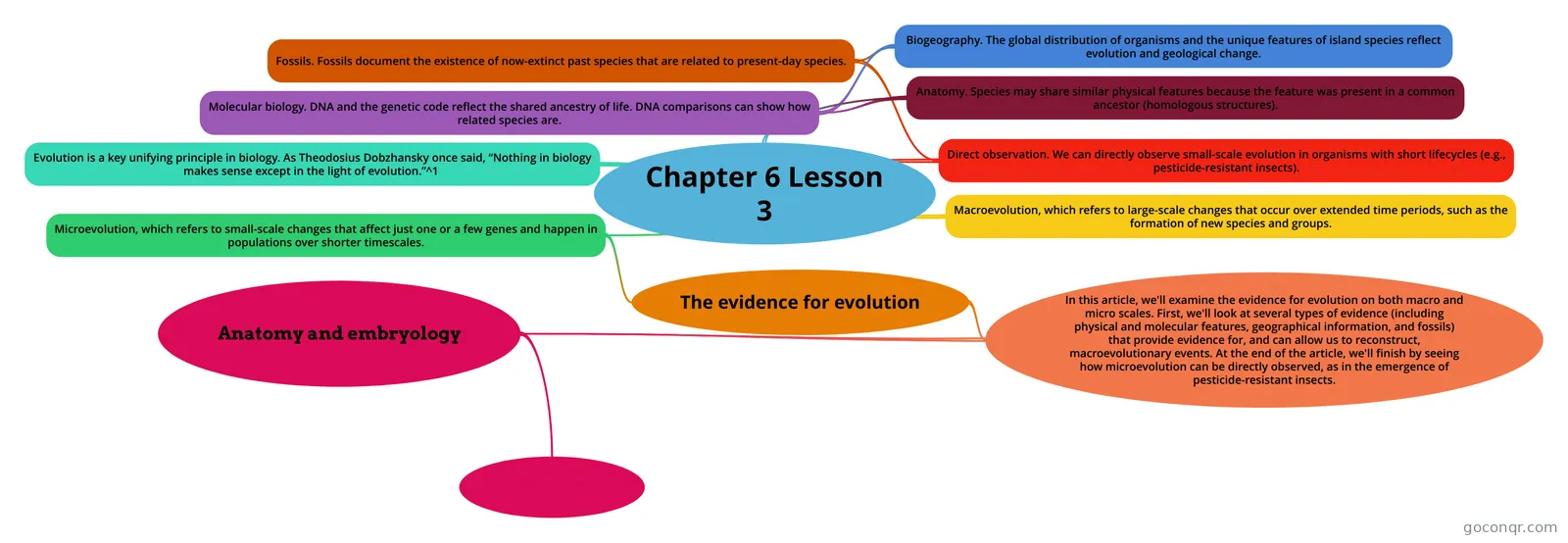
Mind map: Evidence of evolution
Conteúdo do mapa
Chapter 6 Lesson 3
Anatomy. Species may share similar physical features because the feature was present in a common ancestor (homologous structures).
- Molecular biology. DNA and the genetic code reflect the shared ancestry of life. DNA comparisons can show how related species are.
- Biogeography. The global distribution of organisms and the unique features of island species reflect evolution and geological change.
- Fossils. Fossils document the existence of now-extinct past species that are related to present-day species.
- Direct observation. We can directly observe small-scale evolution in organisms with short lifecycles (e.g., pesticide-resistant insects).
- Evolution is a key unifying principle in biology. As Theodosius Dobzhansky once said, “Nothing in biology makes sense except in the light of evolution.”^1
- Macroevolution, which refers to large-scale changes that occur over extended time periods, such as the formation of new species and groups.
- Microevolution, which refers to small-scale changes that affect just one or a few genes and happen in populations over shorter timescales.
- The evidence for evolution
- In this article, we'll examine the evidence for evolution on both macro and micro scales. First, we'll look at several types of evidence (including physical and molecular features, geographical information, and fossils) that provide evidence for, and can allow us to reconstruct, macroevolutionary events. At the end of the article, we'll finish by seeing how microevolution can be directly observed, as in the emergence of pesticide-resistant insects.
- Anatomy and embryology
- Anatomy and embryology
- In this article, we'll examine the evidence for evolution on both macro and micro scales. First, we'll look at several types of evidence (including physical and molecular features, geographical information, and fossils) that provide evidence for, and can allow us to reconstruct, macroevolutionary events. At the end of the article, we'll finish by seeing how microevolution can be directly observed, as in the emergence of pesticide-resistant insects.
- The evidence for evolution
- Microevolution, which refers to small-scale changes that affect just one or a few genes and happen in populations over shorter timescales.
- Macroevolution, which refers to large-scale changes that occur over extended time periods, such as the formation of new species and groups.
- Evolution is a key unifying principle in biology. As Theodosius Dobzhansky once said, “Nothing in biology makes sense except in the light of evolution.”^1
- Direct observation. We can directly observe small-scale evolution in organisms with short lifecycles (e.g., pesticide-resistant insects).
- Fossils. Fossils document the existence of now-extinct past species that are related to present-day species.
- Biogeography. The global distribution of organisms and the unique features of island species reflect evolution and geological change.
- Molecular biology. DNA and the genetic code reflect the shared ancestry of life. DNA comparisons can show how related species are.
Informações
- Descrição
- Mapa Mental sobre Chapter 6 Lesson 3, criado por Kaitlyn Weihe em 05-01-2018.
- Criado por
- Kaitlyn Weihe
- Visualizações
- 0
- Avaliação
Mais sobre Evidence for Evolution