
Mapa mental
Synoptic Paper: Carbon Cycle
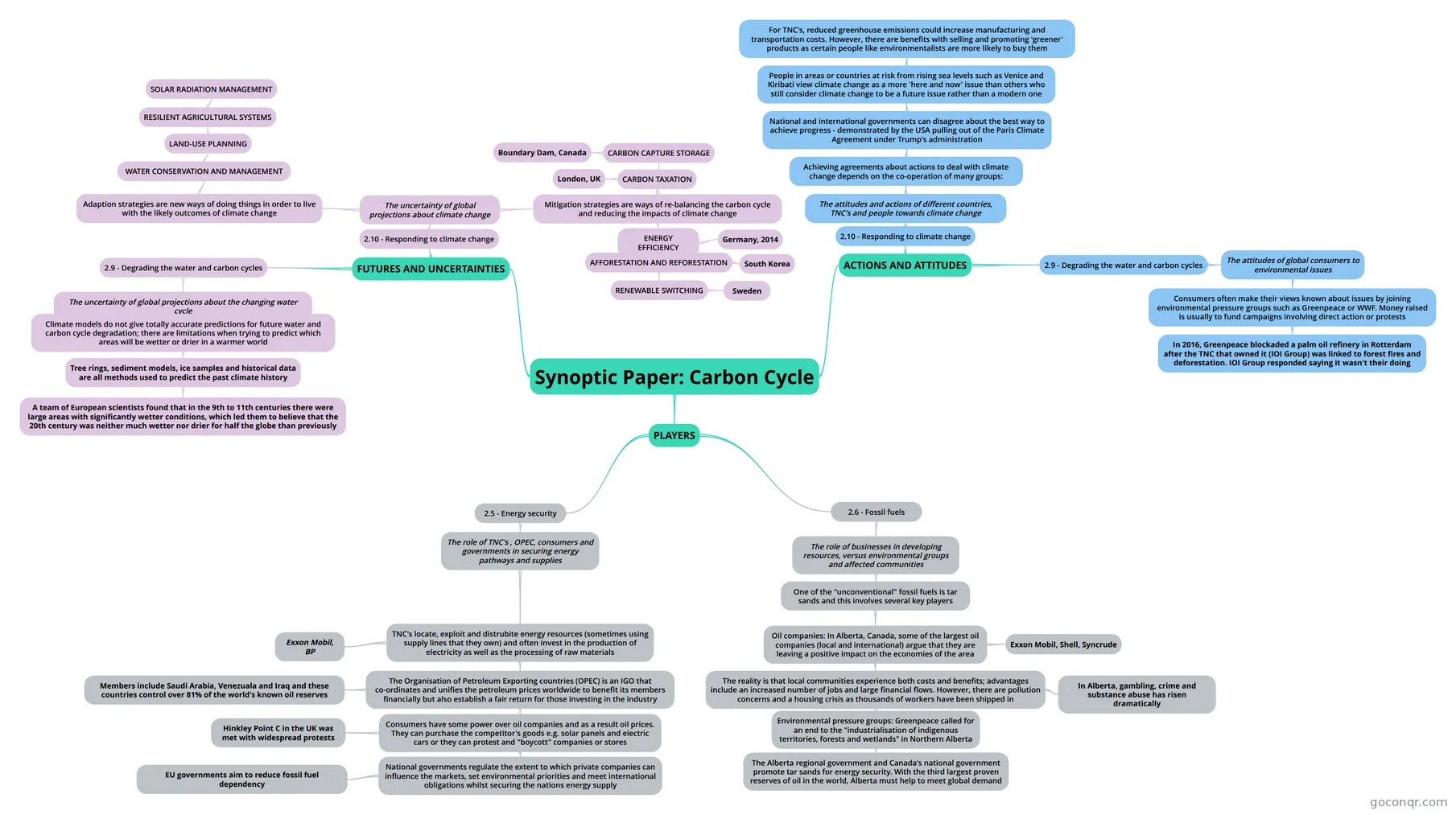
Mind map: Synoptic paper: carbon cycle
Conteúdo do mapa
Synoptic Paper: Carbon Cycle
PLAYERS
- 2.5 - Energy security
- The role of TNC's , OPEC, consumers and governments in securing energy pathways and supplies
- TNC's locate, exploit and distrubite energy resources (sometimes using supply lines that they own) and often invest in the production of electricity as well as the processing of raw materials
- Exxon Mobil, BP
- The Organisation of Petroleum Exporting countries (OPEC) is an IGO that co-ordinates and unifies the petroleum prices worldwide to benefit its members financially but also establish a fair return for those investing in the industry
- Members include Saudi Arabia, Venezuala and Iraq and these countries control over 81% of the world's known oil reserves
- Consumers have some power over oil companies and as a result oil prices. They can purchase the competitor's goods e.g. solar panels and electric cars or they can protest and "boycott" companies or stores
- Hinkley Point C in the UK was met with widespread protests
- National governments regulate the extent to which private companies can influence the markets, set environmental priorities and meet international obligations whilst securing the nations energy supply
- EU governments aim to reduce fossil fuel dependency
- TNC's locate, exploit and distrubite energy resources (sometimes using supply lines that they own) and often invest in the production of electricity as well as the processing of raw materials
- The role of TNC's , OPEC, consumers and governments in securing energy pathways and supplies
- 2.6 - Fossil fuels
- The role of businesses in developing resources, versus environmental groups and affected communities
- One of the "unconventional" fossil fuels is tar sands and this involves several key players
- Oil companies: In Alberta, Canada, some of the largest oil companies (local and international) argue that they are leaving a positive impact on the economies of the area
- The reality is that local communities experience both costs and benefits; advantages include an increased number of jobs and large financial flows. However, there are pollution concerns and a housing crisis as thousands of workers have been shipped in
- Environmental pressure groups: Greenpeace called for an end to the "industrialisation of indigenous territories, forests and wetlands" in Northern Alberta
- The Alberta regional government and Canada's national government promote tar sands for energy security. With the third largest proven reserves of oil in the world, Alberta must help to meet global demand
- In Alberta, gambling, crime and substance abuse has risen dramatically
- Environmental pressure groups: Greenpeace called for an end to the "industrialisation of indigenous territories, forests and wetlands" in Northern Alberta
- Exxon Mobil, Shell, Syncrude
- The reality is that local communities experience both costs and benefits; advantages include an increased number of jobs and large financial flows. However, there are pollution concerns and a housing crisis as thousands of workers have been shipped in
- Oil companies: In Alberta, Canada, some of the largest oil companies (local and international) argue that they are leaving a positive impact on the economies of the area
- One of the "unconventional" fossil fuels is tar sands and this involves several key players
- The role of businesses in developing resources, versus environmental groups and affected communities
- 2.5 - Energy security
ACTIONS AND ATTITUDES
- 2.9 - Degrading the water and carbon cycles
- The attitudes of global consumers to environmental issues
- Consumers often make their views known about issues by joining environmental pressure groups such as Greenpeace or WWF. Money raised is usually to fund campaigns involving direct action or protests
- In 2016, Greenpeace blockaded a palm oil refinery in Rotterdam after the TNC that owned it (IOI Group) was linked to forest fires and deforestation. IOI Group responded saying it wasn't their doing
- Consumers often make their views known about issues by joining environmental pressure groups such as Greenpeace or WWF. Money raised is usually to fund campaigns involving direct action or protests
- The attitudes of global consumers to environmental issues
- 2.10 - Responding to climate change
- The attitudes and actions of different countries, TNC's and people towards climate change
- Achieving agreements about actions to deal with climate change depends on the co-operation of many groups:
- National and international governments can disagree about the best way to achieve progress - demonstrated by the USA pulling out of the Paris Climate Agreement under Trump's administration
- People in areas or countries at risk from rising sea levels such as Venice and Kiribati view climate change as a more 'here and now' issue than others who still consider climate change to be a future issue rather than a modern one
- For TNC's, reduced greenhouse emissions could increase manufacturing and transportation costs. However, there are benefits with selling and promoting 'greener' products as certain people like environmentalists are more likely to buy them
- People in areas or countries at risk from rising sea levels such as Venice and Kiribati view climate change as a more 'here and now' issue than others who still consider climate change to be a future issue rather than a modern one
- National and international governments can disagree about the best way to achieve progress - demonstrated by the USA pulling out of the Paris Climate Agreement under Trump's administration
- Achieving agreements about actions to deal with climate change depends on the co-operation of many groups:
- The attitudes and actions of different countries, TNC's and people towards climate change
- 2.9 - Degrading the water and carbon cycles
FUTURES AND UNCERTAINTIES
- 2.9 - Degrading the water and carbon cycles
- The uncertainty of global projections about the changing water cycle
- Climate models do not give totally accurate predictions for future water and carbon cycle degradation; there are limitations when trying to predict which areas will be wetter or drier in a warmer world
- Tree rings, sediment models, ice samples and historical data are all methods used to predict the past climate history
- A team of European scientists found that in the 9th to 11th centuries there were large areas with significantly wetter conditions, which led them to believe that the 20th century was neither much wetter nor drier for half the globe than previously
- Tree rings, sediment models, ice samples and historical data are all methods used to predict the past climate history
- Climate models do not give totally accurate predictions for future water and carbon cycle degradation; there are limitations when trying to predict which areas will be wetter or drier in a warmer world
- The uncertainty of global projections about the changing water cycle
- 2.10 - Responding to climate change
- The uncertainty of global projections about climate change
- Adaption strategies are new ways of doing things in order to live with the likely outcomes of climate change
- WATER CONSERVATION AND MANAGEMENT
- LAND-USE PLANNING
- RESILIENT AGRICULTURAL SYSTEMS
- SOLAR RADIATION MANAGEMENT
- RESILIENT AGRICULTURAL SYSTEMS
- LAND-USE PLANNING
- WATER CONSERVATION AND MANAGEMENT
- Mitigation strategies are ways of re-balancing the carbon cycle and reducing the impacts of climate change
- CARBON TAXATION
- London, UK
- ENERGY EFFICIENCY
- AFFORESTATION AND REFORESTATION
- RENEWABLE SWITCHING
- Sweden
- South Korea
- RENEWABLE SWITCHING
- Germany, 2014
- AFFORESTATION AND REFORESTATION
- CARBON CAPTURE STORAGE
- Boundary Dam, Canada
- CARBON TAXATION
- Adaption strategies are new ways of doing things in order to live with the likely outcomes of climate change
- The uncertainty of global projections about climate change
- 2.9 - Degrading the water and carbon cycles
Informações
- Descrição
- AS level Geography (A2 Physical Geography) Mapa Mental sobre Synoptic Paper: Carbon Cycle, criado por Oliver Downes em 08-02-2018.
- Criado por
- Oliver Downes
- Visualizações
- 4
- Avaliação
Mais sobre Human Impacts on Biogeochemical Cycles