
Mapa mental
Progressive Era
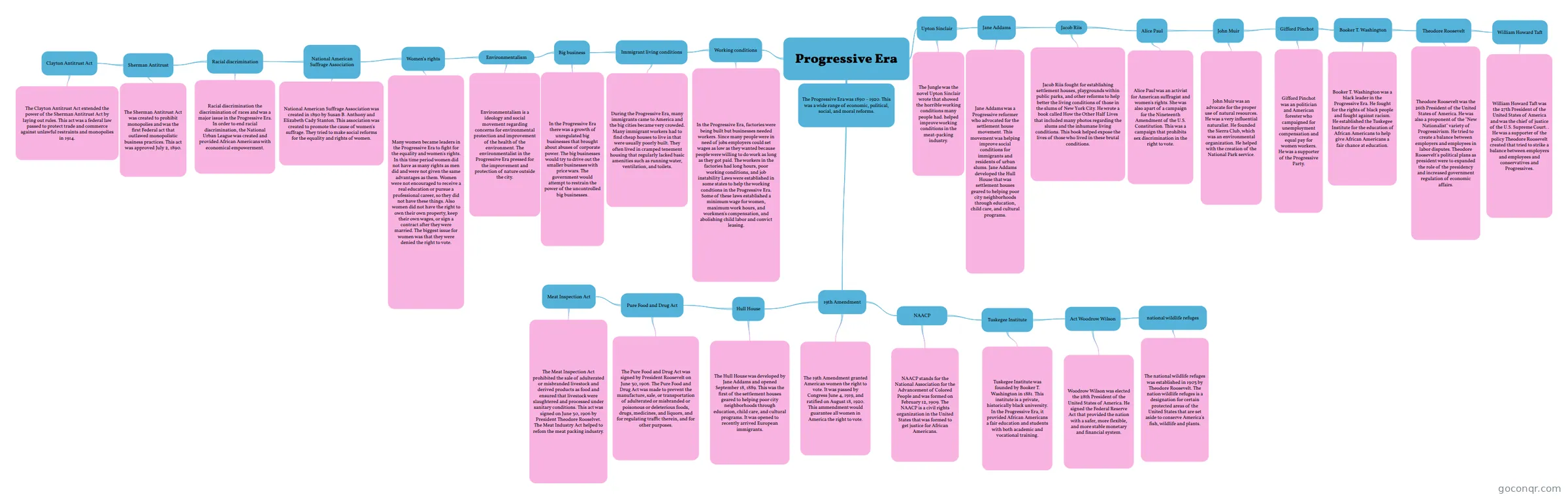
Mind map: Progressive Era reforms and changes
Conteúdo do mapa
Progressive Era
Upton Sinclair
- Jane Addams
- Jacob Riis
- Alice Paul
- Alice Paul was an activist for American suffragist and women's rights. She was also apart of a campaign for the Nineteenth Amendment of the U.S. Constitution. This was a campaign that prohibits sex discrimination in the right to vote.
- John Muir
- Gifford Pinchot
- Gifford Pinchot was an politician and American forester who campaigned for unemployment compensation and equal pay for women workers. He was a supporter of the Progressive Party.
- Booker T. Washington
- Booker T. Washington was a black leader in the Progressive Era. He fought for the rights of black people and fought against racism. He established the Tuskegee Institute for the education of African Americans to help give African Americans a fair chance at education.
- Theodore Roosevelt
- William Howard Taft
- William Howard Taft was the 27th President of the United States of America and was the chief of justice of the U.S. Supreme Court.. He was a supporter of the policy Theodore Roosevelt created that tried to strike a balance between employers and employees and conservatives and Progressives.
- Theodore Roosevelt was the 26th President of the United States of America. He was also a proponent of the "New Nationalist" variety of Progressivism. He tried to create a balance between employers and employees in labor disputes. Theodore Roosevelt's political plans as president were to expanded the role of the presidency and increased government regulation of economic affairs.
- William Howard Taft
- John Muir was an advocate for the proper use of natural resources. He was a very influential naturalist. He founded the Sierra Club, which was an environmental organization. He helped with the creation of the National Park service.
- Gifford Pinchot
- Jacob Riis fought for establishing settlement houses, playgrounds within public parks, and other reforms to help better the living conditions of those in the slums of New York City. He wrote a book called How the Other Half Lives that included many photos regarding the slums and the inhumane living conditions. This book helped expose the lives of those who lived in these brutal conditions.
- Alice Paul
- Jane Addams was a Progressive reformer who advocated for the settlement house movement. This movement was helping improve social conditions for immigrants and residents of urban slums. Jane Addams developed the Hull House that was settlement houses geared to helping poor city neighborhoods through education, child care, and cultural programs.
- Jacob Riis
- The Jungle was the novel Upton Sinclair wrote that showed the horrible working conditions many people had. helped improve working conditions in the meat-packing industry.
- Jane Addams
The Progressive Era was 1890 – 1920. This was a wide range of economic, political, social, and moral reforms.
Working conditions
- In the Progressive Era, factories were being built but businesses needed workers. Since many people were in need of jobs employers could set wages as low as they wanted because people were willing to do work as long as they got paid. The workers in the factories had long hours, poor working conditions, and job instability Laws were established in some states to help the working condtions in the Progressive Era. Some of these laws established a minimum wage for women, maximum work hours, and workmen's compensation, and abolishing child labor and convict leasing.
- Immigrant living conditions
- Big business
- Environmentalism
- Women’s rights
- National American Suffrage Association
- National American Suffrage Association was created in 1890 by Susan B. Anthony and Elizabeth Cady Stanton. This association was created to promote the cause of women's suffrage. They tried to make social reforms for the equality and rights of women.
- Racial discrimination
- Sherman Antitrust
- The Sherman Antitrust Act was created to prohibit monopolies and was the first Federal act that outlawed monopolistic business practices. This act was approved July 2, 1890.
- Clayton Antitrust Act
- The Clayton Antitrust Act extended the power of the Sherman Antitrust Act by laying out rules. This act was a federal law passed to protect trade and commerce against unlawful restraints and monopolies in 1914.
- Racial discrimination the discrimination of races and was a major issue in the Progressive Era. In order to end racial discrimination, the National Urban League was created and provided African Americans with economical empowerment.
- Sherman Antitrust
- Many women became leaders in the Progressive Era to fight for the equality and women's rights. In this time period women did not have as many rights as men did and were not given the same advantages as them. Women were not encouraged to receive a real education or pursue a professional career, so they did not have these things. Also women did not have the right to own their own property, keep their own wages, or sign a contract after they were married. The biggest issue for women was that they were denied the right to vote.
- National American Suffrage Association
- Environmentalism is a ideology and social movement regarding concerns for environmental protection and improvement of the health of the environment. The environmentalist in the Progressive Era pressed for the improvement and protection of nature outside the city.
- Women’s rights
- In the Progressive Era there was a growth of unregulated big businesses that brought about abuses of corporate power. The big businesses would try to drive out the smaller businesses with price wars. The government would attempt to restrain the power of the uncontrolled big businesses.
- Environmentalism
- During the Progressive Era, many immigrants came to America and the big cities became very crowded. Many immigrant workers had to find cheap houses to live in that were usually poorly built. They often lived in cramped tenement housing that regularly lacked basic amenities such as running water, ventilation, and toilets.
- Big business
19th Amendment
- Hull House
- Pure Food and Drug Act
- Meat Inspection Act
- The Meat Inspection Act prohibited the sale of adulterated or misbranded livestock and derived products as food and ensured that livestock were slaughtered and processed under sanitary conditions. This act was signed on June 30, 1906 by President Theodore Rooselvet. The Meat Industry Act helped to refom the meat packing industry.
- The Pure Food and Drug Act was signed by President Roosevelt on June 30, 1906. The Pure Food and Drug Act was made to prevent the manufacture, sale, or transportation of adulterated or misbranded or poisonous or deleterious foods, drugs, medicines, and liquors, and for regulating traffic therein, and for other purposes.
- Meat Inspection Act
- The Hull House was developed by Jane Addams and opened September 18, 1889. This was the first of the settlement houses geared to helping poor city neighborhoods through education, child care, and cultural programs. It was opened to recently arrived European immigrants.
- Pure Food and Drug Act
- The 19th Amendment granted American women the right to vote. It was passed by Congress June 4, 1919, and ratified on August 18, 1920. This ammendment would guarantee all women in America the right to vote.
- NAACP
- Tuskegee Institute
- Tuskegee Institute was founded by Booker T. Washington in 1881. This institute is a private, historically black university. In the Progressive Era, it provided African Americans a fair education and students with both academic and vocational training.
- Act Woodrow Wilson
- Woodrow Wilson was elected the 28th President of the United States of America. He signed the Federal Reserve Act that provided the nation with a safer, more flexible, and more stable monetary and financial system.
- national wildlife refuges
- The national wildlife refuges was established in 1903 by Theodore Roosevelt. The nation wildlife refuges is a designation for certain protected areas of the United States that are set aside to conserve America's fish, wildlife and plants.
- NAACP stands for the National Association for the Advancement of Colored People and was formed on February 12, 1909. The NAACP is a civil rights organization in the United States that was formed to get justice for African Americans.
- Tuskegee Institute
- Hull House