
The Progressive Era
820 resources created by 728 users
This Progressive Era page on GoConqr gathers community-made mind maps, quizzes, flashcards and notes on the years 1890-1920, from working conditions and muckrakers to women's suffrage and the presidencies of Roosevelt, Taft and Wilson. It's built for school students revising the topic and teachers after ready-made material. There are over 800 resources here, including more than 30 quizzes and over 600 mind maps, with AP US History, A-level History and GCSE History all mentioned. Pick a mind map, then test yourself with a quiz.
Top The Progressive Era resources
-
25 questionsUS History 2 AP Chapter 21 (The Rise of Progressivism) Review Who were the progressives?
-
18 questions28 Progressivism and the Republican Roosevelt All of the following were targets of criticism by progressive social critics during the progressive era, 18...
-
20 questionsUS History 2 AP Chapter 22 pt. 1 review What was Teddy Roosevelt's "Square Deal"?
-
32 cards1890-1920 big 4 (W,LG,C,O)
-
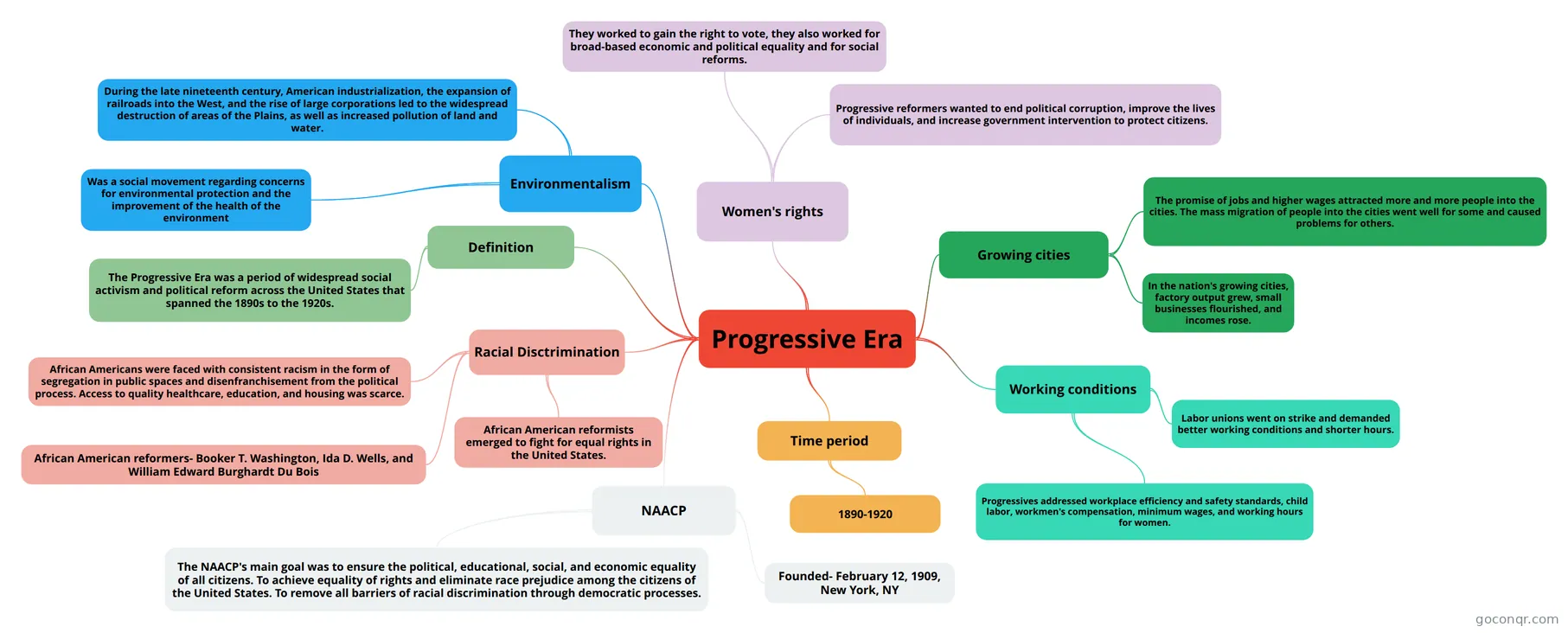 Mind map Progressive Era The Progressive Era began in 1890 and it created one of the most widespread social, political, and economic...
-
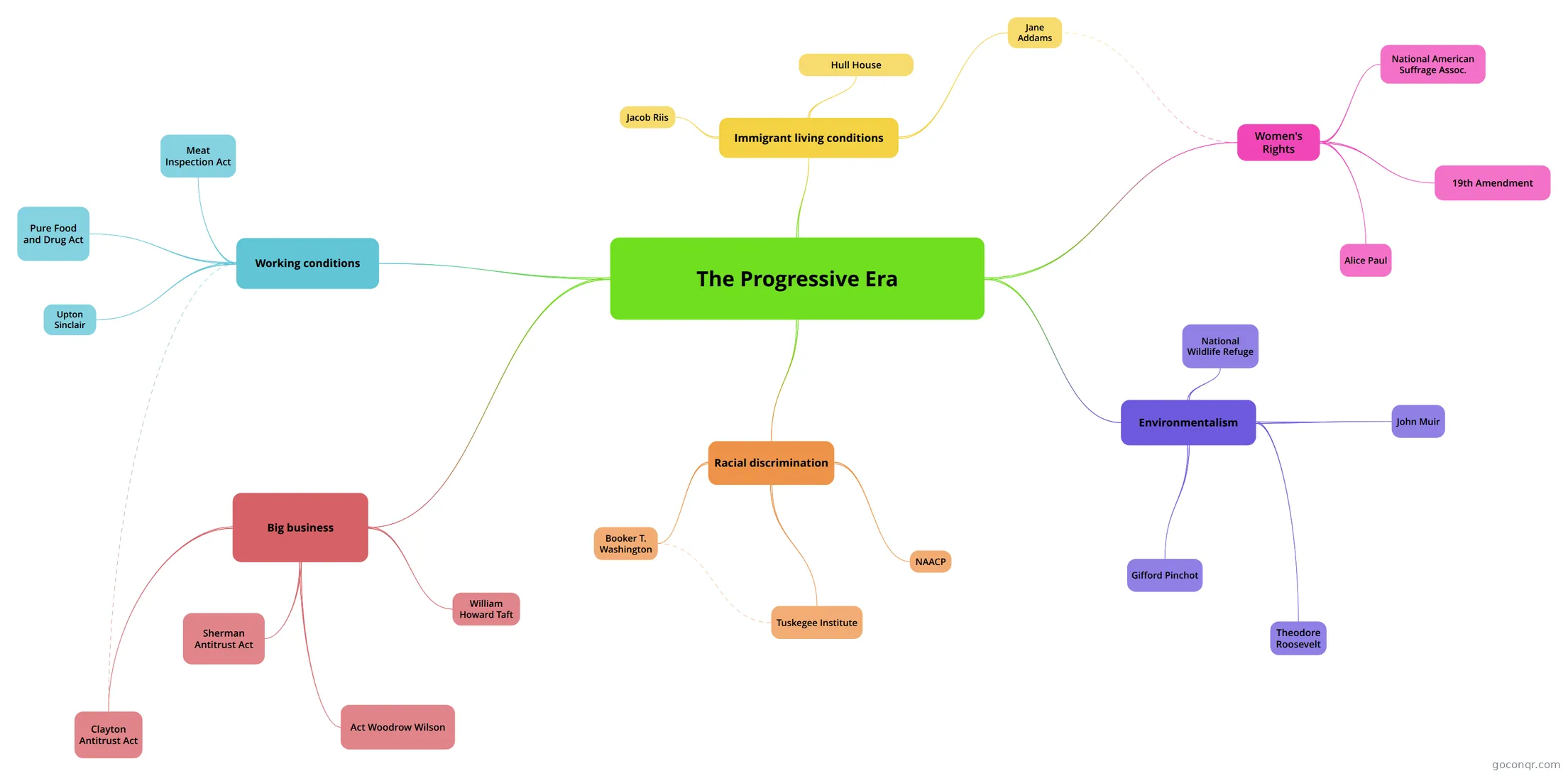 Mind map The Progressive Era The major causes of the Progressive Era with the people and organizations involved, major events, and outco...
-
 Mind map Development of the Progressive Era
-
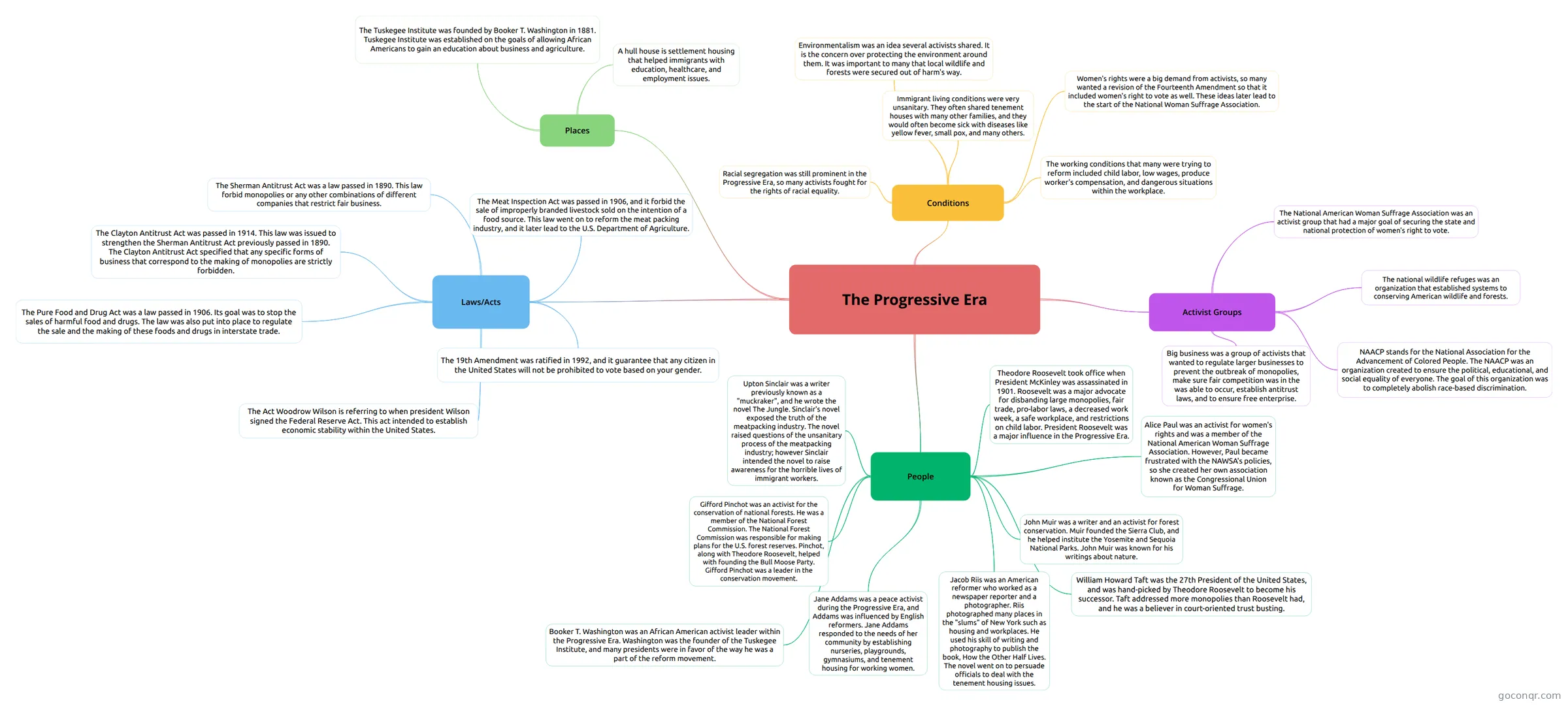 Mind map The Progressive Era
Quizzes
See all 34 quizzes-
25 questionsUS History 2 AP Chapter 21 (The Rise of Progressivism) Review Who were the progressives?
-
18 questions28 Progressivism and the Republican Roosevelt All of the following were targets of criticism by progressive social critics during the progressive era, 18...
-
20 questionsUS History 2 AP Chapter 22 pt. 1 review What was Teddy Roosevelt's "Square Deal"?
-
125 questionsHIST1302 Exam 2 Study Guide
-
33 questionsHistory Exam #3
-
73 questionsChapter 19 Learning Objectives - TEST 2 Which of the following are examples of the worldwide influence of the U.S. in these areas known as the "Ame...
-
33 questionsChapter 19 African-Americans migrated north during the Great Migration for all of the following reasons EXCEPT:
-
50 questionsAmerican History Unit 2 Test Study Guide Who founded Tuskegee Institute in 1881?
Mind maps
See all 607 mind maps-
Progressive Era The Progressive Era began in 1890 and it created one of the most widespread social, political, and economic...
-
The Progressive Era The major causes of the Progressive Era with the people and organizations involved, major events, and outco...
-
Development of the Progressive Era
-
The Progressive Era
-
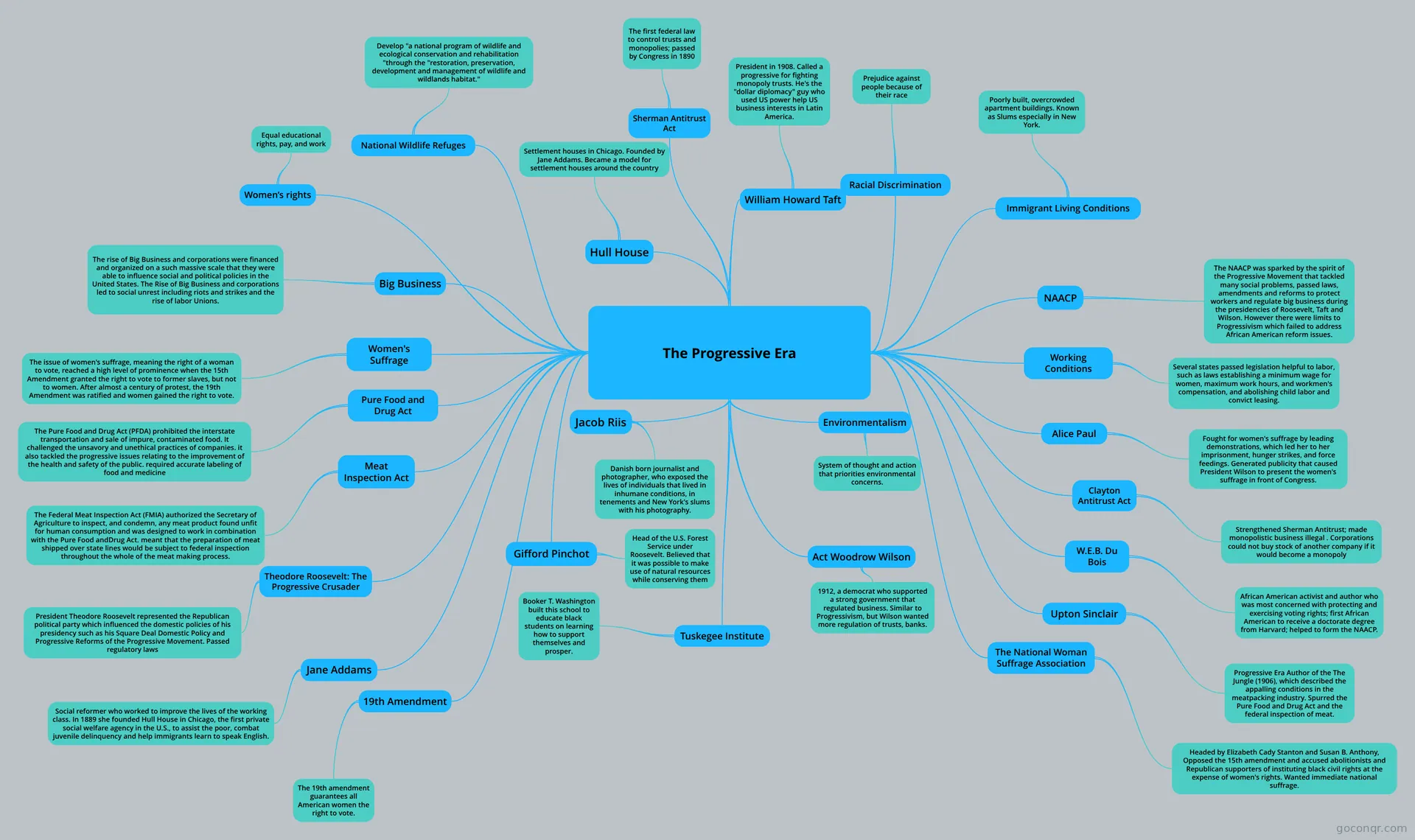 The Progressive Era Reform movement from 1890 to 1920 that sought to make state and national politics more democratic and gover...
-
The Progressive Era:
-
populism, progressivism and imperialism 1890-1920
-
Progressive Era Timeline
Flashcards
See all 135 flashcards-
32 cards1890-1920 big 4 (W,LG,C,O)
-
50 cardsProgressive Movement and Imperialism
-
167 cardsUS History - The Progressive Era When was the Progressive Era?
-
66 cards7.4 Progressivism
-
69 cardsProgresivism election of 1900
-
81 cardsUS History Ch 18
-
28 cardsProgressivism name the three progressive presidents.
-
34 cardsProgressivism Unit Test
Flowcharts
See all 15 flowcharts-
Unit 2: Week 6 assignment 1
-
Dr. G
-
Week 6 Assignment 1
-
Week 6
-
Untitled
-
Progressive Era - Om Patel This mindmap displays the major causes of the Progressive Era. The mindmap also connects the people and org...
-
Unit 2 week 6 This is map showing everything that happened during the Progessive Era and including the people who interac...
-
Week 6 Assignment 1
Notes
See all 25 notes-
Populism, Progressivism and Imperialism 1890-1920 Populism 1890-1912 - is a mode of political communication that is centred around contrasts between the "common man" or "the people" and a real or imagined group of "privileged elites" Reasons for its em...
-
7.4 The Progressives and the Presidents 1900-1920 Progressivism Muckrakers investigative journalists who wrote magazine articles and books about “bad things in society” (Roosevelt didn’t really like them, and gave them this nickname) Progressive Era (1890s–1920...
-
Untitled Chapter 28 Progressivism and the Republican Roosevelt 1901-1912 The progressive movement started at the beginning of the 20th Century. It sought to use the government to improve human welfa...
-
Chapter 20 Review Progressive Era: A period between the end of Reconstruction and the beginning of the World War I when political reformers focused on four main goals: cleaning up politics, limiting the power of big business, reducing ...
-
Chapter 17.5 Chapter 17.5 Wilson's New Freedom : study guide Attacking the Triple wall of PrivilegeThe tariffs,the banks and the trust.Two Key Antitrust Acts (1914) - (strengthened the Sherman Antitrust Act) prohibits corporations...
-
Roosevelt as President Progressive Movement: A. Main Goals 1. giving people more participation in government a. innovations 1. direct primary &nbs...
-
The Effectiveness of Progressive Era Reformers Analyze the effectiveness of Progressive Era reformers in addressing problems of the late nineteenth and early twentieth centuries. In your answer, focus on reform efforts in two of the following areas: state and fede...
-
Progressive Era - created from Mind Map Movements Environmentalism- industrialization and the expansion of railroads into the West, and the rise of large corporations led to the widespread destruction as well as increased pollution of land and water. Women'...
Slides
Topics in The Progressive Era
More History topics
About The Progressive Era
GoConqr OriginalWhat the resources cover
The page is mostly mind maps, with flashcard decks, quizzes, notes, flowcharts and slide sets alongside them. The top mind map, Progressive Era, sets the period as 1890-1920 and looks at working conditions: efficiency, safety standards, child labour, workmen's compensation, minimum wages and working hours.
Other maps focus on people. One names Theodore Roosevelt, Upton Sinclair, Jane Addams, Jacob Riis, Alice Paul, John Muir, Gifford Pinchot and Booker T. Washington, plus Hull House, the NAACP and Tuskegee Institute. Another covers the women's suffrage issue after the 15th Amendment.
Where to start
- Open the Progressive Era mind map for the big picture.
- Read the maps on Theodore Roosevelt 1904-1908, William Howard Taft 1908-1912 and Woodrow Wilson 1912-1921 to follow the presidents in order.
- Move to the flashcard deck Progressive Movement and Imperialism, which lists muckrakers such as Lincoln Steffens and Ida Tarbell, the 16th to 19th Amendments and the Triangle Shirtwaist Fire.
Using quizzes and maps together
Read a map first, then take a quiz without looking. The quiz US History 2 AP Chapter 21 (The Rise of Progressivism) Review asks who the progressives and muckrakers were, what the social gospel was, and who settlement houses helped. The follow-up, US History 2 AP Chapter 22 pt. 1 review, turns to Roosevelt's Square Deal, the Sherman Antitrust Act and the Anthracite Coal Strike.
Wherever you get a question wrong, go back to the matching map branch and reread it. There is also a quiz on progressive social critics from 1890 to 1916 that tests which targets were not criticised, a useful check on detail.
Where this unit sits
The Progressive Era is a unit in the strand The Americas, within History. Resources are written by GoConqr users and vary in style, so compare a few on the same point. Many are labelled with the AP US History course, and some mention A-level History or GCSE History.
When you're ready, choose one map, try a quiz on the same theme and see what sticks.
Frequently asked questions
Which resource should I open first?
Start with the mind map called Progressive Era, which sets out the period as 1890-1920 and begins with working conditions such as child labour, safety standards and working hours. It gives you a frame to hang the rest on. After that, choose a quiz on the same themes.
Which quizzes cover Roosevelt and progressivism?
The quiz US History 2 AP Chapter 22 pt. 1 review asks about the Square Deal, the Sherman Antitrust Act and the Anthracite Coal Strike. The quiz 28 Progressivism and the Republican Roosevelt tests what progressive social critics targeted between 1890 and 1916.
What do the mind maps on this page cover?
They cover working conditions, key reformers like Jane Addams and Upton Sinclair, women's suffrage, big business and mass immigration. Several follow the presidencies of Theodore Roosevelt, William Howard Taft and Woodrow Wilson, so you can trace how progressivism changed across the period.
Are these resources free, and who made them?
Yes. Every resource listed here is free to open, study and take, with no account needed. They were made by GoConqr users rather than by GoConqr itself, so styles differ. A free account saves your quiz scores and lets you make your own materials.
Which exams and levels do they suit?
Almost all the resources are at secondary level, so they suit school students, and teachers can use them as ready-made material. The listed resources mention AP US History, A-level History and GCSE History, though you should check each one against your own course.
What if I can't find a topic I need?
Try the flashcard decks and notes, which break the period into terms, people and chapters. If a subject is still missing, you can build your own mind map or flashcards on it, then use them alongside the community resources here.