
Mapa mental
CAUSATION
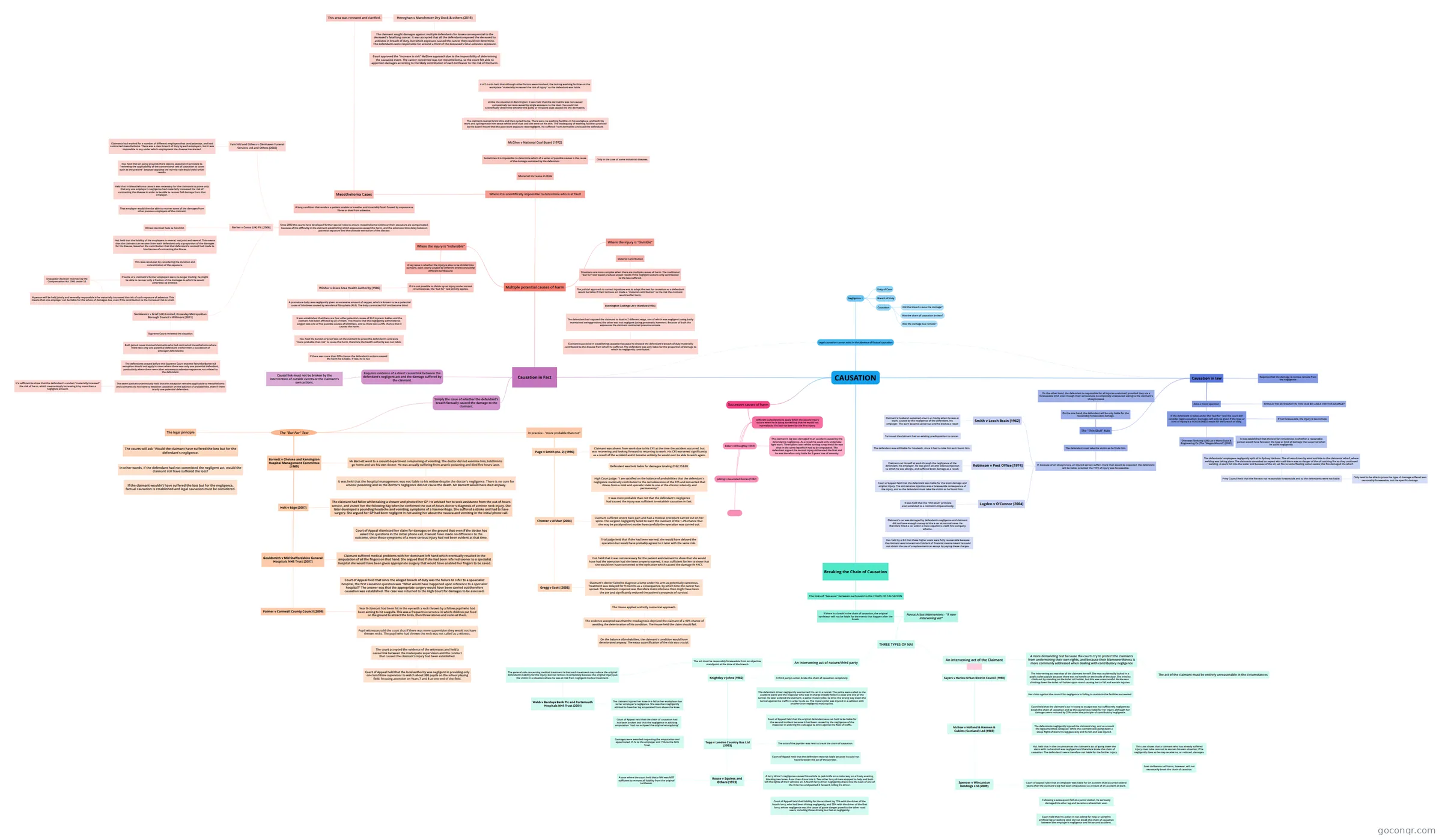
Mind map: Causation in law
Conteúdo do mapa
CAUSATION
Causation in Fact
- Requires evidence of a direct causal link between the defendant's negligent act and the damage suffered by the claimant.
- Causal link must not be broken by the intervention of outside events or the claimant's own actions.
- Simply the issue of whether the defendant's breach factually caused the damage to the claimant.
- The "But For" Test
- The legal principle
- The courts will ask "Would the claimant have suffered the loss but for the defendant's negligence.
- In other words, if the defendant had not committed the negligent act, would the claimant still have suffered the loss?
- If the claimant wouldn't have suffered the loss but for the negligence, factual causation is established and legal causation must be considered.
- In other words, if the defendant had not committed the negligent act, would the claimant still have suffered the loss?
- The courts will ask "Would the claimant have suffered the loss but for the defendant's negligence.
- Barnett v Chelsea and Kensington Hospital Management Committee [1969]
- Mr Barnett went to a casualt department complaining of vomiting. The doctor did not examine him, told him to go home and see his own doctor. He was actually suffering from arsenic poisoning and died five hours later.
- It was held that the hospital management was not liable to his widow despite the doctor's negligence. There is no cure for arsenic poisoning and so the doctor's negligence did not cause the death. Mr Barnett would have died anyway.
- Mr Barnett went to a casualt department complaining of vomiting. The doctor did not examine him, told him to go home and see his own doctor. He was actually suffering from arsenic poisoning and died five hours later.
- Holt v Edge [2007]
- The claimant had fallen whilst taking a shower and phoned her GP. He advised her to seek assistance from the out-of-hours service, and visited her the following day when he confirmed the out-of-hours doctor's diagnosis of a minor neck injury. She later developed a pounding headache and vomiting, symptoms of a haemorrhage. She suffered a stroke and had to have surgery. She argued her GP had been negligent in not asking her about the nausea and vomiting in the initial phone call.
- Court of Appeal dismissed her claim for damages on the ground that even if the doctor has asked the questions in the initial phone call, it would have made no difference to the outcome, since those symptoms of a more serious injury had not been evident at that time.
- The claimant had fallen whilst taking a shower and phoned her GP. He advised her to seek assistance from the out-of-hours service, and visited her the following day when he confirmed the out-of-hours doctor's diagnosis of a minor neck injury. She later developed a pounding headache and vomiting, symptoms of a haemorrhage. She suffered a stroke and had to have surgery. She argued her GP had been negligent in not asking her about the nausea and vomiting in the initial phone call.
- Gouldsmith v Mid Staffordshire General Hospitals NHS Trust [2007]
- Claimant suffered medical problems with her dominant left hand which eventually resulted in the amputation of all the fingers on that hand. She argued that if she had been referred sooner to a specialist hospital she would have been given appropriate surgery that would have enabled her fingers to be saved.
- Court of Appeal held that since the alleged breach of duty was the failure to refer to a speacialist hospital, the first causation question was "What would have happened upon reference to a specialist hospital?" The answer was that the appropriate surgery would have been carried out therefore causation was established. The case was returned to the High Court for damages to be assessed.
- Claimant suffered medical problems with her dominant left hand which eventually resulted in the amputation of all the fingers on that hand. She argued that if she had been referred sooner to a specialist hospital she would have been given appropriate surgery that would have enabled her fingers to be saved.
- Palmer v Cornwall County Council [2009]
- Year 9 claimant had been hit in the eye with a rock thrown by a fellow pupil who had been aiming to hit seagulls. This was a frequent occurrence in which children put food on the ground to attract the birds, then threw stones and rocks at them.
- Pupil witnesses told the court that if there was more supervision they would not have thrown rocks. The pupil who had thrown the rock was not called as a witness.
- The court accepted the evidence of the witnesses and held a causal link between the inadequate supervision and the conduct that caused the claimant's injury had been established.
- Court of Appeal held that the local authority was negligent in providing only one lunchtime supervisor to watch about 300 pupils on the school playing field; focusing attention on Years 7 and 8 at one end of the field.
- The court accepted the evidence of the witnesses and held a causal link between the inadequate supervision and the conduct that caused the claimant's injury had been established.
- Pupil witnesses told the court that if there was more supervision they would not have thrown rocks. The pupil who had thrown the rock was not called as a witness.
- Year 9 claimant had been hit in the eye with a rock thrown by a fellow pupil who had been aiming to hit seagulls. This was a frequent occurrence in which children put food on the ground to attract the birds, then threw stones and rocks at them.
- In practice - "more probable than not"
- Page v Smith (no. 2) [1996]
- Claimant was absent from work due to his CFS at the time the accident occurred, but was recovering and looking forward to returning to work. His CFS worsened significantly as a result of the accident and it became unlikely he would ever be able to work again.
- Defendant was held liable for damages totaling £162,153.00
- High Court Judge: "I am satisfied on the balance of probabilities that the defendant's negligence materially contributed to the recrudescence of the CFS and converted that illness from a mild and sporadic state to one of the chronic intensity and permanency."
- It was more probable than not that the defendant's negligence had caused the injury was sufficient to establish causation in fact.
- High Court Judge: "I am satisfied on the balance of probabilities that the defendant's negligence materially contributed to the recrudescence of the CFS and converted that illness from a mild and sporadic state to one of the chronic intensity and permanency."
- Defendant was held liable for damages totaling £162,153.00
- Claimant was absent from work due to his CFS at the time the accident occurred, but was recovering and looking forward to returning to work. His CFS worsened significantly as a result of the accident and it became unlikely he would ever be able to work again.
- Chester v Afshar [2004]
- Claimant suffered severe back pain and had a medical procedure carried out on her spine. The surgeon negligently failed to warn the claimant of the 1-2% chance that she may be paralysed not matter how carefully the operation was carried out.
- Trial judge held that if she had been warned, she would have delayed the operation but would have probably agreed to it later with the same risk.
- HoL held that it was not necessary for the patient and claimant to show that she would have had the operation had she been properly warned, it was sufficient for her to show that she would not have consented to the operation which caused the damage IN FACT.
- Trial judge held that if she had been warned, she would have delayed the operation but would have probably agreed to it later with the same risk.
- Claimant suffered severe back pain and had a medical procedure carried out on her spine. The surgeon negligently failed to warn the claimant of the 1-2% chance that she may be paralysed not matter how carefully the operation was carried out.
- Gregg v Scott [2005]
- Claimant's doctor failed to diagnose a lump under his arm as potentially cancerous. Treatment was delayed for 9 months as a consequence, by which time the cancer has spread. The treatment required was therefore more intensive then might have been the ase and significantly reduced the patient's prospects of survival.
- The House applied a strictly numerical approach.
- The evidence accepted was that the misdiagnosis deprived the claimant of a 45% chance of avoiding the deterioration of his condition. The House held the claim should fail.
- On the balance ofprobabilites, the claimant's condition would have deteriorated anyway. The exact quantification of the risk was crucial.
- The evidence accepted was that the misdiagnosis deprived the claimant of a 45% chance of avoiding the deterioration of his condition. The House held the claim should fail.
- The House applied a strictly numerical approach.
- Claimant's doctor failed to diagnose a lump under his arm as potentially cancerous. Treatment was delayed for 9 months as a consequence, by which time the cancer has spread. The treatment required was therefore more intensive then might have been the ase and significantly reduced the patient's prospects of survival.
- Page v Smith (no. 2) [1996]
- The legal principle
- The "But For" Test
- Multiple potential causes of harm
- Where the injury is "indivisible"
- A key issue is whether the injury is able to be divided into portions, each clearly caused by different events (including different tortfeasors)
- If it is not possible to divide up an injury under normal circumstances, the "but for" test strictly applies.
- Wilsher v Essex Area Health Authority [1986]
- A premature baby was negligently given an excessive amount of oxygen, which is known to be a potential cause of blindness caused by retrolental fibroplasia (RLF). The baby contracted RLF and became blind.
- It was established that there are four other potential causes of RLF in prem. babies and the claimant had been afflicted by all of them. This means that the negligently administered oxygen was one of five possible causes of blindness, and so there was a 20% chance that it caused the harm.
- HoL held the burden of proof was on the claimant to prove the defendant's acts were "more probable than not" to cause the harm, therefore the health authority was not liable.
- If there was more than 50% chance the defendant's actions caused the harm he is liable. If less, he is not.
- HoL held the burden of proof was on the claimant to prove the defendant's acts were "more probable than not" to cause the harm, therefore the health authority was not liable.
- It was established that there are four other potential causes of RLF in prem. babies and the claimant had been afflicted by all of them. This means that the negligently administered oxygen was one of five possible causes of blindness, and so there was a 20% chance that it caused the harm.
- A premature baby was negligently given an excessive amount of oxygen, which is known to be a potential cause of blindness caused by retrolental fibroplasia (RLF). The baby contracted RLF and became blind.
- Wilsher v Essex Area Health Authority [1986]
- If it is not possible to divide up an injury under normal circumstances, the "but for" test strictly applies.
- A key issue is whether the injury is able to be divided into portions, each clearly caused by different events (including different tortfeasors)
- Where the injury is "divisible"
- Material Contribution
- Situations are more complex when there are multiple causes of harm. The traditional "but for" test would produce unjust results if the negligent actions only contributed to the loss suffered.
- The judicial approach to correct injustices was to adapt the test for causation so a defendant would be liable if their tortious act made a "material contribution" to the risk the claimant would suffer harm.
- Bonnington Castings Ltd v Wardlaw [1956]
- The defendant had exposed the claimant to dust in 2 different ways, one of which was negligent (using badly maintained swing grinders) the other was not negligent (using pneumatic hammer). Because of both the exposures the claimant contracted pneumoconiosis.
- Claimant succeeded in establishing causation because he showed the defendant's breach of duty materially contributed to the disease from which he suffered. The defendant was only liable for the proportion of damage to which he negligently contributed.
- The defendant had exposed the claimant to dust in 2 different ways, one of which was negligent (using badly maintained swing grinders) the other was not negligent (using pneumatic hammer). Because of both the exposures the claimant contracted pneumoconiosis.
- Bonnington Castings Ltd v Wardlaw [1956]
- The judicial approach to correct injustices was to adapt the test for causation so a defendant would be liable if their tortious act made a "material contribution" to the risk the claimant would suffer harm.
- Situations are more complex when there are multiple causes of harm. The traditional "but for" test would produce unjust results if the negligent actions only contributed to the loss suffered.
- Material Contribution
- Where it is scientifically impossible to determine who is at fault
- Material Increase in Risk
- Sometimes it is impossible to determine which of a series of possible causes is the cause of the damage sustained by the defendant.
- Only in the case of some industrial diseases.
- McGhee v National Coal Board [1972]
- The claimant cleaned brick kilns and then cycled home. There were no washing facilities in his workplace, and both his work and cycling made him sweat whilst brick-dust and dirt were on his skin. The inadequacy of washing facilities provided by the board meant that the post-work exposure was negligent. He suffered f rom dermatitis and sued the defendant.
- Unlike the situation in Bonnington, it was held that the dermatitis was not caused cumulatively but was caused by single exposure to the dust. You could not scientifically determine whether the guilty or innocent dust caused the the dermatitis.
- 4 of 5 Lords held that although other factors were involved, the lacking washing facilities at the workplace "materially increased the risk of injury" so the defendant was liable.
- Unlike the situation in Bonnington, it was held that the dermatitis was not caused cumulatively but was caused by single exposure to the dust. You could not scientifically determine whether the guilty or innocent dust caused the the dermatitis.
- The claimant cleaned brick kilns and then cycled home. There were no washing facilities in his workplace, and both his work and cycling made him sweat whilst brick-dust and dirt were on his skin. The inadequacy of washing facilities provided by the board meant that the post-work exposure was negligent. He suffered f rom dermatitis and sued the defendant.
- Sometimes it is impossible to determine which of a series of possible causes is the cause of the damage sustained by the defendant.
- Mesothelioma Cases
- A lung condition that renders a patient unable to breathe, and invariably fatal. Caused by exposure to fibres or dust from asbestos.
- Since 2002 the courts have developed further special rules to ensure mesothelioma victims or their executors are compensated, because of the difficulty in the claimant establishing which exposures caused the harm, and the extensive time delay between potential exposure and the ultimate extraction of the disease.
- Fairchild and Others v Glenhaven Funeral Services Ltd and Others [2002]
- Claimants had worked for a number of different employers that used asbestos, and had contracted mesothelioma. There was a clear breach of duty by each employers, but it was impossible to say under which employment the disease has started.
- HoL held that on policy grounds there was no objection in principle to "reviewing the applicability of the conventional test of causation to cases such as the present" because applying the normla rule would yield unfair results.
- Held that in Mesothelioma cases it was necessary for the claimants to prove only that any one employer's negligence had materially increased the risk of contracting the disease in order to be able to recover full damage from that employer.
- That employer would then be able to recover some of the damages from other previous employers of the claimant.
- Held that in Mesothelioma cases it was necessary for the claimants to prove only that any one employer's negligence had materially increased the risk of contracting the disease in order to be able to recover full damage from that employer.
- HoL held that on policy grounds there was no objection in principle to "reviewing the applicability of the conventional test of causation to cases such as the present" because applying the normla rule would yield unfair results.
- Claimants had worked for a number of different employers that used asbestos, and had contracted mesothelioma. There was a clear breach of duty by each employers, but it was impossible to say under which employment the disease has started.
- Barker v Corus (UK) Plc [2006]
- Almost identical facts to Fairchild.
- HoL held that the liability of the employers is several, not joint and several. This means that the claimant can recover from each defendant only a proportion of the damages for his disease, based on the contribution that that defendant's conduct had made to his chances of contracting the illness.
- This was calculated by considering the duration and concentration of the exposure.
- If some of a claimant's former employers were no longer trading, he might be able to recover only a fraction of the damages to which he would otherwise be entitled.
- Unpopular decision reversed by the Compensation Act 2006 under S3
- A person will be held jointly and severally responsible is he materially increased the risk of such exposure of asbestos. This means that one employer can be liable for the whole of damages due, even if his contribution to the increased risk is small.
- Unpopular decision reversed by the Compensation Act 2006 under S3
- If some of a claimant's former employers were no longer trading, he might be able to recover only a fraction of the damages to which he would otherwise be entitled.
- This was calculated by considering the duration and concentration of the exposure.
- HoL held that the liability of the employers is several, not joint and several. This means that the claimant can recover from each defendant only a proportion of the damages for his disease, based on the contribution that that defendant's conduct had made to his chances of contracting the illness.
- Almost identical facts to Fairchild.
- Sienkiewicz v Grief (UK) Limited; Knowsley Metropolitan Borough Council v Willmore [2011]
- Supreme Court reviewed the situation
- Both joined cases involved claimants who had contracted mesothelioma where there was only one potential defendant (rather than a succession of employer-defendants)
- The defendants argued before the Supreme Court that the Fairchild/Barker/s3 exception should not apply in cases where there was only one potential defendant, particularly where there were ither extraneous asbestos exposures not related to the defendant.
- The seven justices unanimously held that this exception remains applicable to mesothelioma and claimants do not have to establish causation on the balance of probabilities, even if there is only one potential defendant.
- It's sufficient to show that the defendant's conduct "materially inceased" the risk of harm, which means simply increasing it by more than a negligible amount.
- The seven justices unanimously held that this exception remains applicable to mesothelioma and claimants do not have to establish causation on the balance of probabilities, even if there is only one potential defendant.
- The defendants argued before the Supreme Court that the Fairchild/Barker/s3 exception should not apply in cases where there was only one potential defendant, particularly where there were ither extraneous asbestos exposures not related to the defendant.
- Both joined cases involved claimants who had contracted mesothelioma where there was only one potential defendant (rather than a succession of employer-defendants)
- Supreme Court reviewed the situation
- Fairchild and Others v Glenhaven Funeral Services Ltd and Others [2002]
- Since 2002 the courts have developed further special rules to ensure mesothelioma victims or their executors are compensated, because of the difficulty in the claimant establishing which exposures caused the harm, and the extensive time delay between potential exposure and the ultimate extraction of the disease.
- This area was renewed and clarified.
- Heneghan v Manchester Dry Dock & others (2016)
- The claimant sought damages against multiple defendants for losses consequential to the deceased's fatal lung cancer. It was accepted that all the defendants exposed the deceased to asbestos in breach of duty, but which exposure caused the cancer they could not determine. The defendants were responsible for around a third of the deceased's total asbestos exposure.
- Court approved the "increase in risk" McGhee approach due to the impossibility of determining the causative event. The cancer concerned was not mesothelioma, so the court felt able to apportion damages according to the likely contribution of each tortfeasor to the risk of the harm.
- The claimant sought damages against multiple defendants for losses consequential to the deceased's fatal lung cancer. It was accepted that all the defendants exposed the deceased to asbestos in breach of duty, but which exposure caused the cancer they could not determine. The defendants were responsible for around a third of the deceased's total asbestos exposure.
- Heneghan v Manchester Dry Dock & others (2016)
- A lung condition that renders a patient unable to breathe, and invariably fatal. Caused by exposure to fibres or dust from asbestos.
- Material Increase in Risk
- Where the injury is "indivisible"
- Requires evidence of a direct causal link between the defendant's negligent act and the damage suffered by the claimant.
Causation in law
- Requires that the damage is not too remote from the negligence
- Asks a moral question
- SHOULD THE DEFENDANT IN THIS CASE BE LIABLE FOR THIS DAMAGE?
- If the defendant is liable under the "but for" test the court will consider legal causation. Damages will only be given if the type or kind of injury is a FORESEEABLE result for the breach of duty.
- If not foreseeable, the injury is too remote.
- Overseas Tankship (UK) Ltd v Morts Dock & Engineering Co (The "Wagon Mound") [1961]
- It was established that the test for remoteness is whether a reasonable person would have foreseen the type or kind of damage that occurred when he acted negligently.
- The defendants' employees negligently spilt oil in Sydney Harbour. The oil was driven by wind and tide to the claimants' wharf, where welding was taking place. The claimants consulted an expert who said there was no danger of the oil catching fire so they continued welding. A spark fell into the water and because of the oil, set fire to some floating cotton waste; the fire damaged the wharf.
- Privy Council held that the fire was not reasonably foreseeable and so the defendants were not liable.
- Only need to be able to prove the type of damage suffered was reasonably foreseeable, not the specific damage.
- Privy Council held that the fire was not reasonably foreseeable and so the defendants were not liable.
- The defendants' employees negligently spilt oil in Sydney Harbour. The oil was driven by wind and tide to the claimants' wharf, where welding was taking place. The claimants consulted an expert who said there was no danger of the oil catching fire so they continued welding. A spark fell into the water and because of the oil, set fire to some floating cotton waste; the fire damaged the wharf.
- It was established that the test for remoteness is whether a reasonable person would have foreseen the type or kind of damage that occurred when he acted negligently.
- The "Thin Skull" Rule
- The defendant must take the victim as he finds him.
- If, because of an idiosyncracy, an injured person suffers more than would be expected, the defendant will be liable, provided the TYPE of injury was foreseeable.
- Smith v Leech Brain [1962]
- Claimant's husband sustained a burn on his lip when he was at work, caused by the negligence of the defendant, his employer. The burn became cancerous and he died as a result
- Turns out the claimant had an existing predisposition to cancer.
- The defendant was still liable for his death, since it had to take him as it found him.
- Turns out the claimant had an existing predisposition to cancer.
- Claimant's husband sustained a burn on his lip when he was at work, caused by the negligence of the defendant, his employer. The burn became cancerous and he died as a result
- Robinson v Post Office [1974]
- Claimant cut himself at work through the negligence of the defendant, his employer. He was given an anti-tetanus injection to which he was allergic, and suffered brain damage as a result.
- Court of Appeal held that the defendant was liable for the brain damage and original injury. The anti-tetanus injection was a foreseeable consequence of the injury, and so the defendant must take the victim as he found him.
- Claimant cut himself at work through the negligence of the defendant, his employer. He was given an anti-tetanus injection to which he was allergic, and suffered brain damage as a result.
- Lagden v O'Connor [2004]
- It was held that the "thin skull" principle even extended to a claimant's impecuniosity.
- Claimant's car was damaged by defendant's negligence and claimant did not have enough money to hire a car at normal rates. He therefore hired a car under a more expensive credit hire company scheme.
- HoL held by a 3:2 that these higher costs were fully recoverable because the claimant was innocent and his lack of financial means meant he could not obtain the use of a replacement car except by paying these charges.
- Claimant's car was damaged by defendant's negligence and claimant did not have enough money to hire a car at normal rates. He therefore hired a car under a more expensive credit hire company scheme.
- It was held that the "thin skull" principle even extended to a claimant's impecuniosity.
- Smith v Leech Brain [1962]
- If, because of an idiosyncracy, an injured person suffers more than would be expected, the defendant will be liable, provided the TYPE of injury was foreseeable.
- On the one hand, the defendant will be only liable for the reasonably foreseeable damage.
- On the other hand, the defendant is responsible for all injuries sustained, provided they are a foreseeable kind, even though their seriousness is completely unexpected owing to the claimant's idiosyncrasies.
- The defendant must take the victim as he finds him.
Legal causation cannot exist in the absence of factual causation
- Negligence =
- Duty of Care
- Breach of duty
- Causation
- Did the breach cause the damage?
- Was the chain of causation broken?
- Was the damage too remote?
- Negligence =
Breaking the Chain of Causation
- The links of "because" between each event is the CHAIN OF CAUSATION
- If there is a break in the chain of causation, the original tortfeasor will not be liable for the events that happen after the break.
- Novus Actus Interveniens - "A new intervening act"
- THREE TYPES OF NAI
- An intervening act of nature/third party
- The act must be reasonably foreseeable from an objective standpoint at the time of the breach
- Knightley v Johns [1982]
- A third party's action broke the chain of causation completely.
- The defendant driver negligently overturned his car in a tunnel. The police were called to the accident scene and the inspector who was in charge initially failed to close one end of the tunnel. He later ordered the claimant, a police motorcyclist, to drive the wrong way down the tunnel against the traffic in order to do so. The motorcyclist was injured in a collision with another (non negligent) motorcyclist.
- Court of Appeal held that the original defendant was not held to be liable for the second incident because it had been caused by the negligence of the inspector in ordering his colleague to drive against the flow of traffic.
- The defendant driver negligently overturned his car in a tunnel. The police were called to the accident scene and the inspector who was in charge initially failed to close one end of the tunnel. He later ordered the claimant, a police motorcyclist, to drive the wrong way down the tunnel against the traffic in order to do so. The motorcyclist was injured in a collision with another (non negligent) motorcyclist.
- A third party's action broke the chain of causation completely.
- Topp v London Country Bus Ltd [1993]
- The acts of the joyrider was held to break the chain of causation.
- Court of Appeal held that the defendant was not liable because it could not have foreseen the act of the joyrider.
- The acts of the joyrider was held to break the chain of causation.
- Rouse v Squires and Others [1973]
- A lorry driver's negligence caused his vehicle to jack-knife on a motorway on a frosty evening, blocking two lanes. A car then drove into it. Two other lorry drivers stopped to help and both left the lights of their vehicles on. A fourth lorry driver negligently drove into the back of one of the lit lorries and pushed it forward, killing it's driver.
- Court of Appeal held that liability for the accident lay 75% with the driver of the fourth lorry, who had been driving negligently, and 25% with the driver of the first lorry, whose negligence was the cause of grave danger posed to the other road users, including those driving too fast or negligently.
- A case where the court held that a NAI was NOT sufficient to remove all liability from the original tortfeasor.
- A lorry driver's negligence caused his vehicle to jack-knife on a motorway on a frosty evening, blocking two lanes. A car then drove into it. Two other lorry drivers stopped to help and both left the lights of their vehicles on. A fourth lorry driver negligently drove into the back of one of the lit lorries and pushed it forward, killing it's driver.
- The general rule concerning medical treatment is that such treatment may reduce the original defendant's liability for the injury, but not remove it completely because the original injury put the victim in a situation where he was at risk from negligent medical treatment.
- Webb v Barclays Bank Plc and Portsmouth Hospitals NHS Trust [2001]
- The claimant injured her knee in a fall at her workplace due to her employer's negligence. She was then negligently advised to have her leg amputated from above the knee.
- Court of Appeal held that the chain of causation had not been broken and that the negligence in advising amputation "had not eclipsed the original wrongdoing"
- Damages were awarded respecting the amputation and apportioned 25 % to the employer and 75% to the NHS Trust,
- Court of Appeal held that the chain of causation had not been broken and that the negligence in advising amputation "had not eclipsed the original wrongdoing"
- The claimant injured her knee in a fall at her workplace due to her employer's negligence. She was then negligently advised to have her leg amputated from above the knee.
- Webb v Barclays Bank Plc and Portsmouth Hospitals NHS Trust [2001]
- Knightley v Johns [1982]
- The act must be reasonably foreseeable from an objective standpoint at the time of the breach
- An intervening act of the Claimant
- A more demanding test because the courts try to protect the claimants from undermining their own rights, and because their blameworthiness is more commonly addressed when dealing with contributory negligence
- The act of the claimant must be entirely unreasonable in the circumstances
- Sayers v Harlow Urban District Council [1958]
- The intervening act was that of the claimant herself. She was accidentally locked in a public toilet cubicle because there was no handle on the inside of the door. She tried to climb out by standing on the toilet roll holder, but this was unsuccessful. As she was climbing down the toilet roll holder spun round causing her to fall and sustain injuries.
- Her claim against the council for negligence in failing to maintain the facilities succeeded.
- Court held that the claimant's act in trying to escape was not sufficiently negligent to break the chain of causation and so the council was liable for her injury, although her damages were reduced by 25% under the principle of contributory negligence.
- Her claim against the council for negligence in failing to maintain the facilities succeeded.
- The intervening act was that of the claimant herself. She was accidentally locked in a public toilet cubicle because there was no handle on the inside of the door. She tried to climb out by standing on the toilet roll holder, but this was unsuccessful. As she was climbing down the toilet roll holder spun round causing her to fall and sustain injuries.
- McKew v Holland & Hannen & Cubitts (Scotland) Ltd [1969]
- The defendants negligently injured the claimant's leg, and as a result the leg sometimes collapsed. While the claimant was going down a steep flight of stairs his leg gave way and he fell and was injured.
- HoL held that in the circumstances the claimant's act of going down the stairs with no handrail was negligent and therefore broke the chain of causation. The defendant's were therefore not liable for the further injury.
- This case shows that a claimant who has already suffered injury must take care not to worsen his own situation; if he negligently does so he may receive no, or reduced, damages.
- Even deliberate self-harm, however, will not necessarily break the chain of caustion.
- This case shows that a claimant who has already suffered injury must take care not to worsen his own situation; if he negligently does so he may receive no, or reduced, damages.
- HoL held that in the circumstances the claimant's act of going down the stairs with no handrail was negligent and therefore broke the chain of causation. The defendant's were therefore not liable for the further injury.
- The defendants negligently injured the claimant's leg, and as a result the leg sometimes collapsed. While the claimant was going down a steep flight of stairs his leg gave way and he fell and was injured.
- Spencer v Wincanton Holdings Ltd (2009)
- Court of appeal ruled that an employer was liable for an accident that occurred several years after the claimant's leg had been ampoutated as a result of an accident at work.
- Following a subsequent fall at a petrol station, he seriously damaged his other leg and became a wheelchair user.
- Court held that his action in not asking for help or using his artificial leg or walking stick did not break the chain of causation between the employer's negligence and his second accident.
- Following a subsequent fall at a petrol station, he seriously damaged his other leg and became a wheelchair user.
- Court of appeal ruled that an employer was liable for an accident that occurred several years after the claimant's leg had been ampoutated as a result of an accident at work.
- A more demanding test because the courts try to protect the claimants from undermining their own rights, and because their blameworthiness is more commonly addressed when dealing with contributory negligence
- An intervening act of nature/third party
- THREE TYPES OF NAI
- Novus Actus Interveniens - "A new intervening act"
- If there is a break in the chain of causation, the original tortfeasor will not be liable for the events that happen after the break.
- The links of "because" between each event is the CHAIN OF CAUSATION
Successive causes of harm
- Different considerations apply when the second injury occurs when he is doing something that he would not normally do if it had not been for the first injury.
- Baker v Willoughby (1969)
- The claimant's leg was damaged in an accident caused by the defendant's negligence. As a result he could only undertake light work. Three years later whilst sorting scrap metal he was shot in the same leg which had to be amputated. The defendant argued the second injury obliterated the first and he was therefore only liable for 3 years loss of amenity.
- Jobling v Associated Dairies [1982]
- Baker v Willoughby (1969)
- Different considerations apply when the second injury occurs when he is doing something that he would not normally do if it had not been for the first injury.
Informações
- Descrição
- Diploma Tort of Negligence Mapa Mental sobre CAUSATION, criado por Hannah Thompson em 12-03-2018.
- Criado por
- Hannah Thompson
- Visualizações
- 2
- Avaliação